Julie Bishop toes the Liberal Party line on nuclear power, climate, and renewable energy
View from the Street: Bishop goes nuclear, SMH November 30, 2014 Andrew P Street “………..Atomic! Meanwhile Foreign Minister and probable next Coalition PM Julie Bishop has come out in favour of nuclear energy.
“It’s an obvious conclusion that if you want to bring down your greenhouse gas emissions dramatically you have to embrace a form of low or zero-emissions energy and that’s nuclear, the only known 24/7 baseload power supply with zero emissions,” she said, in a statement that no-one especially asked for and that seems timed principally to give people something to talk about other than the Victorian election.
Now, nuclear power doesn’t emit greenhouse gases. It does, however, produce a lot of waste that’s incredibly radioactive – uranium, plutonium, neptunium, californium – and we have zero idea of how to store it aside from “bury it and walk away”.
Nuclear waste dumps are not unreasonably considered one of those things that absolutely everybody wants nowhere near them, making them a political nightmare.
And while things don’t generally go wrong in nuclear plants, those rare accidents tend to beome major disasters – as Fukushima and Chernobyl discovered to their considerable cost.
However, there’s another more immediate, practical reason why nuclear isn’t a likely alternative for Australia: our energy industry now almost entirely consists of private companies, who are not going to build nuclear reactors.
See, nuclear power plants take a long time to build. Depending on the design, construction takes between four and eight years, followed by six-to-twelve months of testing before it actually starts generating electricity. By comparison, building a wind farm takes six months.
As a result reactors are also extraordinarily expensive and typically take decades to turn a profit. AGL’s shareholders are very unlikely to back the company building something that won’t provide any return until most of them are dead.
So it’s not seriously going to happen in Australia. But there’s another issue in there.
Let’s look at that “baseload power” thing
The question of baseload revolves around the fact that people need power all the time including when there’s no sun or wind. Thanks a bunch, nature.
While this sounds at first blush like an insurmountable issue and is inevitably raised by people condescendingly dismissing renewable energy, it’s not that big an issue – and in fact the problem has already been solved.
Mark Diesendorf and colleagues at the University of NSW did a comprehensive study of Australia’s electricity demand and discovered that “It turns out that wind and solar photovoltaic are only unable to meet electricity demand a few times a year… Since the gaps are few in number and none exceeds two hours in duration, there only needs to be a small amount of generation from the so-called flexible renewables: hydro and biofuelled gas turbines. Concentrated solar thermal is also flexible while it has energy in its thermal storage.”
Then again, Bishop’s staying on message. After all, talking up nuclear energy is a great option if you want to move your political party away from your denialist position on climate change while still supporting the mining industry, doing nothing about reducing emissions, and keeping the conversation away from solar and wind.
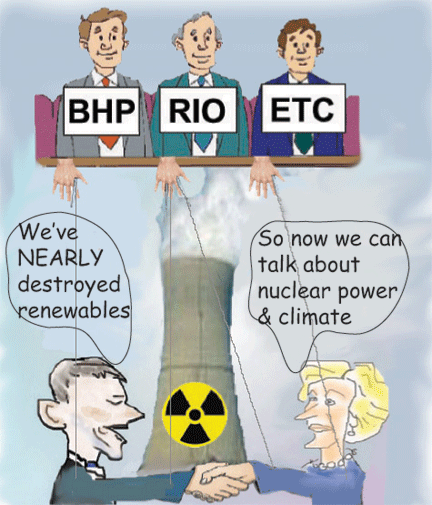
So: expect the Coalition to be banging on about it for the foreseeable.
The cocktail hour: cities in dust
Speaking of Chernobyl, CBS cameraman Danny Cooke posted video he shot of the abandoned city of Pripyat mere days ago.
It’s haunting stuff – especially his sweeping drone shots – and it’s a timely reminder of what nuclear energy can cost. That’s an entire city falling to ruin, right there. http://www.smh.com.au/comment/view-from-the-street/view-from-the-street-bishop-goes-nuclear-20141130-11x4ns.html
No comments yet.
1 This month

of the week – Australians for War Powers Reform (AWPR)
To see nuclear-related stories in greater depth and intensity
 Antinuclear
Leave a comment