Why should tax-payers take the nuclear power risk?
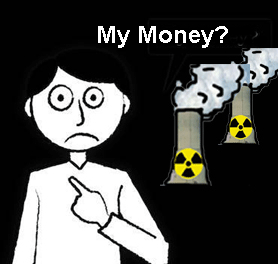
Estimating the cost of building a nuclear power plant is difficult even in countries with established nuclear industries. For a start, not too many have been built in recent years. Further, very few — in fact, not really any — have been built in an open, competitive, private power-supply market where the plant would face competition from alternative electricity sources. Governments indirectly or indirectly play a huge role in offsetting costs, transferring risk from company balance sheets into governments programs, tax offsets and implicit guarantees.
Worst of all, the construction of nuclear power plants is notoriously prone to cost overruns. It wasn’t Three Mile Island and Chernobyl that smashed the US power industry in the 1980s — it was the fact that from the 1960s to the end of the 1970s the final construction cost of US nuclear plants was on average twice to four times the original cost.
Regularly blowing out your costs by 400% is not a way to engender investor and government confidence.
Currently we’re seeing the same thing in Finland and France, where costs for new nuclear plants (initially €3.3 billion, or $A5.3 billion) are currently 50-70% over budget, years out from completion…………
Wind and solar power have the advantage of much shorter construction times, and no decommissioning costs. Neither requires taxpayers to take on risk — either through lending capital to nuclear reactor builders for the decade-plus construction and 200% budget blow-out history shows they require, or through requiring high electricity prices for consumers to guarantee a return on capital, or through the acceptance of safety and storage risks by the taxpayer into infinity, or at least the next 200,000 years.
Some of nuclear power’s construction costs will come down if reactor construction significantly expands globally. By the time Australia has developed the basic regulatory infrastructure and skills base required to seriously consider a nuclear power industry, we may be able to take advantage of it. But construction costs will have to fall a long, long way before nuclear power can be remotely considered a viable economic option compared to renewables or even gas-fired power.
So next time a nuclear proponent tells us we should be “having a debate” about nuclear power, ask them a simple question: why should taxpayers fund the most expensive and slowest energy option when so many alternatives are significantly cheaper and pose less financial risk? http://www.crikey.com.au/2009/11/20/to-those-who-say-beaudy-nuke-why-should-taxpayers-suffer/
No comments yet.
1 This month

of the week – Australians for War Powers Reform (AWPR)
To see nuclear-related stories in greater depth and intensity
 Antinuclear
Leave a comment