Uncertain, unsafe and unwelcome: Kakadu underground uranium plan fails the nuclear test
 Energy Resources of Australia’s plan for a new underground mine at Ranger in Kakadu should not be allowed to proceed because ERA has failed to present key data in its environmental impact statement and the company lacks the capacity to fulfil its rehabilitation obligations at the site, environment groups said today.
As the uranium industry meets in Darwin for a Minerals Council promotion, national and NT environment groups have released a new examination of the economics and assumptions behind ERA’s proposal to construct the so called Ranger 3 Deeps project.
The analysis (attached) says R3D should not proceed due to:
- high levels of uncertainty and an absence of key project data in the EIS
- serious concerns about ERA’s commitment and capacity to meet its rehabilitation obligations at Ranger
- a poor commodity price and an unenthusiastic domestic and international market
- sustained stakeholder concerns and shrinking social license, and
- a short and fixed production ‘runway’ because mining and mineral processing must end at Ranger in January 2021.
“R3D is an ill-considered push by an increasingly embattled company, said ACF campaigner Dave Sweeney.
“Only a year ago ERA was front page news because of a massive spill at Ranger.
“Rather than dig itself into a deeper hole, ERA needs to focus on meeting its legal obligations to rehabilitate the Ranger lease.” Continue reading
Australia wants nuclear power on the agenda at Lima climate talks. USA not so keen
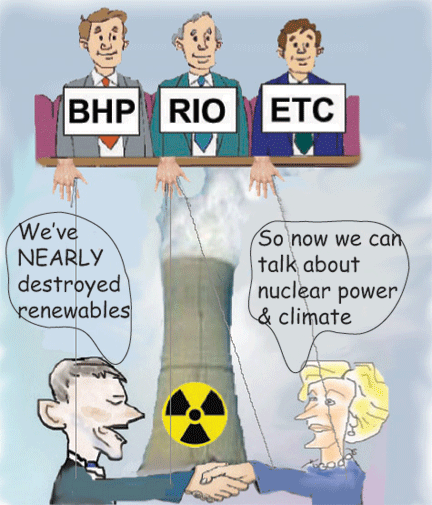
It’s an issue Foreign Minister Julie Bishop wants to discuss at international climate talks in Lima, Peru.
But in the United States, the leader of the world’s biggest nuclear energy producing nation has been decidedly quieter about his plans for the industry which he’s supported since he was a candidate.
North America correspondent Michael Vincent reports.
MICHAEL VINCENT: President Obama has barely mentioned nuclear power at all in his six years in office………..
Dr Edwin Lyman is from the Union of Concerned Scientists.
EDWIN LYMAN: That makes nuclear power plants uneconomical to operate, even the ones that have paid off their capital costs. So the industry is struggling…………..
The US government is also yet to build a national repository for all the waste which is currently stored on site at every power plant.
Some estimate the cost of solving that problem at anywhere between US$38 and US$50 billion – more than half of which is the cost to the American tax payers for not collecting the waste when the government said it would back in 1998.
President Obama has made no mention on that topic recently. http://www.abc.net.au/worldtoday/content/2014/s4141221.htm
Origin Energy’s Grant King jumps on the pro nuclear bandwagon
Yesterday I noted that all at once, a number of ‘worthy’ business types have jumped on the pro nuclear bandwagon, that Julie bishop and Tony Abbott set in motion.
I also noted that a forceful push for the nuclear industry can always be counted on, from South Australia. I repeat my graphic illustration of the South Australian push, here.

The South Australian push provide arguments with varying levels of sophistication.
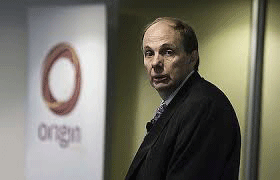 However, today, I found particularly fetching the argument put forward by Origin Energy’s Grant King – reassuring us of nuclear power safety, – just another risk that we all have to take, like driving car.
I recently switched from AGL to Powershop – all renewable AND cheaper. I recommend that Origin Energy electricity customers do that same switch.
Energy boss backs nuclear power STEPHEN JOHNSON AAP DECEMBER 05, 2014 THE head of gas producer and energy retailer Origin Energy says Australia should consider nuclear power.MANAGING director Grant King acknowledges the safety worries raised by the 2011 Fukushima disaster in Japan, but says the controversial industry needs to be considered as an energy source……
“even driving a car’s dangerous.”……….
MANY NUCLEAR REACTORS ARE CLOSING — AND NEW ONES HAVE BEEN BOGGED DOWN BY DELAYS
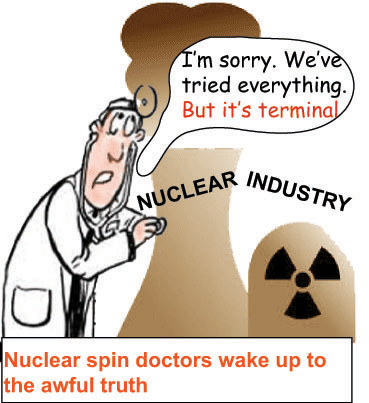 The rise and fall of nuclear power, in 6 charts, Vox Brad Plumer on August 1, 2014, @bradplumer brad@vox.com Nuclear power is slowly going out of style. Back in 1996, atomic energy supplied 17.6 percent of the world’s electricity. Today that’s down to just 10.8 percent — and it could drop even further in the years ahead.
MANY REACTORS ARE CLOSING — AND NEW REACTORS HAVE BEEN BOGGED DOWN BY DELAYS
That’s according to the World Nuclear Industry Status Report 2014, which charts the rise and fall of nuclear power over time.
The upshot is that significantly fewer nuclear reactors are in operation today than was the case in 2010 — in large part due to the shutdown of 48 reactors in Japan after the Fukushima disaster. On the flip side, only China currently has plans to massively ramp up reactor construction. And new reactors in many countries, from Finland to Vietnam, are falling victim to delays and cost overruns.
That’s not encouraging news for efforts to tackle global warming. The proportion of energy that the world gets from carbon-free sources has stagnated since 1999 — in part because of the nuclear industry’s struggles. And the Intergovernmental Panel on Climate Change has warned that reducing emissions will be significantly more expensive if nuclear power’s not available.
Here are six key charts from the report:
1) Nuclear energy production has been falling since 2006……..
2) There are 388 nuclear reactors in operation — down from 438 a decade ago…….
4) There were 67 reactors “under construction” in 2014 — but delays are a problem……..
All told, the report notes that 49 of those reactors under construction have met with significant delays, ranging from several months to several years. Nuclear reactors are expensive and take a long time to build. They can face all sorts of obstacles in the meantime — from cost overruns to complex licensing processes to regulatory hurdles to popular opposition (the latter recently blocked construction of two reactors in Taiwan).
“Past experience shows that simply having an order for a reactor, or even having a nuclear plant at an advanced stage of construction, is no guarantee for grid connection and power production,” the report notes.
5) Just 14 countries have plans to build new nuclear reactors……..
6) Without further action, nuclear power could vanish in 50 years……..
ENE News exposes the nonsense talk of nuclear proponent Professor Wade Allison
 Oxford Professor in Japan: Well so what if Fukushima had triple meltdown? People enjoy effects of radioactive contamination; Sunshine is much more dangerous; Effect of radiation same as oxygen — Former WHO Official: “The man is dangerous… He’s a crank” (VIDEOS)
Wade Allison, Emeritus Professor of Physics at Oxford University, Foreign Correspondents Club of Japan, Dec 3, 2014 (emphasis added):
- 7:30 — Nuclear protestors have no good arguments for saying that nuclear is dangerous, this is demonstrated by what happened at Fukushima.
- 19:30 – The scientific question is, ‘Why is radiation so safe?‘ Because it is very powerful and so that’s very surprising… That’s the job biology does… Any life form that did not look after the effects of radiation and oxygen, which does the same kind of thing, would fail.
- 27:30 — On holiday… we should take [children] around a nuclear power station.
- 31:00 — What can we do to explain… to people and shove under their noses?
- 39:15 – That excellent film Pandora’s Promise, anybody who hasn’t seen that should.
- 45:00 — [Bury the used nuclear fuel] anywhere, anywhere… Fission products [have a] half-life is 30 years or so… it quickly becomes the same activity as the stuff that you dig out of the ground. You need a mine or a hole in the ground which is going to contain stuff for 500 years — but it doesn’t have to be perfect. Here in Japan, people go to Onsen, and enjoy the effects of radioactive contamination of groundwater…everybody’s very happy to do that. That’s what they do on holiday.
- 47:30 — Triple meltdown? Where did you get those words from? Hollywood? What do you mean by a triple meltdown? So what? I’m telling you — so nothing, very much…Triple meltdown, well so what?… It wasn’t a tragedy.
- 52:45 — The sunshine… that’s much more dangerous… than nuclear radiation.
- 1:01:45 — We need people’s confidence. We need to talk to children in school.
- 1:04:45 — The idea that special precautions have to be taken just doesn’t wash,nuclear is not especially dangerous. It’s not as dangerous as fire.
Allison at the Institute of Physics: New safety levels for human radiation exposure are suggested… 100 mSv in total in any month; 5,000 mSv as a total of whole-of-life exposure.
Keith Baverstock, head of the World Health Organization’s Radiation Protection Program for Europe (1991-2003), Foreign Correspondents Club of Japan, Nov 20, 2014:
- 20:00 — Question: My name is Hiroyuki Fujita, [inaudible] Shimbun editor/writer… According to [Dr. Wade Allison], so called low dose radiation, 100 mSv or less, not so bad for human health… all the scientific knowledge is rooted on the experience of the fruit fly.
- 21:00 – Wade Allison, do you know what his scientific expertise is? Physics… not public health, not medicine, not biology… I did a review of [his] book… I said his book is highly entertaining… it is fiction… We don’t have to rely on fruit flies to know what the effects of radiation are. We know what they are on human health. We have a lot of epidemiological information — which he ignores. I think the man is dangerous, I think you are putting yourself in a dangerous position if you believe him… He’s a crank.
Watch Allison’s FCCJ presentation here | Watch Baverstock’s FCCJ presentation here
Gotta watch Labor – now they “will negotiate” om Renewable Energy Target
Labor ‘prepared to negotiate’ with Government to save Renewable Energy Target, ABC News,By political reporter Melissa Clarke 4 Dec 2014,
The Federal Opposition wants to reopen negotiations with the Government on the Renewable Energy Target (RET), despitewalking away from talks last month.
“We’re willing to sit down and work it out with you,” Opposition Leader Bill Shorten said, addressing the Prime Minister.
The RET is being reviewed by the Government, as some in the Coalition are concerned it is too high and driving up electricity prices.
But Labor wants to keep the aim of having 20 per cent of energy produced from renewable resources by 2020………http://www.abc.net.au/news/2014-12-05/labor-prepared-to-negotiate-to-save-renewable-energy-target/5947266
Australia singled out by China’s representative at Lima, for poor response
China says climate aid inadequate, especially Australia http://planetark.org/enviro-news/item/72572
Date: 05-Dec-14
Country: PERU
Author: Alister Doyle Rich nations’ pledges of almost $10 billion to a green fund to help poor nations cope with global warming are “far from adequate”, particularly Australia’s lack of a donation, the head of China’s delegation at U.N. climate talks said on Thursday.
Su Wei also urged all rich nations to deepen their planned cuts in greenhouse gas emissions, signaling that a joint Chinese-U.S. announcement of greenhouse gas curbs last month does not mean an end to deep differences on climate policy.
Speaking during Dec. 1-12 talks in Lima, Su said donor pledges last month totaling $9.7 billion to a new U.N. Green Climate Fund (GCF), to help developing nations cut emissions and adapt to climate change, were only a small part of needed cash.
“It is far from adequate,” he told a news conference, noting that developed nations in 2009 agreed to mobilize $100 billion a year from both public and private sources by 2020 to help poor nations suffering droughts, heat waves, floods and rising seas.
“There is still a large gap toward the 2020 targets of $100 billion a year,” he said. Australia is the main developed nation that has not contributed to the GCF, saying it prefers for now to focus on domestic aid programs.
“It is not good news (about) Australia, if it is true that they refuse to provide any money to the GCF,” Su said. The biggest donors to the GCF are the United States with up to $3 billion and Japan with $1.5 billion.
Delegates from about 190 nations are meeting in Lima to work on a U.N. climate deal due to be agreed in Paris next year. Developing nations had wanted $15 billion for the GCF by the start of the Lima talks to help spur progress.
Su also said that greenhouse gas cuts planned by rich nations before 2020 were far too small and urged a toughening.
In a joint announcement last month, Beijing said it would aim to peak its fast-rising emissions around 2030, the first time it has set a maximum year, and the United States said it would seek to cut emissions by 26 to 28 percent below 2005 levels by 2025.
Su said the joint announcement was intended to give momentum to the talks. “A joint announcement does not necessarily blur the distinction between developed and developing countries,” he said.
(Editing by James Dalgleish)
National Australia Bank’s climate bond (hope it doesn’t include nuclear industry )
 Always look out for that wobbly phrase “low carbon’ – often code for including nuclear. Is NAB going to count nuclear industry projects in its climate bond?
NAB launches first Australian climate bond, ABC News, By business reporter Stephen Letts 4 Dec 2014, Australian renewable energy investment has received a $150 million boost with the release of the first local “climate bond” to finance local projects.
National Australia Bank says proceeds from bond issue have been ring fenced to finance both wind and solar projects in Victoria, South Australia, Tasmania, Western Australia, New South Wales and the ACT.
The bulk of the 17 projects are already operational, while three are still under construction.
The NAB says the climate – or green – bond is the first bank-issued bond to be certified in compliance with international Climate Bonds Standards, a benchmark to assist investors prioritise investments that finance climate change solutions.
The World Bank – backed by Westpac and local institutional investors and super funds – released a $300 million issuance last year, although those funds were more focused on building renewable energy projects in developing nations.
The global green bond market has been experiencing strong growth in the past couple years.
In the first six months of 2014, green bond issuance totalled $US18.4 billion – a 67 per cent increase on 2013.
All up green bonds raised more than $US40 billion worldwide this year.
Investor Group on Climate Change chief executive Nathan Fabian said it shows the banks are getting strong signals from institutional investors wanting “low carbon” and green products………http://www.abc.net.au/news/2014-12-05/nab-launches-first-australian-climate-bond/5945968
Australia’s Trade Minister Abdrew Robb takes his climate ideas from climate change denialist Bjorn Lomborg
Is Bjørn Lomborg writing Australia’s climate and energy policies? REneweconomy, By Giles Parkinson on 5 December 2014 LIMA: Just what is Andrew Robb going to be doing in Peru at the climate negotiations in Lima – apart from “chaperoning” Julie Bishop, as Tony Abbott charmingly phrases it, and making sure the Coalition’s most popular politician does not become “too green”.
Well, that is probably exactly what he will do. Negotiators and observers hear in Lima are scratching their heads as to what role Robb could possibly play in the climate talks – he has no counterparts to talk to because no other country thinks of sending their trade minister. Most of them send their environment or climate change ministers.
Will Robb involve himself in the detail of climate finance, loss and damage, or ratification of the second period of the Kyoto Protocol? Likely not. And why is Australia suddenly sending an “economics” minister to a “climate” event, when it has refused to talk about climate at “economics” events such as the G20 and the FTA with China, arguing – to the astonishment of most – that the two don’t intersect.
Perhaps, then, Robb has been sent to convey a simple message – namely that Australia does not understand what all the fuss is about, that addressing climate change is not that urgent, that we need more research before we start deploying new technologies such as solar, and anyway, it’s a bigger priority to sell coal to poor countries to alleviate “energy poverty.”
To do that, all the government has to do is to channel the thoughts of their favourite thinker, Bjorn Lomborg, who as others have pointed out has made quite a nice career casting doubt on the seriousness of climate change, Continue reading
1 This month

of the week – Australians for War Powers Reform (AWPR)
To see nuclear-related stories in greater depth and intensity
 Antinuclear