At Vienna Conference many religions unite against nuclear weapons
 Faiths United Against Nuclear Weapons TruthOut , 15 December 2014 By Julia Rainer, Inter Press Service | Report Vienna – “Never was there a greater need than now for all the religions to combine, to pull their wisdom and to give the benefit of that combined, huge repository of wisdom to international law and to the world.”
The words are those of Christopher Weeramantry, former judge at the International Court of Justice (ICJ) and its vice-president from 1997 to 2000, who was addressing a session on faiths united against nuclear weapons at the civil society forum organised by the International Campaign to Abolish Nuclear Weapons (ICAN) on Dec. 6 and 7 in the Austrian capital.
Weeramantry strongly criticised the argument of those who claim that nuclear weapons have saved the world from another world war in the last 50 years.
He pointed to the ever-present danger represented by these weapons and said that on many occasions it had been luck that had prevented catastrophic nuclear accidents or the breaking out of a devastating nuclear war.
Noting that nuclear weapons “offend every single principle of religion,” Weeramantry was joined on the panel by a number of different religious leaders, including Mustafa Ceric, Grand Mufti of Bosnia and Herzegovina, Ela Gandhi, granddaughter of Mahatma Gandhi and peace activist, as well as Akemi Bailey-Haynie, national women’s leader of the Buddhist organisation Soka Gakkai International-USA……………….
Desmond Tutu, Nobel Peace Laureate and former Anglican Bishop, sent a video message to participants to express his deep solidarity and support for ICAN’s civil society forum initiative.
He argued that the best way to honour the victims of the incidents in Hiroshima and Nagasaki was to negotiate a total ban on nuclear weapons to ensure that nothing comparable could ever happen again.
Two of the session’s speakers, Ela Gandhi and Mustafa Ceric, also attended the Dec. 8-9 Vienna Conference on the Humanitarian Impact of Nuclear Weapons.
There, Ela Gandhi delivered a speech in the spirit of her grandfather who, she said, would have joined the movement to abolish nuclear weapons if still alive.
As Gandhi had dedicated his life to teaching humanity that there is a non-violent way of dealing with conflict, he even condemned nuclear weapons himself in 1946 when he said: “The atom bomb mentality is immoral, unethical, addictive and only evil can come from it.”
Pointing out that the mere existence of nuclear weapons leads to similar armament of rival countries, Ela Gandhi warned that these nuclear arsenals could destroy a chance for future generations to survive and have a prosperous life………
Religion played an important role at the conference, where many lobbying groups had religious backgrounds, and the opening ceremony was addressed by Pope Francis.
“I am convinced that the desire for peace and fraternity, planted deep in the human heart, will bear fruit in concrete ways to ensure that nuclear weapons are banned once and for all, to the benefit of our common home,” aid Pope Francis, expressing his hope that “a world without nuclear weapons is truly possibly.”
In a statement on behalf of faith communities to the final session, Kimiaki Kawai, Program Director for Peace Affairs at Soka Gakkai International (SGI), said: “The elimination of nuclear weapons is not only a moral imperative; it is the ultimate measure of our worth as a species, as human beings.”
He said that “acceptance of the continued existence of nuclear weapons stifles our capacity to think more broadly and more compassionately about who we are as human beings, and what our potential is. Humanity must find alternative ways of dealing with conflict.”http://www.truth-out.org/news/item/28004-faiths-united-against-nuclear-weapons
Zambia’s Green Party strongly opposing Australian uranium mining project
the uranium mining issue a symptom of an extremely serious malaise affecting Zambia.
ZEMA and Zambia are woefully unqualified to deal with the environmental effects of the proposed uranium mining upstream of the Park and the management of the radiation and its very serious genetic impacts on people.
The Green Party of Zambia and the Lower Zambezi National Park Preserving the Zambezi ecosystem Ian Manning 16 Dec 14,The leader of the Green Party of Zambia, Peter Sinkamba, has set out their platform for the Presidential elections of 20 January 2015: to cancel the mining licence issued to Australia’s Zambezi Resources Limited for the Lower Zambezi National Park. Reading this, the electorate will wonder what could possibly be so important about the proposed mining of a National Park. And why do the Greens consider it the single most important issue facing Zambia today?
Australian governments force Aborigines off their remote lands
 Cheap in the deep sense: the sorry business of Indigenous affairs The Conversation Alison Holland Senior Lecturer in Australian History at Macquarie University 16 December 2014,“……..It might be said that the Abbott government’s decision two months on to stop funding essential services in remote communities was one of the first real policy deliveries since that visit. This would be potentially disastrous for these communities, forcing them off country, escalating dislocation and exacerbating problems of health and well-being in communities already under significant threat.
It also has a flow-on effect as without Commonwealth financial support, the states would have to close the communities.
This is not only cheap policy, but it is deeply grounded in history. It rehearses a profoundly entrenched view in some channels of government that these communities cannot continue and are unviable in the long-term. In this sense, pouring in money is wasting resources better spent elsewhere. In an otherwise fraught policy landscape, cheapness has been one of the cold hard facts of Indigenous affairs………….
Commonwealth expenditure in Aboriginal affairs has historically been very poor when compared to the states and when compared to governments around the world who are similarly placed, like those of North America. The lowest levels of expenditure for much of the 20th century was by governments with the largest nomadic populations – that is, remote communities……….
The discussion at that 1937 conference was quite explicit in relation to the remaining “full-blood” people who, at that stage, were still the majority Indigenous population. The very strong inference was that we couldn’t afford them.
The direction of policy after the Second World War was to concentrate on assimilating those classified as “half-caste”. Most of the bureaucrats held the view that, if left to themselves, the “full-blood” Aborigines would simply die out……….
a history of extraordinary parsimony in this policy arena, particularly for remote communities. It also puts the Closing the Gap initiatives of the former Labor government into perspective. In 2008, the Labor government invested A$3.4 billion in Indigenous affairs in the Northern Territory across ten years to address chronic underfunding. Much of this was directed to remote communities.
Since the change of government, and despite being part of COAG’s national Aboriginal and Torres Strait Islander health plan, the Coalition government has reduced fundingsignificantly. It has rationalised 150 programs to five……….
If he really wants to avoid the failures of his predecessors and of being cheap in the deep sense, Abbott will need to restore funding and respect to remote communities. When in Gulkula in September, he was sitting with representatives of one of the oldest living cultures on earth. In the long-term, ensuring its health and survival might well be less expensive – for us all.https://theconversation.com/cheap-in-the-deep-sense-the-sorry-business-of-indigenous-affairs-34591
Poor financial results for Namibia uranium mines
 Namibia: Uranium and Zinc Industries Perform Poorly All Africa News, 16 Dec 14 Windhoek — Bank of Namibia Governor, Ipumbu Shiimi says the local uranium and zinc industries performed poorly over the last 10 months, compared to other sectors such as construction, diamond mining, manufacturing and wholesale/retail.
Britain’s Hinkley Point C Nuclear Power Project at very serious risk of collapse
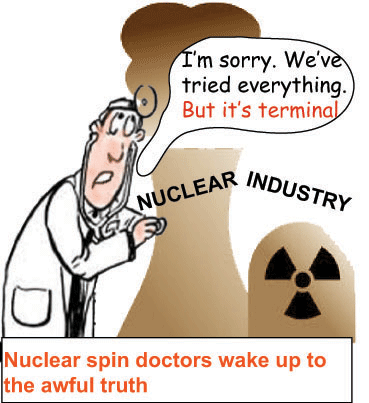 Hinkley Point C – A Review of the Year, nuClear News Dec 14 “………… To many it feels like the project is sleep walking towards disaster. It’s just that no-one is quite sure whether the disaster will be a virtually ‘unconstructable’ power plant struggling to come into operation years late and vastly over budget or the collapse of the whole project before it even starts.
Iran nuclear talks proceeding in atmosphere of good will
Iran says nuclear talks with U.S. proceed in good atmosphere DUBAI Tue Dec 16, 2014 (Reuters) – Iran said on Tuesday bilateral nuclear talks with the United states were proceeding in a good atmosphere despite lingering gaps over key issues such as Tehran’s uranium enrichment capacity and how fast economic sanctions should be lifted.
U.S. and Iranian diplomats began a two-day meeting in Geneva on Monday to pave the way for resuming broader negotiations involving Iran and six world powers there on Wednesday.
They are aimed at resolving a 12-year stand-off over Iran’s disputed nuclear aspirations that has wrought heavy economic sanctions on the Islamic Republic and fears of a new Middle East war unless the dispute can be settled diplomatically soon…………(Reporting by Mehrdad Balali; Editing by Mark Heinrich) http://www.reuters.com/article/2014/12/16/us-iran-nuclear-usa-idUSKBN0JU12Q20141216
1 This month
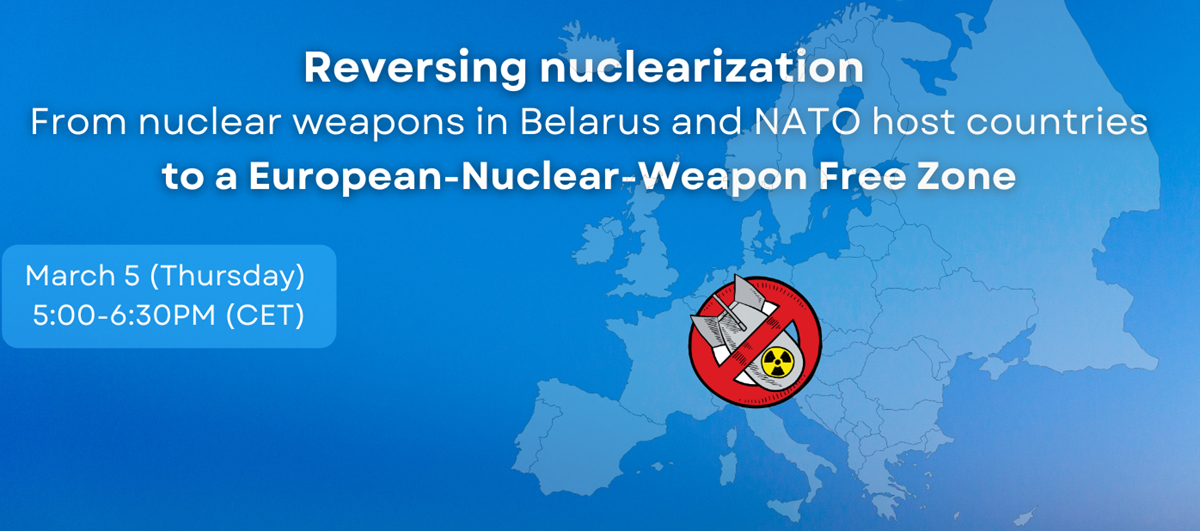
6 March -Online – Reversing nuclearization:
From nuclear weapons in Belarus and NATO host countries to a European-Nuclear-Weapon Free Zone
Mar 6, 2026 03:00 AM in Canberra, Melbourne, Sydney

of the week – Australians for War Powers Reform (AWPR)
To see nuclear-related stories in greater depth and intensity
 Antinuclear