Problem of rising sea levels causing waves of dissent in Queensland Liberal National Party
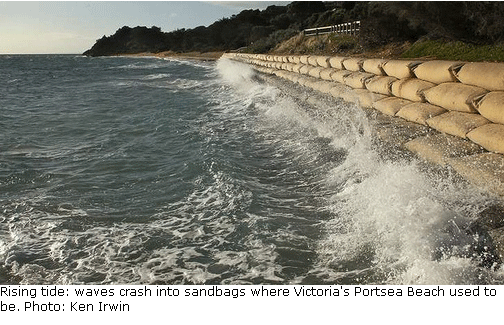 Will climate change denials sink the LNP? DES HOUGHTON THE COURIER-MAIL DECEMBER 20, 2014 IT’S a controversy that could not have come at a worse time for Campbell Newman. Cracks are appearing in LNP ranks over a State Government edict forcing Moreton Bay Regional Council to remove a theoretical climate change sea level rise of 0.8m when considering developments.
Inside the party there are waves of discontent. Continue reading
Tony Abbott shamed Australia at Lima climate summit, but will continue to sabotage climate action anyway
 Abbott’s ‘mean and tricky’ Australia: Lima’s Colossal Fossil, Independent Australia 18 December 2014, The Abbott Government has managed to turn Australia into an international climate pariah and laughing stock in the course of just one year, writes deputy editor Sandi Keane. The Abbott Government’s abject failure to address climate change copped a deserved hammering at Lima. ‘Fossil of the Day’ awards from the international Climate Action Network rained down on Foreign Minister Julie Bishop — the only person there who didn’t see global warming as a threat to the Great Barrier Reef. It all culminated in the final humiliation for the nation, with the ‘Colossal Fossil’ award being bestowed on Australia as the worst performer on climate change action for the entire year.
Having failed to sabotage any new global agreement by demanding legally binding emissions, Julie Bishop is now trying a different tack: as the planet cooks, she wants to cook the books. This could see Australia’s emissions skyrocket to a massive 49-57% above its original 1990 Kyoto pledge.
This latest attempt to protect vested mining interests – the Coalition’s major paymasters – hedges around the success of Bishop’s threat to scuttle any agreement on the second stage of the Kyoto Protocol unless she can use the same favourable rules around land clearing agreed to in Kyoto in 1997. Continue reading
Bob Baldwin – another climate sceptic joins Abbott’s anti environment team
 Tony Abbott appoints climate skeptic to “help” on environment REneweconomy By Giles Parkinson on 22 December 2014 Bob Baldwin, a man who once compared the impact of Australia’s man-made greenhouse gas emissions to that of a single strand of human hair on a 1km bridge, has been appointed parliamentary secretary to the minister of the environment. The announcement was made as part of Prime Minister Tony Abbott’s ministerial reshuffle. Baldwin will assist Greg Hunt, after previously being assistant to the Industry Minister Ian Macfarlane. It comes just a few weeks after Abbott sent Trade Minister Andrew Robb,another climate skeptic, to chaperone foreign minister Julie Bishop at the Lima climate talks.
In a speech in China in 2010, at the APEC SME summit, Baldwin said that the climate had been changing for millions of years – a favourite meme of the climate denier community – and even praised Rupert Murdoch as “the starting point for green innovation”………..
another speech in parliament gives no doubt about Baldwin’s skepticism, if not outright denial. Quoting climate-denying Queensland shock-jock Michael Smith, Baldwin compared the impact of any Australian efforts to curb greenhouse gas emissions to that of a human hair on a 1km bridge………..
o, that’s settled then. Hunt, who says the Abbott government does accept the science of climate change, and describes its emissions reductions to date as Australia’s great “gift to the world”, will have carriage of Australia’s domestic climate policy, while the international stuff is assumed by Bishop, after checking in with Robb.
Hunt, however, also has carriage over approvals to coal mines. The Newcastle Herald, Baldwin’s local paper, reported in August that Baldwin may be asked why the NSW anti corruption watchdog to explain why he wrote to ‘‘implore’’ the NSW Coalition government to support Nathan Tinkler’s proposed coal-loader.
The paper said documents with the Independent Commission Against Corruption show Baldwin drafted a letter to then-state ministers Chris Hartcher, Mike Gallacher and Duncan Gay in April 2011 urging in-principle support to the $1 billion coal-loader. “I implore the New South Wales government to do everything it can to see this project come to fruition,” he wrote……….http://reneweconomy.com.au/2014/tony-abbott-appoints-climate-skeptic-to-help-on-environment-57657
The financial consequences of the Fukushima nuclear accident have been underestimated
Fukushima and the institutional invisibility of nuclear disaster, Ecologist, John Downer 20th December 2014 “……….Take, for example, the disaster’s economic impact. The intense focus on the health and safety effects of Fukushima has all but eclipsed its financial consequences, yet the latter are arguably more significant and are certainly less ambiguous. Continue reading
Small solar desalinator designed for families living near polluted or salty water
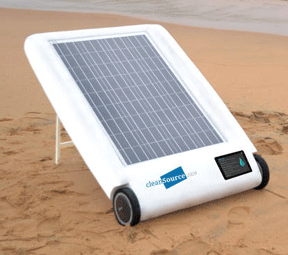 All It Takes For The Desolenator To Make Clean Drinking Water Is A Little Sunlight Fast Coexist, 21 Dec 14 Polluted or salty water becomes drinking water for a small family.Turning saltwater into clean drinking water is usually an expensive and energy-intensive process—a new desalination plant under construction in San Diego has a price tag of $1 billion, and smaller devices can cost as much as $30,000. But a new solar-powered device could make the process affordable for the millions of people around the world who don’t have running water.
“Other devices produce more water, but they are significantly more expensive, and they require quite a bit of maintenance and consumables,” says Desolenator‘s CEO William Janssen. “On the other side you have the solar still, the traditional solution—but that unit only produces half a gallon of water per day. Our solution can produce 3 to 4 gallons a day, enough for drinking and cooking.”
It’s designed for the hundreds of millions of people around the world who lack easy access to drinking water but happen to live near polluted rivers, lakes, or coastlines.
“If you look around the equatorial belt of the world, there are many countries that are very densely populated where water resources are very stressed,” says Janssen. “It will get worse—by 2025, close to 3 billion people will deal with water scarcity daily. We want to give them something that’s an affordable, family-sized device.”…………..http://www.fastcoexist.com/3039870/all-it-takes-for-the-desolenator-to-make-clean-drinking-water-is-a-little-sunlight#1
Earthquake rattles coastal area of Fukushima Prefecture
Earthquake strikes off Fukushima Prefecture; no tsunami warning issued, Japan Times, STAFF REPORT DEC 20, 2014 An earthquake with an intensity of 4 on the Japanese scale to 7 rattled the Hamadori area of eastern Fukushima Prefecture at 6:31 p.m. Saturday, the Meteorological Agency said.
The earthquake measured 3 in the Nakadori district of Fukushima as well as in northern, central and southern areas of adjacent Miyagi Prefecture, and in pars of Ibaraki Prefecture further to the north, the agency said on its website……..http://www.japantimes.co.jp/news/2014/12/20/national/science-health/moderate-quake-rattles-eastern-fukushima-prefecture/#.VJidisA9
Fukushima nuclear operator sued by 344 displaced residents from Minamisoma

 344 displaced residents from Minamisoma sue TEPCO http://www.japantoday.com/category/national/view/344-displaced-residents-from-minamisoma-sue-tepco DEC. 20, 2014 – TOKYO —
A group of 344 former residents of Minamisoma in Fukushima Prefecture are suing Tokyo Electric Power Co (TEPCO) for more than 6 billion yen in compensation for being forced to leave their homes due to the nuclear crisis at the Fukushima Daiichi power plant.
The group’s lawyers filed the suit with the Tokyo District Court on Friday, NTV reported.
According to the suit, the plaintiffs are seeking damages for mental suffering experienced while living in less than adequate temporary housing after being forced from their homes in the Odaka area of the city in the wake of the nuclear disaster in March 2011.
Along with an individual payment of 10 million yen, the plaintiffs are also demanding monthly compensation of 200,000 yen for the next three years until the evacuation order is lifted for their hometown.
Although some areas in Minamisoma are now open for re-entry, none of the citizens has returned to their homes.
Aty Canadian uranium hearings. Aboriginal people of Quebec stand firm
 The Aboriginal peoples of Quebec stand together against uranium at the final hearings of the BAPE in Montreal theturtleislandnews.com/daily/mailer_stories/dec162014/The-Aboriginal-peoples-of-Quebec-stand-together-against-uranium-at-the-final-hearings-of-the-BAPE-in-Montreal-pr1121614.html

MONTREAL, Dec. 15, 2014 – At the final public hearings of the Bureau d’audiences publiques sur l’environnement (BAPE) on the uranium industry in Quebec, to be held today in Montreal, the James Bay Cree Nation will deliver a resounding and united message of opposition to uranium development in their territory, Eeyou Istchee. The Cree Nation, which has led the charge against uranium development, has been joined in this position by the Assembly of First Nations of Quebec and Labrador and the Inuit of northern Quebec, who will also make presentations to the BAPE today.
“A powerful message has been sent by all of the Aboriginal peoples of Quebec. Together, we have said NO to uranium,” said Matthew Coon Come, the Grand Chief of the James Bay Cree Nation. “Today, we show that the Cree Nation speaks in one voice – united with the other Aboriginal peoples of Quebec – when we insist that our lands remain free of uranium mining and uranium waste.”
The Cree Nation Youth Council’s StandAgainstUranium march, which began in Mistissini on November 23, arrived in Montreal today to attend the BAPE hearings. The marchers have travelled on foot over 850 km in 23 days, to share the Cree Nation’s message and to encourage other Quebeckers to stand with them against uranium development. Overwhelmingly, those they met along the way have agreed that uranium mining should be banned in Quebec.
Youth Grand Chief Joshua Iserhoff has led the StandAgainstUranium march and will be making submissions to the BAPE on behalf of the Youth Council. “One of our community’s favourite fishing spots, Gobanji, is on Mistissini Lake, downstream from Strateco’s Matoush project. My grandma’s goose camp is there too,” reflected Youth Chief Iserhoff. “I’ve had lots of time on this walk to think about how important this land is to me, my family and our entire community. I will be telling the Commissioners, on behalf of Cree Youth, that uranium mining, and the radioactive and hazardous waste it will leave behind, are not welcome in Eeyou Istchee.”
“The courage and resolution shown by the StandAgainstUranium marchers over the last few weeks speaks in a powerful way to the determination of our people to protect Eeyou Istchee from the risks of uranium mining and uranium waste, today and for future generations. We give our thanks to the First Nations who offered support and encouragement along the way,” noted Grand Chief Coon Come. “We have been gratified to see that as they learn the facts about uranium, Quebeckers are joining with us in our stand.”
The BAPE’s final hearings will be held in the Salle Ovation at the Hyatt Regency Montreal, at 1pm and 7pm. The evening sessions will be co-chaired by the BAPE Commission, the James Bay Advisory Committee on the Environment and the Kativik Environmental Advisory Committee.
More information about uranium and the Cree Nation’s position can be found at www.StandAgainstUranium.com, on Facebook (James Bay Cree Against Uranium) or on Twitter (@JBCAUranium). SOURCE The Grand Council of the Crees (Eeyou Istchee)
The deadly effects of lingering hole in the ozone layer

Australian scientists have now found the radiation is having much wider effects. “Ecosystem impacts documented so far include changes to growth rates of South American and New Zealand trees, decreased growth of Antarctic mosses and changing biodiversity in Antarctic lakes,” say Sharon Robinson, of Wollongong University in NSW, and David Erickson, from the Oak Ridge National Laboratory in Tennessee.
Because it is no longer absorbing UV light, the stratosphere has cooled, which is reducing air pressure over the South Pole and sucking the southern jetstream southwards, along with its associated weather systems.
That has helped cool the Antarctic and direct more extreme weather towards Australia.http://www.theaustralian.com.au/news/world/the-ozone-hole-is-rewriting-earths-ecosystems/story-fnb64oi6-1227163700598
Nuclear industry kept going due to misleading spin about health effects
Fukushima and the institutional invisibility of nuclear disaster, Ecologist, John Downer 20th December 2014 “………..Two: the accident was tolerable
The second basic narrative through which accounts of Fukushima have kept the accident from undermining the wider nuclear industry rests on the claim that its effects were tolerable – that even though the costs of nuclear accidents might look high, when amortised over time they are acceptable relative to the alternatives.
The ‘accidents are tolerable’ argument is invariably framed in relation to the health effects of nuclear accidents. Continue reading
1 This month

6 March -Online – Reversing nuclearization:
From nuclear weapons in Belarus and NATO host countries to a European-Nuclear-Weapon Free Zone
Mar 6, 2026 03:00 AM in Canberra, Melbourne, Sydney

of the week – Australians for War Powers Reform (AWPR)
To see nuclear-related stories in greater depth and intensity
 Antinuclear