Pope Francis takes on the world’s polluting industries, and promotes renewable energy
 How Pope Francis could tip the balance against fossil fuels http://reneweconomy.com.au/2014/how-pope-francis-could-tip-the-balance-against-fossil-fuels-63601 By Giles Parkinson on 23 December 2014 Six years ago, Pope Benedict XVI installed more than 1,000 solar panels on the Vatican’s audience hall, helping him earn him the sobriquet of the “Green Pope.
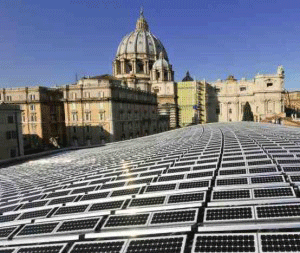 Some time in the next few months, his successor Pope Francis may just go one step further. His actions could tip the balance against fossil fuels, as the world’s wealthiest institution takes on the world’s most powerful industry.
The signs have been building. In November, the Pope sent a letter to Australian Prime Minister Tony Abbott urging him to address climate change and sustainability at the G20 summit – something Abbott had pointedly refused to do.
At Lima, the Pope sent another letter urging diplomats to agree on a strong deal to tackle climate change as UN negotiations drew to a close. In a message to Peru’s environment minister, Manuel Pulgar Vidal, who led the discussions in Lima, Francis warned that “the time to find global solutions is running out.”
A group of Catholic Bishops went one step further, calling for an end to fossil fuel use, citing climate change’s threat to the global poor as the lodestar of their concern. The document, signed by bishops from all continents, insisted on limiting global temperature rise to 1.5°C relative to pre-industrial levels — a considerably more ambitious goal than the 2°C ceiling that’s generally agreed on as the threshold beyond which climate change becomes truly dangerous.
They also called for the building of “new models of development and lifestyles that are both climate compatible” and can “bring people out of poverty.” Specifically, they said: “Central to this is to put an end to the fossil fuel era, phasing out fossil fuel emissions and phasing in 100 per cent renewables with sustainable energy access for all.”
There is growing speculation within church circles that this view is held at the highest level. Pope Francis wants the image of the Catholic Church to evolve beyond that of a huge multi-national corporation, to its origins as a social and humanitarian based organisation.
As he showed in his extraordinary speech this week to the priests, Pope Francis is very much his own man, not of the establishment.
Francis told the bishops and cardinals who run the Curia – the central administration of the Roman Catholic Church – that their careerism, scheming and greed had infected them with “spiritual Alzheimer’s”.
It was Benedict, though, who put the wheels in motion. The solar panels on the audience hall were enough to power the lighting, heating and cooling of a portion of the entire Vatican state. According to this National Geographic article, he authorised the Vatican’s bank to purchase carbon credits by funding a Hungarian forest, thus making the Catholic city the only fully carbon neutral nation-state.
Several years later, he unveiled a new hybrid Popemobile that would be partially electric. Francis went a step further, commissioning Osram to install 7,000 LED lights in the Sistine Chapel, cutting energy consumption by 90 per cent. It is now being extended to other Vatican museums.
But how much further could Pope Francis go? There is speculation that in his Encyclical, due in April, or even in a New Year’s speech, he could call for dramatic reform by the Catholic church. It would be similar, but bolder and more practical, than the Ecological Conversion address of Pope John Paul II in 2001.
This could include divestment. No one knows how much the Catholic Church has in its funds. It is likely to be hundreds of billions. The Uniting Church in Australia has voted to divest from fossil fuels. In July, the World Council of Churches, an umbrella group representing over half a billion Christians, announced its plans to fully divest from fossil fuels.
The SMH reports that in the same month, the Anglican Church of Australia passed a motion encouraging its diocese to divest. It noted then than a global campaign for the Vatican to divest had just been launched. Ironically, the Vatican’s finances are now controlled by Cardinal George Pell, the former archbishop of Sydney who is a noted climate science denier.
There is speculation that the Pope could emulate the bishops’ call for 100 per cent renewables. What he could do is repeat and enhance the efforts to install solar and lighting at the Vatican across the church’s global assets. In effect, he could follow in the footsteps of other corporate giants – such as Google, Apple and Ikea – and set a goal of 100 per cent renewables for his own church, or corporate entity.
The Catholic Church is not just the largest private employer in Australia (and other countries), with some 180,000 employees, it is also one of the biggest energy consumers – with a combined annual bill that runs into the billions of dollars from schools, aged care centres, churches, parish centres and hospitals.
A series of initiatives that encouraged energy efficiency, the installation of solar systems – schools would be perfect for this because usage matches solar output – and also battery storage would have a profound impact on the incumbent energy system, hastening the inevitable transition to decentralised energy grid.
Not only will this encourage and facilitate a much higher overall adoption of renewables, it will also likely result in cheaper energy for all consumers. Major network providers in Australia see this as inevitable, and are already installing – without subsidies – battery storage instead of upgrading grids,and talking of renewables-based micro-grids instead of relying on the old centralised model.
In the US, the combined energy consumption of Catholic organisations – schools, hospitals, aged care, churches, seminaries and the like, would run into the tens of billions. In Europe, the same again.
But if the Pope’s criticism of the Curia was greeted by stunned silence in the Vatican, it is unlikely that any move towards divestment or a massive uptake of renewables would be greeted in the same way.
The fossil fuel industry is certainly worried. Rio Tinto CEO Sam Walsh, who has repeatedly told everyone that the future is coal, took part in a “day of reflection” at the Vatican in September last year. It was ostensibly billed as a chance for mining companies to get “Christian ethical input” to their conversations about the future of their industry. Others saw it as a lobbying exercise.
More recently, the AFR reports, Walsh and other CEOs of major fossil fuel companies took part in an “Ecumenical Day of Reflection on Mining” at Lambeth Palace, the seat of the Church of England, another massive institution – both in terms of funds, and energy consumption.
High radiation rules out human workers : robots needed to clean up Fukushima reactors 1,2 & 3
Japan Atomic Power set to deploy 100 specialists to help with Fukushima dismantling THE ASAHI SHIMBUN by Daiki Koga and Tsuyoshi Nagano, 25 Dec 14 Japan Atomic Power Co. is working on plans to send a team of more than 100 specialists, backed up by robotic technology, to the beleaguered Fukushima No. 1 nuclear power plant to accelerate decommissioning work there……….
The plant operator finished removing nuclear fuel at the No. 4 reactor on Dec. 20 and is expected to start full-scale dismantling of the more problematic Nos. 1 to 3 reactors soon.
However, due to difficulties in preventing the spread of radioactive substances and removing debris around the reactor, the removal of fuel at the No. 1 reactor is estimated to start two to five years later than originally planned.
Some of the procedures are likely too difficult for TEPCO to undertake on its own, as the utility does not have sufficient experience in decommissioning nuclear reactors.
Workers in protective suits undertook the removal of fuel from the No. 4 reactor in rotation, as radiation levels were relatively low there. However, as radiation levels are much higher at the No. 3 reactor, the removal of fuel from its storage pool has to be conducted using remote-controlled robots……..http://ajw.asahi.com/article/0311disaster/fukushima/AJ201412250035
Renewable Energy Target makes economic sense for Australia

 The economic case for renewable energy Brisbane Times,December 25, 2014 – Andrew Leigh “………Let’s start with electricity prices. This year, the Warburton review commissioned modelling by ACIL Allen showing that the RET delivers lower electricity prices for consumers. If the Abbott government cut the RET, the modelling showed, Australian consumers would pay more for their electricity. Puzzlingly, after presenting this evidence, the Warburton review recommended cutting the RET anyway.
How about employment? The RET creates jobs because it opens up new fields of activity: installing solar panels, building and maintaining wind farms, researching and developing new ways to capture wave and geothermal energy. More than 24,000 Australians were employed in the renewable energy sector in 2012. The Clean Energy Council estimates that a further 18,400 new jobs will be created by 2020 if the RET is retained in its current form.
Recent surveys put the jobless rate at about 6 percent, the highest rate since Tony Abbott was employment minister. Right now, more than 700,000 Australians are looking for work. In such a tight employment market, 18,000 more jobs should drive down the unemployment rate. If the government scales back the RET to what it calls a ‘true’ 20 per cent target (in reality, a 40 per cent cut), the Clean Energy Council’s modelling suggests 6200 less jobs will created over the next six years. Scrapping the RET altogether will see us lose the opportunity to create 11,800 new jobs.
Then there’s investment. Since the RET was introduced, more than $10 billion has already been invested in large-scale renewable energy projects like First Solar’s huge plants in the NSW towns of Nyngan and Broken Hill. First Solar says it has already invested about $142 million in its plants, creating more than 600 jobs in the process.
By contrast, scrapping the RET altogether will put at risk $11 billion of additional investment between now and 2020. Even scaling back the RET to the government’s preferred level has been modelled as leading to a $6 billion drop-off in investment. The renewable energy business is a good one to be in right now as countries and companies around the world look for ways to grow the supply of alternatives to coal and gas. It is perplexing that the Abbott government wants Australia to get out of this business just when there is the potential for a major international investment boom.
All this new investment and the jobs created as a result are clearly good for Australia’s economic growth. But the RET also has the potential to support growth in places where the decline of other industries would otherwise see them go backwards. In Geelong, IXL used to make components for the auto industry, but since Ford and other car companies announced their withdrawal from Australia, the company has switched to manufacturing steel mounting structures for solar farms. IXL is now a major supplier to First Solar’s two NSW plants, and has recently opened an Adelaide factory to keep up with the demand…….
By stimulating demand for this kind of manufacturing, the RET also has the potential to help communities such as Geelong and Elizabeth grow economically in the future.
For a government that once declared Australia ‘open for business’, it’s puzzling to see Mr Abbott putting a ‘closed’ sign on the renewable energy industry. Whether you want lower electricity prices, more jobs, or more investment, keeping the RET makes sense. Oh, and by the way, it’s good for the environment too.
Andrew Leigh is the shadow assistant treasurer and Member for Fraser. www.andrewleigh.com.
http://www.brisbanetimes.com.au/comment/the-economic-case-for-renewable-energy-20141225-12dcl5.html
The nuclear lobby carpetbaggers’ pathetic attempt to sell nuclear power to Germany!
The so-called luminaries attempting to sell (or should that be “shill”) Mad Maxatomstrom are lightweights like Robert Stone who, having made a bad propaganda documentary about nuclear energy sees himself as some kind of expert. Also on the list is Patrick Moore, the notorious paid proponent not only of nuclear but the chemical industry, (as in bring back DDT), the genetic engineering industry, and clear-cut logging. (How does any self-respecting reporter still dare to refer to him as an “environmentalist”?) And then there’s the blinkered Barry Brook who wrongly claimed that North Korea never signed the nuclear Non-Proliferation Treaty and buys the completely discredited IAEA-WHO death figure of 60 for the Chernobyl disaster.
The obvious conclusion is that Mad Maxatomstrom is another desperate, last-ditch attempt by the nuclear coven to cling on to a corner of the energy sector, at least in the mind’s eye if not in the actual marketplace

Except there won’t be much. Money that is. Because the Mad Maxatomstrom plan is to carpet-bag into Germany and try to sell them on nuclear energy and only nuclear energy. Yes, you read that right, Mad Maxatomstrom is Germany’s “first provider of 100 percent nuclear power.” (Okay, the company is actually called Maxatomstrom, but the business plan is so mad, who could resist?)
I say “carpet-bag” because notably all the “spokespeople” are anglo-saxon, most of them pulled from the Evangelical School of Nuclear Deniers. They are also all male and all white. Make of that what you choose.
It’s fitting that this new all-nuclear energy company was apparently launched by a member of Germany’s so-called Pirate Party (it has no members of Parliament.) When I first read the press release I thought it was a spoof. It’s also telling that the company could not find a single, prominent German spokesperson.
And I say “not much money” because there are so many other better and equally competitive, if not cheaper, electricity choices already in Germany, some of which are providers of 100% renewable energy. Germany-based anaylst Craig Norris ran the Maxatomstrom numbersand got “three different offers, each around 50 euros a month – an absolutely unremarkable outcome (it’s basically what I pay right now for 100 percent green power.)” So these pirates won’t really be doing so well in the plundering-the-German-people department.
Mad Maxatomstrom claims it already boasts 3,000 customers! Wow, that’s just a tenth of the amount of people still employed in Germany’s declining nuclear sector, and about 100th of the people employed in the growing renewable energy sector. The local Mom and Pop corner store probably does better. Continue reading
New USA electricity generation in November – 77% wind and solar
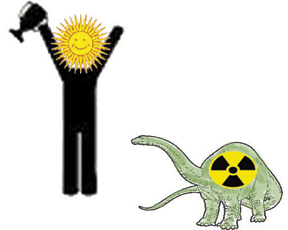
 Wind & Solar = 77% Of New US Electricity Generating Capacity In November Clean Technica December 23rd, 2014 by Joshua S Hill “……. I have included an estimate of non-utility-scale solar (i.e., residential and commercial solar) in the numbers below……The United States Federal Energy Regulatory Commission’s (FERC) Office of Energy Projects released its monthly “Energy Infrastructure Update” on Tuesday, and the big winners from the month of November seem to be wind and solar, which combined added up to over 70% of all new electrical generating capacity placed into service during the month. If you add in our estimate for non-utility-scale solar, the market share of solar and wind rises to 77%.
And as Ken Bossong, Executive Director of the SUN DAY Campaign, says, this is a good thing:
“With only one month left in 2014, it has become a horse race between natural gas and renewable energy as to which will dominate new electrical generation for the year. Regardless of the winner, it is apparent that coal, oil, and nuclear will be left behind in the dust.”……… https://cleantechnica.com/2014/12/23/wind-solar-account-70-new-us-generating-capacity-november/
Jobs increased in renewable energy: lost in other power sections, especially nuclear
Employment Drops in All Segments of the Power Sector—Except Renewables , Greentech Solar Jobs in solar power generation have increased by 201 percent since 2011. Julia Pyper December 24, 2014

The electric power sector lost more than 5,800 jobs over the last three years, with employment is taking a hit in nearly all energy sources except for renewables, according to the Energy Information Administration (EIA).
Non-hydro renewable electricity generation gained nearly 1,800 jobs over the period, largely in the solar sector.
Data compiled from the Bureau of Labor Statistics only reflects the jobs in electric power generation, and not the jobs associated with managing the grid. Jobs related to the construction of new facilities, processing or transportation of fuels, or behind-the-meter distributed generation installations and service were also excluded from the number set………….
recent coal plant closures caused a net decline of 1,750 fossil fuel power generation jobs since 2011. According to the EIA, the new natural gas plants are less labor-intensive than the older coal plants they’re replacing.
The nuclear industry, however, was the hardest hit. Jobs at nuclear power plants fell by 9 percent, which amounts to 4,900 positions, over the last three years.
The downward trend is on track to continue. Several U.S. nuclear power plants are slated for closure in the coming years and there are next to no plans to replace them. The International Energy Agency, a leading Washington think tank and group of conservation scientists recently made separate appeals for the U.S. to rethink its nuclear energy strategy.
Julia Pyper
Julia Pyper is a Senior Writer at Greentech Media covering utilities, grid issues, electric vehicles, the solar industry and energy storage. Find her on Twitter @JMPyper. http://www.greentechmedia.com/articles/read/employment-drops-in-all-segments-of-the-power-sector-except-renewables
Increase in sunshine brings increase in Arctic ice melting
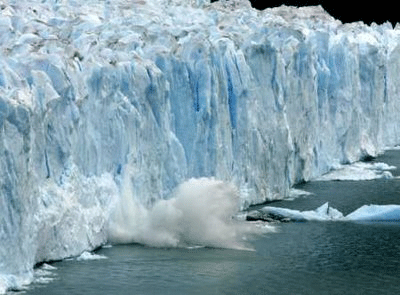 Arctic Ice Melting Due To Absorption Of Increased Solar Radiation http://au.ibtimes.com/articles/576820/20141222/arctic-melting-ice-solar-radiation.htm#.VJ20osA8 By India Ashok | December 22, 2014
In recent years, the Arctic region has been absorbing more and more of the sun’s radioactive energy, causing the rapid melting of ice in the region. Researchers have found a direct correlation in the rise of solar radiation being absorbed and the decrease in the mount of Arctic sea ice. Since 2000, scientists have observed that the reflective quality of the sea ice has been overwhelmed by the increased levels of absorption of solar radiation such that sea ice in the area has been shrinking at a consistently alarming rate. In fact, the overall climate of the Arctic region is reported to have undergone a marked increase in warmth.
Norman Loeb of NASA’s Langley Research Centre in Virginia has reportedly stated that the Arctic region experienced an increase of warmth in the climate of about five percent. In fact, scientists have concluded that the Arctic region is the only one in the world to have experienced such a rise in temperatures. NASA’s Clouds and the Earth’s Radiant Energy System (CERES) instruments, which have been placed on a few satellites are responsible for uncovering the data and measurements from which the Arctic climactic conditions can be analysed.
Leob went on to say that “Advances in our understanding of Arctic climate change and the underlying processes that influence will depend critically upon high quality observations like these from CERES.” What is confounding most scientists is that the Arctic region is comparatively showing more changes in its climate than any other region on the planet.
Mark Tschudi of the University of Colorado provided enough data that portrayed that since 2000, the Arctic region has lost a total of 1.4 million square kilometres of old ice. Further observation into the climactic conditions of the Arctic region only reinforce the theory that the marked temperature rise in the region is slated to continue increasing at this rate. While most would like to spend more time observing climactic patterns before venturing a root cause for such drastic changes, the possibly that global warming may have a hand in all this could not be ruled out.
To contact the editor, e-mail: editor@ibtimes.com
The nuclear industry’s propaganda themes do not stand up to scrutiny
“If the owners and operators of nuclear reactors had to face the full liability of a Fukushima-style nuclear accident or go head-to-head with alternatives in a truly competitive marketplace, unfettered by subsidies, no one would have built a nuclear reactor in the past, no one would build one today, and anyone who owns a reactor would exit the nuclear business as quickly as possible.”
Fukushima and the institutional invisibility of nuclear disaster, Ecologist, John Downer 20th December 2014 The nuclear industry and its supporters have contrived a variety of narratives to justify and explain away nuclear catastrophes, writes John Downer. None of them actually hold water, yet they serve their purpose – to command political and media heights, and reassure public sentiment on ‘safety’. But if it’s so safe, why the low limits on nuclear liabilities? Continue reading
Desperate nuclear industry calls for “strong government intervention”
 With US Nuclear in Decline, Scientists and Analysts Urge Support for Next-Generation Technologies, The Energy Collective, Stephen Lacey December 24, 2014 “……..The global nuclear industry is in steady decline. Since hitting a peak in 1996 at nearly 18 percent of global energy production, the industry’s share has dropped down to less than 11 percent.
Even with countries like China and India looking to boost their low-carbon energy supplies with nuclear, project developers around the world have faced long delays, cost overruns, and strong competition from natural gas and distributed resources, as well as policies designed to phase nuclear out entirely.
America is facing its own imminent decline in nuclear generation……….
A comprehensive federal plan, says IEA, is the only way to keep the industry relevant. ………..”The domestic nuclear industry is therefore at a critical juncture as a consequence of its declining economic competitiveness, and existing market mechanisms do not favor investment in high capital-intensive nuclear technology,” concluded the IEA.
Articulating that strategy will not be easy.
On a levelized-cost-of energy basis (an admittedly limited metric), distributed renewables are competing with nuclear plants, adding to the pain inflicted by low natural gas prices. Both free-market advocates and renewable energy proponents say new nuclear shouldn’t be built if it can’t compete in today’s market.
Cost overruns are also hurting the industry’s image. The first U.S. nuclear project to be built in 30 years, the Vogtle power plant in Georgia, is now $1.5 billion over budget and getting more expensive. Angry about rate increases caused by Vogtle, the Green Tea Party and environmental groups were able to force Georgia Power to support half a gigawatt of new solar in the state — much of it procured for 6.5 cents per kilowatt-hour.
Meanwhile, many environmentalists remain staunchly opposed to nuclear for traditional health and safety reasons……….
For nuclear to have any chance of succeeding, strong government intervention will be needed to fund more R&D and back loans for commercial-scale plants, say proponents…..
1 This month
Chernobyl: The Lost Tapes – A good documentary on Chernobyl on SBS available On Demand for the next 3 weeks– https://www.sbs.com.au/ondemand/tv-program/chernobyl-the-lost-tapes/2352741955560
15 April – Zoom –Nuclear Power is Not the Solution
Apr 15, 2026 01:00 AM in Canberra, Melbourne, Sydney

Join the International Physicians for the Prevention of Nuclear War (IPPNW) on Tuesday, April 14th for a timely webinar exploring the risks associated with nuclear power and challenging the myth that it offers a simple, safe, carbon-free solution to the climate crisis

21 April Webinar: No Nuclear Weapons in Australia
Start: 2026-04-21 18:00:00 UTC Canberra, Melbourne, Sydney (GMT+10:00)
End: 2026-04-21 19:30:00 UTC Canberra, Melbourne, Sydney (GMT+10:00)
Event Type: Virtual
A virtual link will be communicated before the event.
Host Contact Info: australia@icanw.org

of the week – Australians for War Powers Reform (AWPR)
To see nuclear-related stories in greater depth and intensity
 Antinuclear