Local opposition to Cameco’s Yeelirrie uranium mine in Western Australia
 Cameco’s Yeelirrie uranium mine in Western Australia faces opposition by locals, Energy Business Review 10 December 2014 The Western Australia (WA) Conservation Council reports that Canadian giant Cameco’s application to mine uranium in the northern Goldfields is being opposed by traditional owners and locals.
The Western Australia (WA) Conservation Council claimed that Canadian company Cameco’s application to mine uranium in the northern Goldfields is being opposed by traditional owners and locals.
Currently, the company’s plan is being evaluated by the Environmental Protection Authority (EPA) for the uranium mine, which is located in the remote Northern Goldfields region of Western Australia, approximately 420km north of Kalgoorlie-Boulder, 70km south-west of Wiluna and 110km north-west of Leinster.
A similar proposal for the same project was approved by the EPA to BHP Billiton in 2010 prior to its sale to Cameco in 2012, reports ABC Local.
Western Australia Conservation Council campaigner Mia Pepper said: that the project requires a public inquiry.
“Yeelirrie in the traditional language means place of death which is a strong indication about local knowledge and there’s also white communities there that have opposed the project for over 40 years.”…………..http://www.energy-business-review.com/news/wa-conservation-council-reports-yeelirrie-uranium-mine-bid-opposition-by-locals-4465630
Pope Francis’ courageous stand for action on climate change
 Pope Francis’s edict on climate change will anger deniers and US churches, Guardian, John Vidal, 28 Dec 14 Pontiff hopes to inspire action at next year’s UN meeting in Paris in December after visits to Philippines and New York “……can Francis achieve a feat that has so far eluded secular powers and inspire decisive action on climate change?It looks as if he will give it a go. In 2015, the pope will issue a lengthy message on the subject to the world’s 1.2 billion Catholics, give an address to the UN general assembly and call a summit of the world’s main religions.
The reason for such frenetic activity, says Bishop Marcelo Sorondo, chancellor of the Vatican’s Pontifical Academy of Sciences, is the pope’s wish to directly influence next year’s crucial UN climate meeting in Paris, when countries will try to conclude 20 years of fraught negotiations with a universal commitment to reduce emissions.
“Our academics supported the pope’s initiative to influence next year’s crucial decisions,” Sorondo told Cafod, the Catholic development agency, at a meeting in London. “The idea is to convene a meeting with leaders of the main religions to make all people aware of the state of our climate and the tragedy of social exclusion.”
Following a visit in March to Tacloban, the Philippine city devastated in 2012 by typhoon Haiyan, the pope will publish a rare encyclical on climate change and human ecology. Urging all Catholics to take action on moral and scientific grounds, the document will be sent to the world’s 5,000 Catholic bishops and 400,000 priests, who will distribute it to parishioners.
According to Vatican insiders, Francis will meet other faith leaders and lobby politicians at the general assembly in New York in September, when countries will sign up to new anti-poverty and environmental goals………..
According to Neil Thorns, head of advocacy at Cafod, said: “The anticipation around Pope Francis’s forthcoming encyclical is unprecedented. We have seen thousands of our supporters commit to making sure their MPs know climate change is affecting the poorest communities.”
However, Francis’s environmental radicalism is likely to attract resistance from Vatican conservatives and in rightwing church circles, particularly in the US – where Catholic climate sceptics also include John Boehner, Republican leader of the House of Representatives and Rick Santorum, the former Republican presidential candidate.
Cardinal George Pell, a former archbishop of Sydney who has been placed in charge of the Vatican’s budget, is a climate change sceptic who has been criticised for claiming that global warming has ceased and that if carbon dioxide in the atmosphere were doubled, then “plants would love it”………
Francis will also be opposed by the powerful US evangelical movement, said Calvin Beisner, spokesman for the conservative Cornwall Alliance for the Stewardship of Creation, which has declared the US environmental movement to be “un-biblical” and a false religion……..http://www.theguardian.com/world/2014/dec/27/pope-francis-edict-climate-change-us-rightwing?CMP=share_btn_tw

Australian government’s budget cuts threaten remote Aboriginal communities
Aboriginal communities under threat Ft.com December 26, 2014 Jamie Smyth in Sydney Dickie Bedford was born in the 1960s at a time when thousands of aboriginal people were being evicted from pastoral cattle stations. Half a century later a new generation of indigenous Australians faces a similar fate as budget cuts threaten to close hundreds of remote communities.
“They will turn us into fringe-dwellers again if they go ahead with these closures,” says Mr Bedford, executive director of the Marra Worra Worra aboriginal corporation in Western Australia.
“Withdrawing municipal services from these remote communities will force people to move into overcrowded hub towns where they are much more likely to encounter drugs, alcohol and family dysfunction,” he says.
Western Australia has warned that 150 of its 270 remote indigenous communities may have to close as the state cannot afford to pay for road, power, water or waste services. A further 60 aboriginal communities in South Australia are under threat as the federal and state government argue over who should fund basic services.
About 16,000 indigenous people live in these remote communities, which have received federal government funding for more than 50 years. Tony Abbott, Australia’s prime minister, has decided to phase out federal funding and shift responsibility to state governments following final one-off payments of A$90m (US$73m) to Western Australia and A$10m to South Australia………
In May, the federal government unveiled the toughest budget in two decades, which included a A$500m cut in aboriginal funding programmes, to tackle a $48.5bn budget deficit. Western Australia, which is heavily dependent on taxes from mining companies, is selling state assets and considering spending cuts.
Advocacy groups say aboriginal people, already the most marginalised group in society, are bearing the brunt of the tougher economic climate. They say the threat to close hundreds of communities harks back to an earlier era when indigenous people were forced from their land by white settlers following a court ruling that they must be paid a basic wage.
“Forcing aboriginal people to move from their communities is a form of cultural genocide,” says Tammy Solonec of Amnesty International Australia………..
The National Congress of Australia’s First Peoples, an advocacy group, has written to Mr Abbott urging him to intervene.
A federal government spokeswoman said the issue was a matter for states to settle.
South Australia’s government is resisting the federal government’s decision to withdraw services, accusing it of using “gun-toting” tactics to force states to accept “insulting” final payments from Canberra. ………http://www.ft.com/cms/s/0/f12f376c-81ba-11e4-b9d0-00144feabdc0.html#axzz3N84itvYv
The new threat to nuclear facilities – DRONES!
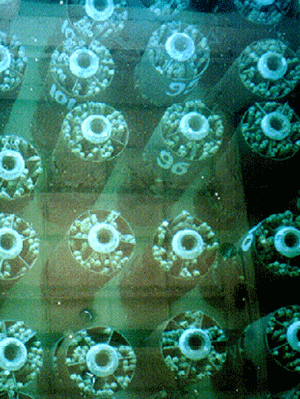 The flyovers have also exposed vulnerabilities on the ground. For example, spent-fuel pools are often unprotected or only protected by thin tin roofs.
Drones: The Threat to Nuclear Plants http://www.newsweek.com/drones-threat-nuclear-plants-294458 BY CAROLINE BAYLON 12/27/14 From small commercial drones for express parcel delivery to military ones used to attack terrorist suspects, the past year has seen a proliferation in the use of all types of unmanned aerial vehicles. Yet the prospect of increasing numbers of drones filling the skies poses abundant security concerns for critical infrastructure—including for the nuclear industry.
Just last week, news media reported that in July a drone came within six yards of a plane landing at Heathrow airport in London. Last month, French authorities revealed that unidentified drones had breached restricted airspace over 13 of France’s 19 nuclear power plants between early October and late November. The drones are believed to have been sophisticated civilian devices costing several thousands of pounds, and the intrusions were seemingly coordinated and generally occurred at night.
Given that the majority of security measures at nuclear power plants were conceived before the advent of drone technology, the flights over French facilities have exposed nuclear plants’ lack of adequate defenses against drones. This has left the French government—while outwardly reassuring the public that it has put in place ‘all means necessary to protect nuclear installations’—scrambling to find adequate solutions.

Drones can pose a number of problems for nuclear facilities. Flyovers could be used for reconnaissance by hostile actors, for example in the collection of photos and video footage of guard movements and the site layout. This could help to prepare for a ground-based attack. Drones could also provide air support in the event of an actual ground-based attack: They could drop explosives to damage power or communications networks, or could deliver weapons to insiders within the plant. Drones could also be used to bomb spent-fuel pools, which are less well protected than reactor cores.
The world cannot afford to lose the battle for switching to renewable energy
 Research by the International Renewable Energy Agency (Irena) shows that a doubling of the world’s share of renewable energy by 2030, from about 18% in 2010 to 36%, would help avoid the worst effects of climate change and would be cheaper than not doing so.
When considering factors like the cost of ill health and environmental damage due to pollution, switching to renewable energy could save up to $740bn (£476bn) per year by 2030. If these costs were factored into energy prices, renewable energy and energy efficiency measures would be cheaper than fossil fuel alternatives.
The switch to renewable power is a battle we cannot afford to lose Adnan Z Amin http://www.theguardian.com/environment/2014/dec/24/the-switch-to-renewable-power-is-a-battle-we-cannot-afford-to-lose Adnan Z Amin
Since the final gavel fell at the Lima climate talks earlier this month, discussions have centred on one question: what did the talks actually accomplish?
After two weeks of intense negotiation, governments settled on a draft text that will hopefully lead to a successful global climate deal in Paris next December. While opinions vary regarding the success or failure of the outcome, there is another story emerging outside the negotiation room.
This year’s conference represented a highly-significant shift in the positive momentum to act on climate change. While negotiators engaged in contentious debates, businesses, non-governmental organisations and local authorities stepped forward to present their own climate initiatives and committed to more action on the ground.
In this shift, renewable energy took centre stage. Continue reading
1 This month
Chernobyl: The Lost Tapes – A good documentary on Chernobyl on SBS available On Demand for the next 3 weeks– https://www.sbs.com.au/ondemand/tv-program/chernobyl-the-lost-tapes/2352741955560
15 April – Zoom –Nuclear Power is Not the Solution
Apr 15, 2026 01:00 AM in Canberra, Melbourne, Sydney

Join the International Physicians for the Prevention of Nuclear War (IPPNW) on Tuesday, April 14th for a timely webinar exploring the risks associated with nuclear power and challenging the myth that it offers a simple, safe, carbon-free solution to the climate crisis

21 April Webinar: No Nuclear Weapons in Australia
Start: 2026-04-21 18:00:00 UTC Canberra, Melbourne, Sydney (GMT+10:00)
End: 2026-04-21 19:30:00 UTC Canberra, Melbourne, Sydney (GMT+10:00)
Event Type: Virtual
A virtual link will be communicated before the event.
Host Contact Info: australia@icanw.org

of the week – Australians for War Powers Reform (AWPR)
To see nuclear-related stories in greater depth and intensity
 Antinuclear