The Ugly Australian: Paladin uranium miner discharging radioactive sludge into Lake Malawi?
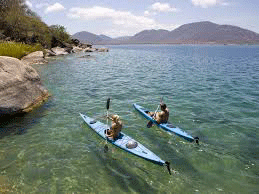 The lake provides water for drinking and domestic use to millions of Malawians. Part of the lake is protected as a national park, and it is inhabited by more than 850 cichlid fish species found nowhere else on Earth.
Malawi: Paladin Accused of Discharging Uranium-Contaminated Sludge in Lake Malawi http://allafrica.com/stories/201412301012.html A coalition of Malawi civil society organisations (CSOs) has accused Paladin Energy Ltd, a company that is mining Uranium ore at Kayerekera in the northern district of Karonga over reports the mining company is secretly discharging into Lake Malawi uranium contaminated sludge from the tailings dam at the mining site.
Renowned human rights activist, Rafiq Hajat shared a report compiled by a members of the Natural Resources Justice Network (NRJN) in which it is alleged paladin is discharging uranium sludge from Kayerekera into Lake Malawi.
“A radius of 35 km from the Boma, you will be shocked to see fish of different species dead with some communities along the lakeshore collecting [the fish]. Collectiong as part of their relish. The cause not yet known. Reports from the Beach Village Chairman indicates that this started in late November but Government was not forth coming (sich)” reads part of the post. Continue reading
The Maralinga nuclear bomb test scandal lingers on
Lingering impact of British nuclear tests in the Australian outback http://www.bbc.com/news/world-australia-30640338 Jon DonnisonSydney correspondent 1 Jan 2015, “It seems remarkable today but less than 60 years ago, Britain was exploding nuclear bombs in the middle of Australia. In the mid-1950s, seven bombs were tested at Maralinga in the south-west Australian outback. The combined force of the weapons doubled that of the bomb dropped on the Japanese city of Hiroshima in World War Two.
In archive video footage, British and Australian soldiers can be seen looking on, wearing short sleeves and shorts and doing little to protect themselves other than turning their backs and covering their eyes with their hands.
Some reported the flashes of the blasts being so bright that they could see the bones of their fingers, like x-rays as they pressed against their faces.Much has been written about the health problems suffered by the servicemen as a result of radiation poisoning.
Far less well-documented is the plight of the Aboriginal people who were living close to Maralinga at the time.
“Every night I cry for them,” Hilary Williams tells me as she sits around a campfire for an impromptu picnic of kangaroo tails laid on for our visit.
Her mother and grandparents all witnessed at least one of the explosions from just a few kilometres away.
Ms Williams said all three of them died young after suffering lung problems.
“It’s so sad. They’re not here anymore,” she said, adding that she had heart problems she believes were also linked to the bombs.Locals around Maralinga spoke about a black mist of radioactive dust over their communities following the explosions.
“A lot of people got sick and died,” said Mima Smart, an aboriginal community leader.
“It was like a cancer on them. People were having lung disease, liver problems, and kidney problems. A lot of them died,” she said, adding that communities around Maralinga have been paid little by way of compensation……….
Robin Matthews, caretaker of the Maralinga Nuclear Test Site. “They thought they’d pick a supposedly uninhabited spot out in the Australian desert. Only they got it wrong. There were people here.”

During the 1960s and 70s, there were several large clean-up operations to try and decontaminate the site. All the test buildings and equipment were destroyed and buried. Large areas of the surface around the blast sites was also scraped up and buried.
But Mr Matthews said the clean-up, as well as the tests themselves, were done very much behind closed doors with a high level of secrecy. “You’ve got to remember that this was during the height of the Cold War. The British were terrified that Russian spies might try and access the site,” he said.
The indigenous communities say many locals involved in the clean-up operation also got sick..
‘Sick land’
Maralinga has long been declared safe. There are even plans to open up the site to tourism. But it was only a few months ago that the last of the land was finally handed back to the Aboriginal people. Most, though, say they have no desire to return there.
Mima Smart told me she regards Maralinga as sick land. “I don’t want to go back. Too many bad memories.”
And even almost 60 years on, the land still hasn’t recovered. Huge concrete plinths mark the spots where each of the bombs was detonated.
Around each, the blast area would have stretched for several kilometres.The orangey red soil of the outback sparkles strangely green.If you look closely, you can see the ground is covered with what looks like broken glass, where the soil got so hot it literally melted and turned to silicon.
And even after all this time, the natural vegetation still won’t grow back. “The grass here only ever grows a few inches,” said Mr Matthews. “Even the birds and the kangaroos still stay clear of this area.”
More than half a century on, most people here still regard Maralinga as a dark chapter in British Australian history
World leaders in denial about climate change – Sir David Attenborough warns
 David Attenborough: Leaders are in denial about climate change The Independent 1 Jan 15 Sir David Attenborough is calling on global leaders to step-up their actions to curb climate change, saying that they are in denial about the dangers it poses despite the overwhelming evidence about its risks.
The TV naturalist said those who wield power need to use it: “Wherever you look there are huge risks. The awful thing is that people in authority and power deny that, when the evidence is overwhelming and they deny it because it’s easier to deny it – much easier to deny it’s a problem and say ‘we don’t care’,” Sir David said.
In terms of climate change, “we won’t do enough and no one can do enough, because it’s a very major, serious problem facing humanity; but at the same time it would be silly to minimise the size of the problem,” he told Sky News.
Later this year a crucial UN climate summit will be held, at which world leaders have pledged to agree to tough cuts in their carbon emissions, to ensure the increase in global warming does not exceed 2°C – beyond which its consequences become increasingly devastating.
Although that meeting is not scheduled to take place until December, the scale of the task ahead is huge and world leaders are already working towards the summit.
However Sir David is concerned that, despite the increasingly obvious scale of the threat climate change poses, leaders are not taking the matter as seriously as they should. “Never in the history of humanity in the last 10 million years have all human beings got together to face one danger that threatens us – never.
“It’s a big ask, but the penalty of not taking any notice is huge,” he said.
Sir David’s comments come two days after a separate warning – on the dangers posed by the booming human population. “It’s desperately difficult, the dangers are apparent to anybody,” he told The Independent. We can’t go on increasing at the rate human beings are increasing forever, because the Earth is finite and you can’t put infinity into something that is finite.
“So if we don’t do something about it – the natural world that is – we will starve,” Sir David said…………..http://www.independent.co.uk/environment/climate-change/david-attenborough-leaders-are-in-denial-about-climate-change-9953302.html
Abbott government must hate Powershop – it’s making renewable sourced electricity cheaper!
 No wonder that the Abbott government is keen to wreck the Renewable Energy Target. Clever renewable electricity suppliers like Powershop are providing cheaper electricity – threatening Abbott’s backers – the polluting industries
Burge said that Powershop’s service was challenging the view put forward by major energy retailers that renewable energy would drive power bills up.
Miles George chairman of the Clean Energy Council and managing director Infigen Energy said that second tier generators had captured a “healthy” share of the retail energy market by offering discounts
“If we didn’t have a [target] those businesses wouldn’t be operating the way they are now and likely
Ben Burge, the man hoping to re-ignite the electricity market http://www.theage.com.au/it-pro/business-it/ben-burge-the-man-hoping-to-reignite-the-electricity-market-20150101-12fojw.html January 2, 2015 Andrew Colley Meet Ben Burge, the math whiz trying to shake up the staid retail energy market with a smartphone app and a good dose of analytics.
When he is away with the family, his mother-in-law pops by discreetly to do a load of washing. Her only explanation for his seemingly clairvoyant ability to know when to send her thank-you flowers is strategically placed web cams.
It’s a powerful tool and one he wants to put in the hands every Australian in a bid to take on the major energy retailers with cheaper and cleaner electricity.
 The truth is far more prosaic. Burge, chief executive of online retail energy challengerPowershop, knows when she’s there because the company’s app on his smartphone registers an unmistakeable spike in his home’s energy consumption. Burge, once Australia’s youngest CEO of a listed company, eMitch, at 25, and keen skateboarder, has already picked up 30,000 customers in Victoria whilst at the helm of what Powershop claims is the world’s first retail online energy market.
It lets consumers use a smartphone app (on iPhone and Android) or the web to monitor their energy consumption at home and choose the source of their electricity – from alternative energy projects including wind, solar or even sugarcane processing and landfill generation. A move that could help increase demand for renewable energy.
Some time early in 2015 the service will launch in NSW. Continue reading
Cabinet papers 1988-89; Bob Hawke and the Aboriginal Treaty that never came
Cabinet papers 1988-89 SMH: Aboriginal Treaty SMH Damien Murphy 1 Jan 15 “……...The treaty that never came Bob Hawke attended the Barunga festival in the Northern Territory in June 1988 and promised an historic treaty with the Aboriginal people.
 The Hawke government had been promising to improve representation of Aboriginal interests and issues, but by 1985 attempts to frame a “national model” for land rights had stalled in compromise, amid farmer and miner opposition and distrust from Aboriginal groups. So Hawke’s treaty had more than a touch of the sun about it. Continue reading
Renewable energy soars: 2015 will be a tough year for nuclear
investors are increasingly sceptical about putting their money into nuclear − whereas renewables promise an increasingly rapid return on investment, and may get a further boost if the governments of the world finally take climate change seriously.
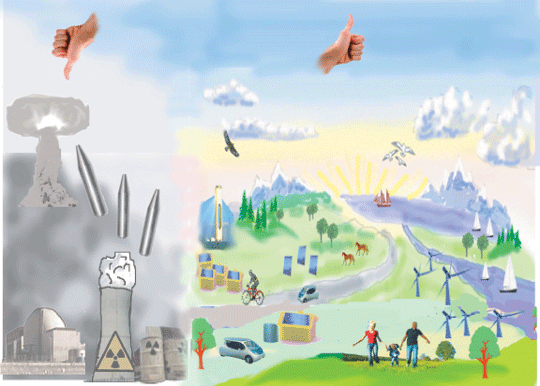 Nuclear faces tough 2015 as renewables growth soars RTCC Responding to Climate Change 31 December 2014, Governments are still spending billions on nuclear research, but it looks like being an unhappy new year for the industry By Paul Brown
With nuclear power falling ever further behind renewables as a global energy source, and as the price of oil and gas falls, the future of the industry in 2015 and beyond looks bleak.
Renewables now supply 22% of global electricity and nuclear only 11% − a share that is gradually falling as old plants close and fewer new ones are commissioned.
New large-scale installations of wind and solar power arrays continue to surge across the world. Continue reading
America’s CIA orchestrated the coup in Ukraine – says film-maker Oliver Stone

 Oliver Stone Says Ukrainian Coup Was Directed by CIA http://sputniknews.com/art_living/20141231/1016415810.html US film maker claims he is currently engaged in production of a documentary about Ukrainian president Viktor Yanukovych. WASHINGTON, December 31 (Sputnik) – US filmmaker Oliver Stone is currently engaged in production of a documentary about Ukrainian president Viktor Yanukovych, who fled the country following the February coup, according to the post on his Facebook page published Tuesday.
“[I] Interviewed Viktor Yanukovych 4 hours in Moscow for new English language documentary produced by Ukrainians. He [Yanukovych] was the legitimate President of Ukraine until he suddenly wasn’t on February 22 of this year. Details to follow in the documentary,” Stone said.
According to the renowned filmmaker, in the aftermath of the coup, “the West has maintained the dominant narrative of ‘Russia in Crimea’ whereas the true narrative is ‘USA in Ukraine.’ The truth is not being aired in the West. It’s a surreal perversion of history that’s going on once again, as in Bush pre-Iraq ‘WMD’ [Weapons of Mass Destruction] campaign.” Continue reading
PM Tony Abbott close to signing the secretive Trans Pacific Partnership
 Will Tony Abbott to stand up for Australia on the TPP? http://action.sumofus.org/a/australia-tpp/2/2/ Abbott’s government has confirmed they’re getting ready to crack down on internet freedom to comply with the TPP — including a “three strikes” provision that forces ISPs to monitor and police our activity online.
Tony Abbott’s trade minister is about to sign a secret, global pact to allow corporations to sue the Australian government for billions — just for passing laws to protect our health or the environment.
Tony Abbott wants us to believe the 12-country Trans-Pacific Partnership (TPP) is all about getting a better deal for ordinary Australians. But the truth is that it could end up being one of the biggest corporate power grabs in a generation.
Abbott and his cronies are refusing to make the deal public (although corporate lobbyists seem to be getting the inside track) — making it hard to know just what’s in the TPP. But leaks so far indicate this is bad news. That’s why Tony Abbott wants it to stay confidential — he’d prefer to quietly sign away our rights without a big fuss.
This deal is too important to leave to the politicians: it could affect the lives of Australians for generations to come. Continue reading
Tony Abbott insincere on Aboriginal people and the Constitution
At a meeting of Australia’s largest Aboriginal Land Council in Kakadu National Park, Joe Morrison said the Prime Minister’s push for a referendum on Constitutional recognition would be threatened by the Government’s handling of Aboriginal affairs in general.
Aboriginal leaders question motives behind PM Tony Abbott’s push on Constitution http://www.abc.net.au/news/2014-12-12/aboriginal-leaders-question-motive-behind-pms-constitution-push/5964088 By the National Reporting Team’s Kate Wild 11 Dec 2014 Aboriginal leaders have questioned the motives behind Prime Minister Tony Abbott’s pledge at a fundraising dinner in Sydney on Thursday to “sweat blood” for a referendum on whether to recognise Indigenous people in the Constitution.
One prominent elder, NT Australian of the Year and prominent Indigenous activist Rosalie Kunoth-Monks, described the move as insincere. Continue reading
Australia’s high skin cancer rate: banning of tanning beds is welcome
Australia Launches Tanning-Bed Ban To Tackle High Cancer Rate http://www.ibtimes.com/australia-launches-tanning-bed-ban-tackle-high-cancer-rates-1770926 1 Jan 15 By Shuan Sim @ShuanSim s.sim@ibtimes.com on December 31 2014 Indoor tanning fans in Australia will soon have to go outdoors for a golden skin tone after their tanning beds are switched off because of a nationwide ban taking effect on Thursday. The ban, which the government has been planning since October 2013, is part of an ongoing effort to tackle the country’s skin cancer rate, one of the highest in the world.
The crackdown on tanning beds will take effect in five of Australia’s six states, and one of two territories – New South Wales, Victoria, South Australia, Tasmania, Queensland and the Australian Capital Territory. Western Australia said it will also ban tanning beds, but hasn’t announced a start date. The legislation does not affect the Northern Territory because there are no commercial tanning bed facilities in that part of the country.
Australia has one of the highest skin cancer rates in the world, affecting two out of three Australians by the age of 70. Continue reading
1 This month

of the week – Australians for War Powers Reform (AWPR)
To see nuclear-related stories in greater depth and intensity
 Antinuclear