The Ugly Australian, Paladin, has another radioactive spill at its Malawi uranium mine
Uranium miner announces spill, Australian Miner, 8 January, 2015 Vicky Validakis Just days after uranium miner Paladin Energy denied it discharged polluted water into a river, the company announced a tank failure at its Kayelekera mine has resulted in a spill.
Paladin told the ASX a 20-minnute high-intensity storm resulted in around 25mm of rain falling at the mine site, located in northern Malawi.
As a result, a surge of stormwater caused the liner in the plant run-off tank to rupture, releasing 500 cubic metres of material to the bunded areas of the site, the company said.
Up to 50 litres of the material “overtopped” one of the containment bunds………..
On Monday Paladin denied claims it released toxic water from the mine into a local river system………
Kayelekera mine has been in care and maintenance since February 2014 due to the depressed price of uranium.http://www.miningaustralia.com.au/news/uranium-miner-announces-spill
Despite Minderoo’s objections, uranium exploration will go ahead on Andrew Forrest’s land in W.A.
West Australian Mines Minister Bill Marmion gave the exploration proposal the go-ahead after the mining warden recommended it be rejected in February 2014.
Mining Warden Kevin Tavener said the application for three exploration permits on Minderoo should be rejected because of the company’s low cash position.
It was a decision that reverberated throughout the industry as junior mining companies typically do not have access to deep cash reserves……..
Forrest’s Minderoo expressed its disappointment at the decision.
“Minderoo is disappointed at the minister’s decision to allow exploration by Cauldron Energy within the historical and environmentally fragile parts of Minderoo station,” a spokesperson said.
“As we have continuously stated on the public record, Minderoo supports development as long as it has no negative impact on the environment, and specifically protects the delicate environment of the Ashburton River.”http://www.miningaustralia.com.au/news/uranium-exploration-given-the-go-ahead-on-forrest
Andrew Forrest a majority shareholder in uranium company
The deal comes just days after Forrest bought Harvey Beef for a reported $40 million.
The uranium buy came as a surprise to the industry, with spot prices yet to recover to pre-Fukushima levels and dropping as low as US$30.75……..http://www.miningaustralia.com.au/news/andrew-forrest-invests-in-west-australian-uranium
Former Soviet leader Mikhail Gorbachev gives a sober warning over the Ukraine crisis
 Gorbachev issues new warning of nuclear war over Ukraine http://www.dw.de/gorbachev-issues-new-warning-of-nuclear-war-over-ukraine/a-18182899 9 Jan 15 Former Soviet leader Mikhail Gorbachev has warned that the crisis in Ukraine could lead to a major war, or even a nuclear war. In an interview with a German magazine, he criticized both Russia and the West. In an interview with the German weekly news magazine Spiegel, 83-year-old former Soviet leader Mikhail Gorbachev said the crisis in Ukraine could lead to large-scale war in Europe or even a nuclear war. “We won’t survive if someone loses their nerves in the current tension.” Continue reading
Abbott govt in a political dilemma over its climate change denialist stance
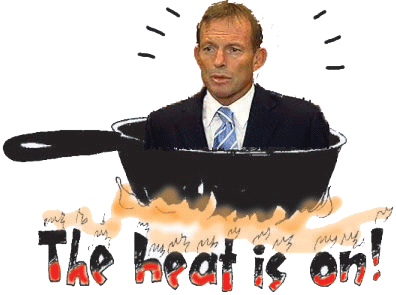 The political value of climate denial has fallen to zero. What will Abbott do now? Guardian Gabrielle Kuiper 8 Jan 15 Climate change denial was useful to Tony Abbott as long as it helped to bring down the Rudd-Gillard government. Now it’s a hindrance, and he looks isolated at home and abroad
In his renowned 1998 study of power and rationality, the Danish social scientist Bent Flyvbjerg concluded: “Power determines what counts as knowledge … while it ignores or suppresses that knowledge which does not serve it.”
Tony Abbott used climate denial to support his purpose of bringing down the Rudd-Gillard government and gaining power, but it now seems to be a hindrance to his government. Continue reading
Australian government tax regulation delivers a blow to the anti wind farm cause
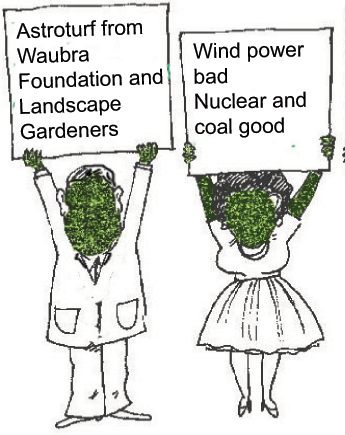 A black eye for the anti-windfarm issue https:/managingoutcomes.wordpress.com/ January 5, 2015 Allegations about supposed health effects are a common challenge for issue managers. And there are few health issues with so little scientific evidence and so much emotion as claims that wind turbines cause a whole catalogue of illnesses.
But the campaign against wind turbines just got a serious black eye with the Australian Government revoking the status of the Waubra Foundation, one of the country’s most active and vocal anti-windfarm lobby groups. Federal regulators have stripped the group of its health promotion charity status, which effectively means they can no longer receive tax-deductible donations.
Now, it may be a matter of opinion whether wind turbines are ugly and a blight on the landscape. However it’s a matter of fact that passing birds are far more likely to be killed by cats or from crashing into lighted windows at night. And it is a matter of fact that repeated studies around the world have found no real evidence of any link between wind turbines and human health. Indeed a Victorian Health Department report found no physiological health effects caused by turbines, although “expectation of symptoms may lead to increased reporting of health complaints associated with wind turbines.” In other words people could “worry themselves sick” as a result of all the activist claims and allegations.
The recent Government decision about the Waubra Foundation certainly won’t put an end to the anti-windfarm issue, Continue reading
Climate change denialists will now dominate U.S. Congress and Senate

 The Anti-Science Climate Denier Caucus: 114th Congress Edition, Climate Progress BY TIFFANY GERMAIN – GUEST CONTRIBUTOR, KRISTEN ELLINGBOE – GUEST CONTRIBUTOR, KILEY KROH JANUARY 8, 2015 THIS WEEK CONGRESS RETURNS TO THE NATION’S CAPITAL WITH 71 NEW MEMBERS IN ITS RANKS. THOSE ADDITIONS WILL BRING LITTLE IMPROVEMENT IN THE VIEWS OF CONGRESSIONAL REPUBLICANS REGARDING THE SCIENTIFIC REALITY OF CLIMATE CHANGE,
HOWEVER. OVER 56 PERCENT OF REPUBLICANS IN THE 114TH CONGRESS DENY OR QUESTION THE SCIENCE BEHIND HUMAN-CAUSED CLIMATE CHANGE, ACCORDING TO AN ANALYSIS BY CAP ACTION.
On the heels of what looks to be the warmest year in recorded history, with the global carbon dioxide levels that drive climate change reaching unprecedented levels, 53 percent — 131 members — of the Republican caucus in the House of Representatives deny the occurrence of human-caused global warming and 72 percent — 39 members — on the Senate side sing the same tune. Continue reading
Denmark’s wind power sets world record
 Denmark Sets World Record For Wind Power Production BY ARI PHILLIPS THINK PROGRESS JANUARY 8, 2015 Denmark has been long been a pioneer in wind power, having installed its first turbines in the mid-1970s when oil shocks sent the import-dependent nation on a quest for energy security. Thirty-seven years later, the country has set a new world record for wind production by getting 39.1 percent of its overall electricity from wind in 2014. This puts the Northern European nation well on track to meet its 2020 goal of getting 50 percent of its power from renewables.
The news of Denmark’s feat adds to the national records the U.K. and Germany set for 2014 and further establishes Europe as a leader in the wind power industry. This is especially true when it comes to offshore resources, as countries like Scotland, England, and Denmark build out their offshore wind farms. Wind generated enough electricity to power just over 25 percent of U.K. homes in 2014 — a 15 percent increase from 2013. In December, Germany generated more wind power, 8.9 terawatt-hours, than in any previous month.
A big source of the surge of Denmark’s wind production this year came from the addition of around 100 new offshore wind turbines. In January of 2014, the peninsular country got just over 61 percent of its power from wind. This is more than three times the overall productionof 10 years ago, when wind only made up 18.8 percent of the energy supply. The country has a long-term goal of being fossil fuel-free by 2050. Continue reading
News South Wales report on Renewable Energy progress in 2014
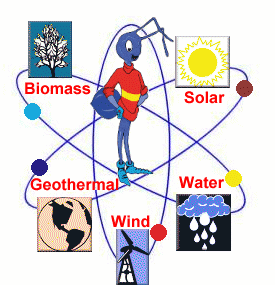 NSW Gov releases progress report on renewables http://ecogeneration.com.au/news/nsw_gov_releases_renewables_annual_report/090661/ Thu, 8 January 2015 The NSW Government has released its annual report, Progressing the Renewable Energy Action Plan for 2014, which confirmed approximately 13 per cent of the state’s energy generation came from renewables in 2013.
The Annual Report, which details the progress of the NSW Government’s Renewable EnergyAction Plan found that the share of renewable energy in NSW’s electricity generation mix has almost doubled in the past 5-6 years.
Other key findings include:
- There are currently estimated to be more than 13,000 jobs supported by renewable energy in NSW. This includes 4,400 direct renewable energy jobs.
- Over 2,900 megawatt (MW) of projects with an estimated investment value of $5.9 billion and the potential to support around 14,000 construction jobs and 1,000 operational jobs, currently have development approval. All of these projects are located in regional NSW (August 2014).
- Total investment in small-scale solar photovoltaic (PV) in NSW has been $1.3 billion. 298,000 households have installed small-scale PV.
The report also identifies the key achievements from the period since implementing the Plan, which include construction commencing on AGL’s $450 million, 155 MW Solar Flagships project in Nyngan and Broken Hill, which the Government has played a key role in supporting and facilitating.
Australian Renewable Energy Agency (ARENA) call for input for renewables R&D program
 ARENA seeks input for renewables R&D program http://ecogeneration.com.au/news/arena_seeks_input_for_rd_program/090638/, 6 January 2015
ARENA is seeking feedback on four priority areas proposed for its R&D program to encourage collaboration between the research sector and industry in the second round of the program in 2015.
Australian Renewable Energy Agency (ARENA) CEO Ivor Frischknecht said “Strong collaboration between research and industry will help ensure Australia’s world-class renewable energy knowledge is translated into commercial outcomes and increase the economic, social and environmental return on investment in R&D.”
The current priority areas include:
- Balance of system cost reduction
- Integration and high penetration of renewables into networks
- Renewables as an alternative to gas for industrial process heat
- Integration of renewable energy into building materials or other products (consumer products, vehicles, signage, sensors etc.)
The agency is seeking feedback from stakeholders on the following:
- Do the proposed priority areas address a current energy challenge for Australia? Are there any other energy challenges that industry-researcher partnerships could address?
- How willing/able is industry to invest in R&D in these priority areas? What other areas would industry be willing to invest in? What level of support is industry willing/able to provide?
- To what extent can existing researcher/industry linkages be leveraged? How easy (or otherwise) is it to establish a new industry-researcher partnership to develop and deliver a project?
- What are the commercialisation prospects (either domestic or international) for research conducted in the proposed priority areas? Are there any areas not listed above where researchers and industry could collaborate effectively to achieve a commercial outcome Does Australia have world-leading research capability in any (or all) of the above areas?
To submit comments, email: submissions@arena.gov.au by COB 30 January 2015.
ARENA also recently announced $2 million for a biomass project in Australia.
Dive in renewable energy investment in Australia, contrasting with global rise
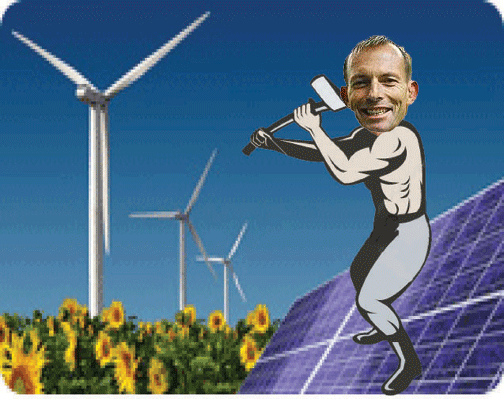 Renewable investment dives in Australia, bucking global trend, SMH January 10, 2015 – Peter Hannam Environment Editor, The Sydney Morning Herald Investments in renewable energy rose to record levels globally in 2014 but fell sharply in Australia because of uncertainty triggered by the Abbott government’s review of the industry, Bloomberg New Energy Finance said.
Worldwide investment in wind farms, solar photovoltaics and other clean energy sources jumped 16 per cent last year to $US310 billion ($383 billion), or more than five times the tally of a decade earlier. Solar investments accounted for almost half the total.
China led the way, with investment soaring almost one-third to $US89.5 billion, while US investment gained 8 per cent to $US51.8 billion, and Brazil’s almost doubled to $US7.9 billion.
Australia, though, went the other way, with investment sinking 35 per cent to $US3.7 billion. BNEF said the amount was the “lowest since 2009, as wind and solar project developers delayed decisions while they awaited the government’s response to its Renewable Energy Target review”.
The Australian tally in fact masks a much steeper dive for large-scale renewable plants as small-scale solar PV largely held its own in 2014 even as state-based support schemes were wound back further.
“Four wind farms are currently under construction, but these signed contracts before the last RET review,” said Darren Gladman, the acting policy director for the Clean Energy Council.
“No more projects in the country have imminent construction plans.
“Australia is not just at risk of falling behind the rest of the world on renewable energy, we have already slipped off the back of the wave. We have some of the best sun, wind and waves in the world, but this new research shows that we are squandering some of our huge natural advantages.”
Fairfax Media sought comment from Industry Minister Ian Macfarlane, who has sought to cut the country’s renewable energy target from the current goal of 41 terawatt-hours annually by 2020 to as low as 27tWh.
So far, the Senate has blocked such a move but uncertainty over whether and when the goal will be reset has made it almost impossible to raise financing for new projects………..http://www.smh.com.au/business/renewable-investment-dives-in-australia-bucking-global-trend-20150109-12kqhk.html
Australian govt policy uncertainty leads to scrapping of Burdekin hydro power project
Meridian Energy Australia announced on Friday it would not proceed with the Burdekin hydro power generation project, which was intended to “harness the otherwise wasted power of the largest dam in Australia at Burdekin falls”………… Burge said regulatory uncertainty over the RET was the reason for not proceeding with the Burdekin project.
The project would have improved energy security in north Queensland, meeting the growing needs of agricultural and mineral businesses, and provided about 150 jobs during development and construction, the company said.
“Sadly, the decision to undermine the long-term investment signals of the RET makes it more difficult to realise these benefits for Queensland businesses and households,” Burge said.
The opposition leader, Bill Shorten, and the environment spokesman, Mark Butler, said the Meridian decision showed the government’s stance on the RET was costing jobs. Shorten and Butler said Labor would reopen RET negotiations if the government moved away from its position.“Australian families will have Tony Abbott to thank when their power bills rise because of his ideologically destructive approach to renewable energy,” they said in a joint statement.
Meridian is not the first company to cite RET uncertainty as a reason for shelving or cancelling projects. Silex Systems announced in August it was suspending a project to construct a large solar power station in Mildura, Victoria.
Keppel Prince Engineering, a wind turbine manufacturer based in Portland, Victoria, notified workers in October that 100 staff would be made redundant.
Other renewables companies have said the uncertainty has stopped them making long-term investment decisions. http://www.theguardian.com/environment/2014/dec/12/burdekin-hydro-power-project-scrapped-over-renewable-energy-target-concerns
Western Australia’s dramatic drop in indigenous sites receiving heritage listing
 Slump in recommended indigenous sites receiving heritage listing VICTORIA LAURIE, THE AUSTRALIAN JANUARY 10, 2015 A STEEP drop in Aboriginal sites being added to Western Australia’s heritage register is leading to “a vast sea of ignorance” that will thwart heritage protection, according to Carmen Lawrence, the chair of the Australian Heritage Council.
The dramatic drop in Aboriginal sites being registered — from 80 per cent of sites recommended to the Department of Aboriginal Affairs to only 6 per cent — has occurred over three years, from 2011 to May last year.
At least 27 sites registered under the Aboriginal Heritage Act have also had their status cancelled in the past year.
Ms Lawrence said the failure to register sites would make it even harder to identify the state’s heritage, lore and culture, which needed protection. “I’m concerned that we’re going back in time to a place we’d abandoned, the respect and protection levels of the 1950s,” she said.
“In the case of Burrup rock art in the Pilbara, it was unprotected for many years because nobody knew anything about it and Aboriginal voices weren’t heard.”………
Ms Lawrence said amendments to the Aboriginal Heritage Act, now before parliament, removed the requirement for a specialist anthropologist to assess sites. She was also concerned a “sacred” site applied only to those places where religious activity was conducted.
“I’m deeply concerned that song cycles and dreaming lines are explicitly excluded from consideration in this state due to a narrowing of definition,” she said. “Leaving that out is a major part of indigenous heritage. James Price Point is a good example: there are middens and burial sites along the Lurujarri Heritage Trail near Broome, but a lot of the significance relates to songs and dreaming tracks.”
She said a 2011 State of the Environment report found indigenous heritage was neither well protected nor well recorded……..http://www.theaustralian.com.au/national-affairs/indigenous/slump-in-recommended-indigenous-sites-receiving-heritage-listing/story-fn9hm1pm-1227180010783?sv=dc1f2218356b75c3fbcaafe8c6f6e071
Three Australian States pushing Fed govt for climate change action
Victoria’s environment minister, Lisa Neville, said she was seeking “urgent” talks with the NSW and SA governments to forge a united front against Tony Abbott’s stance on climate change.
Neville told Guardian Australia the states would seek greater clarity on how the federal Emissions Reduction Fund, which will provide grants to businesses, would work. The federal government’s leadership on climate change would also be questioned.
“I’m looking to have urgent conversations with NSW and South Australia on the role they can play with us,” she said. “We’ll look at whether there’s a shared view on emissions reduction and also national advocacy so we can put climate change back into public debate.
“Each state has a responsibility to push the federal government in this area. National action will have the most impact on climate change, so we need a unified voice to get the federal government, first of all, to acknowledge climate change.
“The Abbott government has, unfortunately, walked away from its responsibility to act on climate change. We’d prefer strong national and international action, but if we have to play a leadership role in Victoria, we will do that.
“We need to put pressure on the federal government as well as build a proper community conversation about climate change again.”
Neville, who will have her first meeting with the federal environment minister, Greg Hunt, this month, said the federal Coalition needed to resolve the “mess” surrounding its attempts to cut the national renewable energy target and ensure its ERF grants were spent effectively to bring down emissions……….
South Australia’s renewable energy investment has forged ahead of Victoria and NSW, at a time when all states are experiencing a trend of rising temperatures…….
The NSW government, while keen to not publicly criticise its Coalition counterpart in Canberra, has indicated that it wants stronger action on climate change…….“The NSW government also has a renewable energy action plan to increase the proportion of renewable energy in NSW and has made its position on the renewable energy target clear.”
….Hunt’s office did not respond to a request for comment. http://www.theguardian.com/environment/2015/jan/08/climate-change-victoria-seeks-join-nsw-south-australia
Except for Australia, world’s renewable energy investment is growing
 Solar power drives renewable energy investment boom in 2014, Guardian, Damian Carrington, 10 Jan 15 Global clean energy investment leapt 16% in 2014 led by solar power surge in US and China – but Europe lags behind Global investment in clean energy jumped 16% in 2014, boosted by fast-growing solar power in the US and China. Solar, whose costs have plummeted in recent years, attracted over half the total funding for the first time.
The green energy market has been gloomy in recent years and the rise in investment is the first since 2011. But despite strong growth in most regions, only a series of large offshore wind farms stopped Europe going into reverse, while the Australian government’s antipathy to renewables saw investment there tumble by 35%.
The new figures, from Bloomberg New Energy Finance (BNEF), show $310bn (£205bn) was ploughed into green energy last year, just short of the record $317bn in 2011. However, as green energy gets ever cheaper, the money invested in 2014 bought almost double the clean electricity capacity than in 2011.
“The investment bounce back in 2014 exceeded our expectations,” said Michael Liebreich, chairman of BNEF’s advisory board. “Solar was the biggest single contributor, thanks to the huge improvements in its cost-competitiveness over the last five years.”…….
“The figures show that renewable energy is increasingly cost-competitive, with solar in particular rapidly approaching parity with fossil-fuel generation. They suggest also that investors are growing weary of increasingly volatile fossil fuel markets,” said Richard Black, director of the Energy and Climate Intelligence Unit.
“Some developing countries have increased low-carbon investment hugely – a staggering 88% in the case of Brazil – and there is a danger that the UK, with its restrictive planning regulations for renewables, will find itself increasingly swimming against the global tide,” Black said.
“It’s encouraging to see the smart money in the world’s economic powerhouses is betting on clean energy,” said Doug Parr, Greenpeace UK’s chief scientist. “The only disappointment is that, save for offshore wind, the UK and the EU are now lagging behind. For all the whinging about UK ‘going it alone’ on clean energy, it is increasingly clear that the bigger economic risk is being left behind as the low-carbon jobs go where political leaders show genuine commitment to a clean energy future.”http://www.theguardian.com/environment/2015/jan/09/solar-power-drives-renewable-energy-investment-boom-2014
1 This month

of the week – Australians for War Powers Reform (AWPR)
To see nuclear-related stories in greater depth and intensity
 Antinuclear