Abbott govt in a political dilemma over its climate change denialist stance
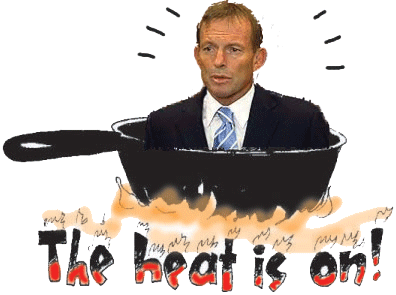 The political value of climate denial has fallen to zero. What will Abbott do now? Guardian Gabrielle Kuiper 8 Jan 15 Climate change denial was useful to Tony Abbott as long as it helped to bring down the Rudd-Gillard government. Now it’s a hindrance, and he looks isolated at home and abroad
In his renowned 1998 study of power and rationality, the Danish social scientist Bent Flyvbjerg concluded: “Power determines what counts as knowledge … while it ignores or suppresses that knowledge which does not serve it.”
Tony Abbott used climate denial to support his purpose of bringing down the Rudd-Gillard government and gaining power, but it now seems to be a hindrance to his government.
During the 2013 election, Abbott walked a fine line, neither agreeing nor disagreeing with climate deniers. Then, on his first day as prime minister, he sacked the Climate Commission, the authoritative body set up by the previous Labor government to educate the public about climate change. A few months later, his mentor, former prime minister John Howard, spoke in support of climate change scepticism, saying he “instinctively feel(s) that some of the claims are exaggerated”.
Howard baldly admitted that he only agreed to act on climate change and to consider an emissions trading scheme in 2006-7 for political purposes. Later, a climate denier, Maurice Newman, was appointed as Abbott’s chief business adviser. Dick Warburton, another denier, conducted a review into the Renewable Energy Target. And research by the University of Technology, Sydney found Abbott had help in the media: nearly all of the 36% of coverage in Australian newspapers in 2012 that did not accept the scientific consensus on global warming was published by the Murdoch press.
The Abbott government then commenced its well-documented destruction of environment and climate change laws, policies and programs – the supposed salve for which was the so-called Direct Action policy. It was continuously criticised for being unworkable, expensive and worse, that it would encourage“rent-seeking” and create a “subsidy culture”………
While Canadian prime minister Stephen Harper stood with Australia on opposing carbon pricing in June, Abbott’s attempt to create a broader “conservative alliance” that also included Britain, India and New Zealand fell embarrassingly flat. David Cameron and New Zealand’s prime minister, John Key, both expressed strong support for global action on climate change, including emissions trading. The story of an alliance disappeared almost as quickly as it had arisen.
What was astounding was how poorly Abbott misread the views of his fellow conservatives. He seemed oblivious of the fact that a few months earlier Britain had joined France, Germany and Italy in calling for a raised EU emission reduction target of 40% by 2030.
From then on, it only got worse. The New York Times reported on 2 January 2014 that John Kerry was determined to play a major role in brokering a global climate treaty in Paris in 2015, including by focusing the US relationship with China on the issue. ………
There are two major climate change questions for Abbott in 2015. The first is how will he deal with resolving the impasse over the future of the RET. Billions of dollars of investment are at stake. While Origin CEO Grant King has been campaigning against both the carbon price and RET for several years – and is said to have the ear of the prime minister – a successful industry and citizen campaign to save solar is raising the profile of the issue with voters. Will Abbott continue to advocate for polluting big businesses or will he agree to a compromise with Labor?
The second is the question of narrative. In response to the dramatic Sydney bushfires in October 2013, Abbott said “these fires are certainly not a function of climate change, they are just a function of life in Australia”. He then accused UN climate chief Christine Figueres of “talking through her hat” when she said (in general terms) bushfires are “absolutely” linked to climate change.
To return to our Danish social scientist, Flyvbjerg notes that “in a democratic society, rational argument is one of the few forms of power the powerless still possess”.
The voices of the powerless are now being amplified: climate change stories are now being told by the most powerful men and women in the world. As bushfires rage, floodwaters rise and cyclones blow over the next year, how will the prime minister modify his language and use of the facts? http://www.theguardian.com/commentisfree/2015/jan/08/the-political-value-of-climate-denial-has-fallen-to-zero-what-will-abbott-do-now#comment-45942470
No comments yet.
1 This month

of the week – Australians for War Powers Reform (AWPR)
To see nuclear-related stories in greater depth and intensity
 Antinuclear
Leave a comment