Australia’s unstoppable solar energy revolution
“If you look at what the mainstream analysts are saying now, they are talking about the solar  revolution,” said Parkinson. “Even the energy distributors in Australia, they are talking about the end of centralisation and the rise of the micro-grid.” According to Parkinson, solar is now at “grid parity” with traditional sources of electricity.
 “You can’t address climate change using heavily centralised, obsolete, hideously risky fission reactors,” Milne told Al Jazeera. “It’s a humiliating stance. Australia needs to phase out fossil fuels and move to 100 percent renewable energy for the climate – and for our economy.”
Australia’s rising solar power ‘revolution‘, Aljazeera, After record-breaking solar project, scientists question why coal-dominated nation ignores renewable innovation. Royce Kurmelovs 13 Jan 2015 Adelaide, Australia – Australian researchers broke the world’s solar power efficiency record last month with their design of a novel commercial energy system, raising hopes the fossil-fuel dominated country may someday switch off its reliance on coal.
Led by Professor Martin Green, the University of New South Wales team worked with a local company to create a highly efficient solar energy system that uses mirrors to concentrate sunlight onto a central solar panel to generate electricity.
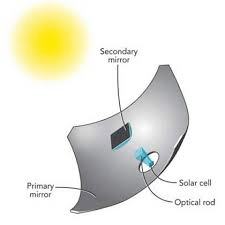 The method is known as concentrator photovoltaics (CPV), and the end product is a system with an efficiency of 40 percent – meaning 40 percent of the sunlight hitting the solar panels is converted into energy, the highest such level ever achieved.
Most importantly, the design uses readily available materials that makes putting the system into operation easier – and cheaper – than trying to commercialise more experimental designs.
Green, who is also the director for the Australian Centre for Advanced Photovoltaics, has a history of this kind of innovation.In 2011, he and his team built a solar cell that operated with 19.3 percent efficiency and soon after pushed this to 19.4 percent, edging out the previous record holder with 18.9 percent efficiency.
Off the grid
This kind of innovation has become the hallmark of the solar energy industry, and it is only going to grow, according to Green.
“What’s happening now is that photovoltaics has improved so much recently that it is better at producing electricity than using hot steam,” Green told Al Jazeera. “Solar will become the cheapest way to generate electricity at any scale. The transition is going to occur where it becomes cheaper to use solar than coal.”
In the past, lower efficiencies and the risk of a power outage on a cloudy day meant solar power was viewed with suspicion by consumers and industry analysts.
But that has changed over the last five years as the cost of installing a solar energy system in Australia has been reduced.
With a huge uptick in the number of people installing solar powered systems on their rooftops, there is less demand during periods of peak usage, such as during the afternoon.
This, in turn, is forcing electricity prices lower and will force a fundamental change in the way developed nations generate electricity, according to Giles Parkinson, editor of RenewEconomy, an Australian website that tracks developments in the solar energy industry.
“If you look at what the mainstream analysts are saying now, they are talking about the solar revolution,” said Parkinson. “Even the energy distributors in Australia, they are talking about the end of centralisation and the rise of the micro-grid.” According to Parkinson, solar is now at “grid parity” with traditional sources of electricity.
“What we’re starting to see now, in Australia and around the world, is that the large utilities have realised the transition is inevitable, that they can slow it down but they can’t stop it,” Parkinson said………
Going nuclear
During late 2014, the trajectory of Australian policy on climate and energy became clear in a now infamous statement made by the prime minister during the opening of a $3.8bn coal mine in Queensland state.
There Abbott told an audience that “coal was good for humanity”, effectively tying the country to the coal industry.
In another instance, the Australian government seemed to revive the debate over nuclear power with Australian Foreign Minister Julie Bishop saying it was an “obvious conclusion” that nuclear offered the best way to bring down emissions.
Australia is one of the world’s biggest carbon emitters on a per capita basis and is among the worst performing industrial nations on climate change, according to a report by Germanwatch, a sustainable development advocacy group……..
Senator Christine Milne, leader of the Australian Greens Party, said the move is “embarrassing” in the eyes of the world.
“You can’t address climate change using heavily centralised, obsolete, hideously risky fission reactors,” Milne told Al Jazeera. “It’s a humiliating stance. Australia needs to phase out fossil fuels and move to 100 percent renewable energy for the climate – and for our economy.”……http://www.aljazeera.com/indepth/features/2015/01/australia-rising-solar-power-revolution-2015112123135920787.html
No comments yet.
1 This month
7 April – WEBINAR – Australia and the Doomsday Clock – Preventing nuclear war through NoFirstUse and other policies
Online | Tuesday April 7, 4:00-5:30pm, Australian Eastern Time / 8:00-9:30am Central Europe Time
– Access the registration link
15 April – Zoom –Nuclear Power is Not the Solution
Apr 15, 2026 01:00 AM in Canberra, Melbourne, Sydney

Join the International Physicians for the Prevention of Nuclear War (IPPNW) on Tuesday, April 14th for a timely webinar exploring the risks associated with nuclear power and challenging the myth that it offers a simple, safe, carbon-free solution to the climate crisis

21 April Webinar: No Nuclear Weapons in Australia
Start: 2026-04-21 18:00:00 UTC Canberra, Melbourne, Sydney (GMT+10:00)
End: 2026-04-21 19:30:00 UTC Canberra, Melbourne, Sydney (GMT+10:00)
Event Type: Virtual
A virtual link will be communicated before the event.
Host Contact Info: australia@icanw.org

of the week – Australians for War Powers Reform (AWPR)
To see nuclear-related stories in greater depth and intensity
 Antinuclear
Leave a comment