Even if it worked nuclear fusion would be too expensive
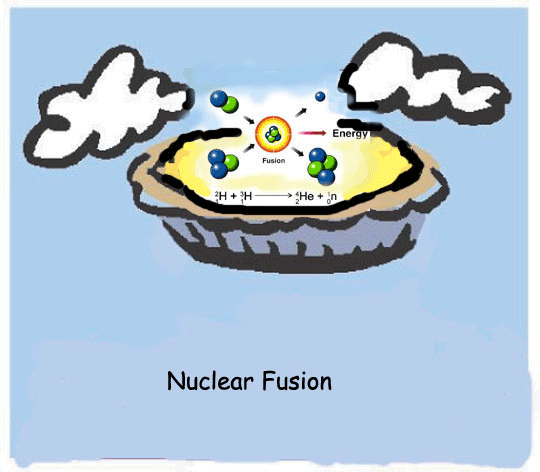 Even If Lockheed Has Made a Breakthrough in Fusion Power, the Hard Part Will Be the Economics http://www.forbes.com/sites/amorylovins/2015/01/16/even-if-lockheed-has-made-a-breakthrough-in-fusion-power-the-hard-part-will-be-the-economics/ Lockheed-Martin has just confirmed that it is among the private firms—the rest generally much smaller—that are pursuing various innovative designs for nuclear fusion reactors. Some of these innovations may prove technically feasible. All will be very challenging: if we can do controlled fusion, it will be arguably the most difficult engineering humans have ever done.
No comments yet.
1 This month
7 April – WEBINAR – Australia and the Doomsday Clock – Preventing nuclear war through NoFirstUse and other policies
Online | Tuesday April 7, 4:00-5:30pm, Australian Eastern Time / 8:00-9:30am Central Europe Time
– Access the registration link
15 April – Zoom –Nuclear Power is Not the Solution
Apr 15, 2026 01:00 AM in Canberra, Melbourne, Sydney

Join the International Physicians for the Prevention of Nuclear War (IPPNW) on Tuesday, April 14th for a timely webinar exploring the risks associated with nuclear power and challenging the myth that it offers a simple, safe, carbon-free solution to the climate crisis

21 April Webinar: No Nuclear Weapons in Australia
Start: 2026-04-21 18:00:00 UTC Canberra, Melbourne, Sydney (GMT+10:00)
End: 2026-04-21 19:30:00 UTC Canberra, Melbourne, Sydney (GMT+10:00)
Event Type: Virtual
A virtual link will be communicated before the event.
Host Contact Info: australia@icanw.org

of the week – Australians for War Powers Reform (AWPR)
To see nuclear-related stories in greater depth and intensity
 Antinuclear
Leave a comment