This week: Australian nuclear and climate news
 My website http://www.nuclear -news was shut down for 24 hours – very cleverly hacked, by I don’t know whom. Could it be that this modest little website is annoying the nuclear industry? I feel quite honoured.
AUSTRALIA
National Nuclear power Nowhere to put Lucas Heights nuclear waste – but they still keep making it! Australian government funding research in China into dodgy thorium nuclear reactors
Tony Abbott ignores the chance to benefit Australia by using the low 10-year bond rates
Climate change: The Global Catholic Climate Movement launched in Australia Quakers remove funds from 4 major banks – cannot fund uranium, nuclear weapons, coal. Despite overwhelming evidence, Australia’s government in denial about climate change . Liberal Party kids at Uni dutifully toe the Party line on fossil fuels
Uranium price rally was short-lived Lowest production for 16 years. Cameco admits that sagging uranium prices continue to be a problem. Investors are wary, as Australian miner Paladin sells uranium at way below cost of producing it
Aboriginal issues For the convenience of uranium mining, Aborigines are moved off remote homelands
Australia on USA nuclear bandwagon, to sell uranium to India, but technical problems remain
Renewable energy. Billions of dollars and associated jobs in the renewable energy sector are being lost due to Abbott government . Australian government snubs International Renewable Energy Agency congress. Australia: globally top potential for renewable energy, bottom chance in market
Still Australia has achieved quite a lot in 2014, despite the Abbott government’s war against renewables. Rooftop solar is becoming cost competitive with fossil fuel powered electricity. Clean Energy Finance Corporation is proving very successful in its 40 direct investments and 25 projects co-financed . International Renewable Energy Agency (IRENA) reports that Australia’s solar PV highly competitive
Queensland. Labor promises to promote solar energy, if elected. Queensland Deputy Premier Jeff Seeney dismissed climate change as “a semi-religious belief”. McKinlay Shire plans solar panels for business and Council buildings
Victorian health report supports wind farms
NSW. Gunnedah Shire Council takes the solar power plunge
Western Australian Government’s plan to extinguish native title & land rights in one hit
Tasmanian government moves to restrict citizen’s power to criticise corporations
Australia Day – the disconnect from the country’s true history
My mother is a fifth-generation Australian of English and Irish heritage and my father is Munanjahli and an Australian-born South Sea Islander…….
The disconnect I feel on the January 26 is not a rejection of my mother’s history. Rather, it is a rejection of the privileging of one version of history at the expense of another. I simply cannot be part of the collective amnesia that sweeps the nation on January 26 each year. This amnesia is evidenced in our current prime minister choosing the arrival of the First Fleet as the “defining moment” of our national identity.
This nation has a history that extends well beyond the past 227 years, not to mention a few more inclusive “defining moments” since then.
There is no doubt that the arrival of the First Fleet was a“defining moment” for this nation, but defining for vastly different reasons for Indigenous and non-Indigenous Australians. For me, this day is worthy of commemoration, not celebration……..
The iconic Australia Day images of people adorning various flag paraphernalia, parades, boozy BBQs, and bikini-clad girls on beaches shows complete disregard for the Indigenous lives, lands and languages that were lost as a result of the British invasion of this country and the persisting inequalities that exist
So how do I commemorate Invasion Day? I march. I march not because I’m bitter or stuck in the past, or ungrateful for the privileges I enjoy today. Rather, I march in remembrance for those who lost their lives simply defending their own land and people. I march with pride and pay tribute to the innumerable acts of resistance of our warriors and the ongoing resilience of our communities.
I march with my children so they will never forget about who they are, where they come from and how they came to be where they are today.
Last year, my husband and I took our eldest three children to participate in the Invasion Day march organised by the Brisbane Aboriginal Sovereign Embassy. As we walked through the city to join the march wearing Aboriginal flag T-shirts, we noticed the responses of our fellow Australians. Many averted their gaze or looked disturbed simply by our presence. I just didn’t feel very Australian at all.
More than 1,000 of us marched across Victoria Bridge to South Bank where the official Australia Day celebrations were being held. We noted the newly erected fences around the two main entrances to the South Bank Parklands and the heavy police guard ensuring that we didn’t spoil their parade by entering. It was a stark reminder of our standing in this country…….
Hey, maybe you could even step out to one of the marches taking place in our capital cities and commemorate January 26 with your fellow Australians – the first peoples of the land that you proudly call home.
And maybe then, you will come to understand why this really should be a day to commemorate, not celebrate.http://theconversation.com/the-day-i-dont-feel-australian-that-would-be-australia-day-36352
A Labor win in Queensland will be a win for solar energy

 Queensland Labor Promises Solar Support http://www.energymatters.com.au/renewable-news/queensland-labor-solar-em4657/ January 26, 2015 Queensland Opposition Leader Annastacia Palaszczuk has committed Labor to boosting the state’s renewable energy sector if it wins the election.
“In office Labor will call for proposals to generate 40-megawatts of base-load renewable energy including solar power. This will be used as a trial for more renewable power plants,” said Ms. Palaszczuk.
Labor would also investigate introducing competition in the power sector by enabling remote area councils to generate electricity from renewables to be sold at a lower cost to consumers.
“We will also initiate a renewable energy study to investigate measures to create an export-orientated renewable energy economy here in Queensland,” said Ms. Palaszczuk; who additionally promised an independent review to determine a fair price for a solar feed-in tariff based on all the benefits it provides, “rather than the requirements of large companies.”
Ms. Palaszczuk accused the LNP of being stuck in the past and pointed out after the last election Campbell Newman reneged on promises on renewable energy; cutting $660 million in related programs.
Clean Energy Council Chief Executive Kane Thornton said while Queensland has seen a huge number of households install solar power systems, the state trails behind others when it comes to new large-scale renewable energy developments.
“The Queensland Opposition’s plan to generate 40 megawatts of power from solar and other renewable sources is a welcome move, particularly in light of the ongoing review of the federal Renewable Energy Target – which has caused investment in the sector to collapse,” said Mr Thornton.
The Australian Solar Council also welcomed Labor’s announcement.
“Labor has released a solar plan for the Sunshine State, which is responsible and affordable and will restore confidence in a battered solar industry,” said Australian Solar Council CEO John Grimes.
“Labor’s solar policy stands in stark contrast to the contempt shown by the Newman and Abbott Governments towards solar families and workers.”
If the Council’s Save Solar Community Forum in Townsville last week is anything to go by, the LNP should be very worried – it was a standing room only event. The next forum is at Springwood on Thursday, January 29.
Last week the Greens also unveiled their solar policy, which would ensure all Queensland solar households are paid a fair price for their electricity exports. The policy would also provide 100,000 extra households the opportunity to control their power bills by installing solar.
New USA- India nuclear deal weakens weapons proliferation safeguards
The Short Walk Home. How PM Modi, President Barack Obama Clinched Nuclear Deal NDTV All India | Reported by Nidhi Razdan (with inputs from agencies) | January 25, 2015 Within hours of US President Barack Obama’s arrival in Delhi, a landmark breakthrough on nuclear trade was clinched with Prime Minister Narendra Modi……….
India has offered to set up an insurance pool to indemnify companies that build reactors in the country  against liability in case of a nuclear accident.
Sources say America has forfeited its demand on insistence on “flagging” or tracking the nuclear material they supply to India, required under its rules to ensure it is not being used for military purposes. Continue reading
India’s government will cover nuclear insurance risks under new deal with USA
 Insurers to offer Rs 750 cr capacity for nuclear pool; rest from govt, Standard.com M Saraswathy | Mumbai January 26, 2015
 Both operators and suppliers would be provided as cover against associated risks The proposed nuclear risk pool that will be set up in India will have five government-owned insurance companies (General Insurance Corporation of India (GIC), New India Assurance, Oriental India Insurance, National Insurance and United India Insurance) providing half the capacity for the Rs 1,500-crore pool. The rest will come from the central government. Continue reading
Time for Tony Abbott to give up his war against renewable energy
Setting aside the widespread voter support for renewable energy, especially solar, the government’s attack on the industry looks like bad economics.
Abbott says 2015 is looking like another “long, hard slog”. Maintaining his government’s efforts to stall renewable energy’s inevitable advance will only make it worse.
 Time for Tony Abbott to join renewable energy’s flow SMH, January 22, 2015 The government is leading a battle against the growth of renewable energy in Australia. For the nation’s sake, it is one fight Tony Abbott should drop. “…….developments in two of Australia’s major energy markets will be watched nervously by our fossil fuel exporters. They also throw into sharp contrast Australia’s alarming retreat on the clean energy front.
Under the Abbott government, the country has dived on international rankings as a favourable destination for low-emissions investments despite its natural bounty of abundant solar, wind and other renewable energy sources.
By Bloomberg’s count, spending on large-scale renewable energy sank 88 per cent last year to $240 million while global investment advanced 16 per cent. Tiny Panama and war-torn Sri Lanka were among 38 nations investing more than Australia. Continue reading
Nuclear deal between USA and India, but details remain vague
Obama and Modi agree to limit US liability in case of nuclear disaster, Guardian, Dan Roberts in Delhi @RobertsDan 26 Jan 15 Decision set to lead to contracts worth billions of dollars but hopes for a US-China-style air pollution deal are dashed. US industrial interests took centre-stage at the start of Barack Obama’s visit to India as he and the prime minister, Narendra Modi, outlined a deal to limit the legal liability of US suppliers in the event of a nuclear power plant catastrophe.Thirty years after an infamous chemical leak killed thousands at Union Carbide’s factory in Bhopal, the threat of tough Indian compensation laws has frustrated US hopes of an export boom in the energy sector – despite an agreement by former US president George W Bush to share civil nuclear technology in 2005.
After pressure from US diplomats, the Indian government was thought to have agreed a state-backed insurance scheme that would cap the exposure of nuclear suppliers and open the door to billions of dollars of new contracts. India will also allow closer tracking of spent fuel to limit the risk of it falling into terrorist hands.
“Today we achieved a breakthrough understanding on two issues that were holding up our civil nuclear cooperation,” Obama said on Sunday………
Details of the deal remain vague, however, and officials stressed they were still working out the finer arrangements of the scheme, which is designed to avoid the need to change Indian law……….
The two governments also said they had struck deals to share defence technology and improve dialogue in future, with a security hotline between Obama and Modi……….
“Nuclear liability remains the cinder in the eye of the relationship right now,” Rick Rossow, of the Centre for Strategic and International Studies (CSIS), said in Washington last week. “Nuclear cooperation was the high-water mark for our bilateral history and the fact that India’s nuclear liability law precludes American involvement, it stings.”
US suggestions of full legal indemnity for suppliers were knocked by the Indian government, which is wary of trying to overturn a 2010 nuclear liability law in parliament……. http://www.theguardian.com/world/2015/jan/25/obama-modi-limit-us-liability-nuclear-disaster
Rooftop solar to become the most cost competitive primary source of energy in Australia.
In Australia more than 4 gigawatts (peak generation capacity) of solar panels are mounted on more than a million Australian roofs to date, adding up to about 7% of Australia’s electricity generation capacity.

As solar panels do not always produce all the electricity they possibly can, rooftop solar today contributes around 2% of Australia’s total electricity generation. But in some states during the day, solar’s contribution already reaches double digits. You can watch solar generation live here.
But what’s next for rooftop solar? It’s likely that costs will continue to fall, eventually making solar the dominant source of electricity in many parts of the world including Australia. Here’s the evidence. (graphs) ……… Continue reading
Britain’s intractable problem of accumulating nuclear waste
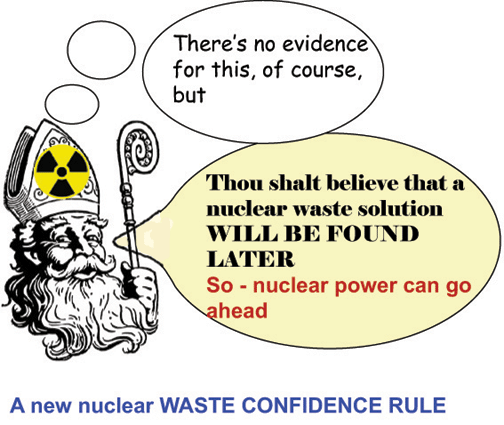 Ill-founded hope The belief was always that science would find some way of neutralising the dangerous radioactivity, and then it could be buried as simply as any other rubbish. This hope has proved to be ill-founded.
Still No Solution to Storage of High-Level Radioactive Nuclear Waste http://ecowatch.com/2015/01/25/no-solution-radioactive-nuclear-waste/ Paul Brown, Climate News Network | January 25, 2015 A private consortium formed to deal with Europe’s most difficult nuclear waste at a site in Britain’s beautiful Lake District has been sacked by the British government because not sufficient progress has been made in making it safe.
It is the latest setback for an industry that claims nuclear power is the low-carbon answer toclimate change, but has not yet found a safe resting place for radioactive rubbish it creates when nuclear fuel and machinery reaches the end of its life.
Dealing with the waste stored at this one site at Sellafield—the largest of a dozen nuclear sites in Britain—already costs the UK taxpayer £2 billion a year, and it is expected to be at least as much as this every year for half a century.
Hundreds of people are employed to prevent the radioactivity leaking or overheating to cause a nuclear disaster, and the cost of dealing with the waste at this site alone has already risen to £70 billion.
Dangerous to humans
This extraordinary legacy of dangerous radioactive waste is present in every country that has adopted nuclear power as a form of electricity production, as well as those with nuclear weapons. No country has yet solved the problem of how to deal with waste that remains dangerous to humans for thousands of years. Continue reading
Radioactive water cleanup at Fukushima months behind schedule
 Fukushima Watch: Tepco Two Months Behind on Cleaning Tainted Water http://blogs.wsj.com/japanrealtime/2015/01/26/fukushima-watch-tepco-two-months-behind-on-cleaning-tainted-water/ By MARI IWATA Tokyo Electric Power Co. says it will need an additional two months to process all the highly contaminated water in storage at the Fukushima Daiichi nuclear plant.
The power company previously said it would clean all the water by the end of March. A Tepco spokesman said Friday that the process had been slowed down by the need for workers to frequently clean the filters of the water processing system. He also said the system needed more initial adjustments than first expected when it came into use.
Tepco plans to give a more detailed outline of the water processing schedule in March, the spokesman said.
A large amount of groundwater keeps flowing underneath the reactors, creating about 300 to 400 tons a day of highly contaminated water. The water has been stored in about 1,000 tanks set up at the site.Tepco has been processing the water to remove most of the radioactive materials to reduce the contamination to a low level. The system is unable to remove tritium, a less harmful material.
The company now says it won’t finish processing the stored water until May. After that it will have sufficient capacity to deal with the daily inflows of groundwater.
Double standards, as USA persuades India to weaken nuclear liability law
Under pressure from GE and Westinghouse, the two American nuclear vendors hoping to sell billions of dollars worth of reactors to India, the Obama administration has demanded that Section 17(b) and Section 46 of the Indian liability law be deleted or amended.
Double standards? The irony is that American nuclear suppliers operate under a domestic liability regime that allows operators to sue them for recovery of damages in the event of an accident. That is how Metropolitan Edison, the operator of the Three Mile Island nuclear plant, sued Babcock Wilcox after the infamous 1979 accident.
 Why India should say no to US demand to dilute its nuclear liability law The Modi government should resist pressure from Barack Obama, who landed in New Delhi on Sunday morning, to change key provisions to favour foreign supplier of reactors. Siddharth Varadarajan Scroll.in 26 Jan 15
With the issue of nuclear liability emerging as an obstacle in the relationship between India and the US, the Modi government is under pressure to dilute the law in favour of foreign reactor suppliers. Without this, we are told, it will not be possible to operationalise the US-India nuclear agreement and provide the country with the electricity its people need.
In the event of a major nuclear accident in India, one which damages lives and property, what does the law say about how liability is to be apportioned? Continue reading
Clean Energy Finance Corporation boosts commercial Solar Energy with Power Purchase Agreements (PPAs)
 CEFC Provides $20 Million For Solar PPA Programs http://www.energymatters.com.au/renewable-news/cefc-solar-ppa-em4654/ January 22, 2015 Australia’s Clean Energy Finance Corporation (CEFC) has announced it will provide up to $20 million to accelerate the uptake of commercial solar power systems.
The senior debt finance will be provided to ET Solar Australia to go towards a Power Purchase Agreement (PPA) program. A solar PPA is a long term contract to purchase electricity generated by a solar power system installed at a company’s facilities.
There is huge scope to expand and deepen the solar PV market in the commercial sector,” said CEFC CEO Oliver Yates. “We see the PPA finance model as a way to remove the barrier of the upfront capital requirement which should enable many more Australian businesses to benefit from solar, reducing energy costs and lowering emissions.”
The CEFC backed program, already underway with a shopping center solar carport pilot project in Queensland, will see the installation of systems ranging between 30KW and 2MW. The program has an emphasis on major energy users; including shopping centers, mining and manufacturing businesses.
PPA’s provide long-term peace of mind on the price companies pay for the solar component of the power they use – and that electricity is significantly cheaper than the cost of mains grid supplied power. If grid electricity prices increase, overall savings will increase.
The PPA model overcomes the barrier of significant payback periods, enabling customers to achieve immediate savings on their energy bills.
The program isn’t the first time the CEFC has backed a solar leasing type initiative. Last year, the CEFC announced it will provide finance of up to $70 million for SunEdison programs offering long-term leasing and power purchase agreements for commercial and residential solar installations.
The CEFC says the PPA model has proven highly successful elsewhere and more than 75 per cent of new home solar power systems in California are installed under lease financing.
By the end of June last year, the Clean Energy Finance Corporation had contracted investments of over $900 million in projects with a total value of over $3 billion. Its 40 direct investments and 25 projects co-financed under aggregation programs are expected to achieve a positive net benefit Australian taxpayers.
India saving water with solar plants over canals
 INDIA BUILDS SOLAR PLANTS ATOP CANALS TO SAVE LAND, WATER. https://jpratt27.wordpress.com/2015/01/25/india-builds-solar-plants-atop-canals-to-save-land-water/As India moves to ramp up investment in solar power, it is exploring innovative places to install solar plants, including across the top of canals.
Last weekend, U.N. Secretary General Ban Ki-moon inaugurated a new “canal-top” solar energy plant in Vadodara district in India’s western state of Gujarat. “I saw more than glittering panels – I saw the future of India and the future of our world,” said Ban. “I saw India’s bright creativity, ingenuity and cutting-edge technology.”
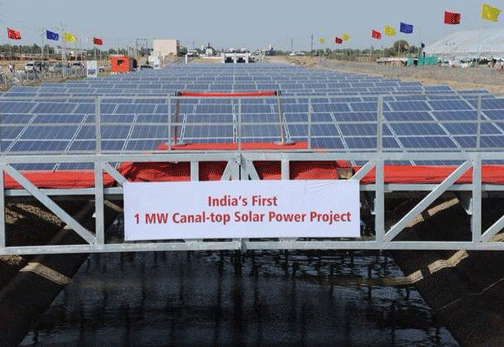
Experts identify two major advantages in building solar plants atop canals: efficient and cheap land use, and reduced water evaporation from the channels underneath. business-standard.com
Australia’s wonderful achievements in renewable energy, despite the Abbott government
The federal government’s decision to abolish the Renewable Energy Target (RET) is not only a planned demise of a potentially thriving industry but, to use the words of environmentalist David Suzuki, criminal negligence against future generations.
This is especially so in Australia’s rural communities, where renewable energy has always been a means of providing electricity when connecting to the grid is not viable. It is important now in times of prolonged drought that farmers can use some of their land to invest in solar and wind farms to subsidise their income.
Renewable energy rises to power https://www.greenleft.org.au/node/58094, January 24, 2015 By Lisa Hinde Despite the brutal cuts to leading renewable energy bodies by the Coalition government last year, incredible benchmarks in the field have been achieved.
Last month, a team operating out of the University of NSW recorded the highest level of efficiency for a photovoltaic solar panel, converting 40% of the light into electricity. The average efficiency of rooftop solar panels is about 15-18% so exciting possibilities exist with this huge leap in conversion. As the technology develops, the industry will experience an influx of more compact units capable of using even more of the sun’s energy with less space and equipment required.

September 30 marked the day that South Australia exceeded 100% of their required power using only wind and rooftop solar. This is bad news for fossil fuels in SA, which are effectively priced out of the market by renewables that are able to go as low as necessary to sell their power as it occurs.
The ACT showcased its entrepreneurial talent by securing the development of Australia’s largest solar farm by reverse auction. Switched on late last year, the solar farm generates 20 megawatts with the capacity to power 4500 homes, helping the ACT to achieve its target of 90% renewables by 2020.
On December 23 it was quietly announced that the second year of the carbon tax’s operation led to a 1.4% drop in total emissions (including a 4% drop in electricity). To somehow justify being the only country to abolish a carbon tax, Environment minister Greg Hunt campaigned relentlessly as to its ineffectiveness. Continue reading
India’s PM Modi announces support for climate action, and solar energy goal
“We very much support India’s ambitious goal for solar energy and stand ready to speed this advancement with additional financing,” Obama said during the news conference at Hyderabad House.
Modi Shifts on Climate Change With India Renewables Goal, Bloomberg By Reed Landberg and Natalie Obiko Pearson Jan 26, 2015 Prime Minister Narendra Modi said India is ready to expand its use of renewable energy as a way to reduce greenhouse gas pollution, a signal that his government is moving toward joining an international deal on global warming.
After a meeting with U.S. President Barack Obama in New Delhi, the prime minister said that his nation along with all others has an obligation to act on reducing the fossil-fuel emissions blamed for damaging the climate.
The remarks represent a shift in India’s tone on global warming………….
Environmental groups led by the World Resources Institute in Washington said Modi appeared to be moving toward a nationwide goal on renewables, expanding its current program of reaching 100 gigawatts of solar energy by 2022.
“This announcement builds on the recent progress on climate made between the U.S. and China,” Continue reading
1 This month
7 April – WEBINAR – Australia and the Doomsday Clock – Preventing nuclear war through NoFirstUse and other policies
Online | Tuesday April 7, 4:00-5:30pm, Australian Eastern Time / 8:00-9:30am Central Europe Time
– Access the registration link
15 April – Zoom –Nuclear Power is Not the Solution
Apr 15, 2026 01:00 AM in Canberra, Melbourne, Sydney

Join the International Physicians for the Prevention of Nuclear War (IPPNW) on Tuesday, April 14th for a timely webinar exploring the risks associated with nuclear power and challenging the myth that it offers a simple, safe, carbon-free solution to the climate crisis

21 April Webinar: No Nuclear Weapons in Australia
Start: 2026-04-21 18:00:00 UTC Canberra, Melbourne, Sydney (GMT+10:00)
End: 2026-04-21 19:30:00 UTC Canberra, Melbourne, Sydney (GMT+10:00)
Event Type: Virtual
A virtual link will be communicated before the event.
Host Contact Info: australia@icanw.org

of the week – Australians for War Powers Reform (AWPR)
To see nuclear-related stories in greater depth and intensity
 Antinuclear