Queensland election – Party Policy Platforms
Election 2015 – Policy Platforms PAINTING FAKES, 28 Jan 15 “……..Of all the minor parties,  the Greens are the ones who have taken policy issues most seriously. The Greens grew out of the conservation movement and are still often perceived as an environmental party. However, over the years they have evolved into a more rounded progressive party. Despite never having had a member elected to the Queensland parliament – and this is not likely to change on Saturday – they have a specific Queensland policy platform that runs to over one hundred pages. This is not developed specifically with this election in mind, but has been put together over a number of years to clarify what the Greens stand for.
It covers a wide range of issues under five headings – Natural Environment, covering biodiversity, water quality, food and agriculture, animal welfare and fishing; Social and Democracy, which includes policies about political accountability, criminal justice, ageing and disability, gambling and gender identity; Economics and Energy, which includes climate change, policies about various industries and policies on government finance; Built Environment with policies about transport and planning; and Human Services which includes education, health, social housing and reproductive rights. You probably won’t be surprised to learn that their policies are fairly consistently progressive or “left” – on environmental issues in favour of conservation, on economic issues in favour of better regulation and more equity and sustainability, on social issues in favour of better services and more public provision, and on “moral” issues in favour of gay marriage, abortion and euthanasia……..
 If you were to compare the two major parties solely on the basis of their election promises, you would probably end up feeling depressed at the quality of the alternatives. Most of the policies on both sides are very specific, playing to a particular region or interest group. There is a lot of “rollback” in the Labor policies, a lot of items funded by assets sales (sorry, “leases”) in the LNP’s.
Beyond the question of quality and vision, you have a choice between a moderate, centrist party interested in a notion of balance between economy, equity and environment, and a party that sees government as about economic development, delivering specific items of infrastrucute and a narrow range of mainstream services. Neither really has any kind of focus beyond the next three-year electoral cycle……..http://paintingfakes.blogspot.com.au/
Western Australia’s Conservation Council condemn’s govt’s approval to Kintyre uranium mine proposal
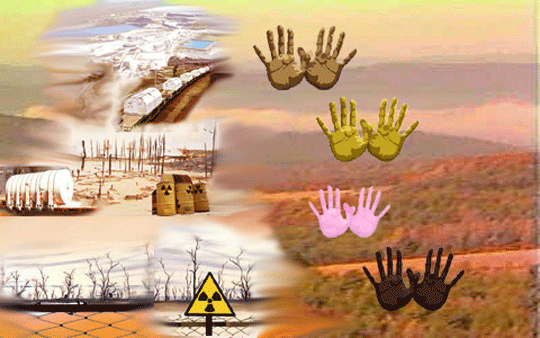 Minister approves uranium mine threat to National Park The states peak environment group, the Conservation Council of WA, has condemned the decision by Environment Minister Albert Jacob to approve the Kintyre uranium mine proposal in an excised area from WA’s biggest National Park, Karlamilyi.
Piers Verstegen, Director of the Conservation Council said “The Kintyre uranium proposal directly threatens the unique desert environment of the Karlamilyi National Park, the intricate water network of the Karlamilyi River water catchment and many endangered and threatened species.”
“This decision shows a weakening of standards for environmental protection and is a reminder that uranium and other environmentally significant and dangerous projects must retain Federal oversight under the EPBC Act, something both Governments are trying axe.”
Mia Pepper, Nuclear Free Campaigner of the Conservation Council of WA said “In an attempt to gain public support for uranium this Government is desperately trying to ‘normalise’ uranium. But uranium is not like any other mineral; it is radioactive and poses a significant and long term risk to the environment and public health. It is the asbestos of the 21st century and we cannot afford to treat it like any other mineral.”
“This decision is just one of many still needed before construction could begin at the proposed mine. This is a bad deal but not a done deal and we will continue to explore every avenue possible to challenge this uranium proposal.”
“Cameco the proponent of the Kintyre uranium mine has a shocking operating record overseas we will be watching their every move here and internationally, uniting with other communities that have been negatively impacted by this company.” Ms Pepper concluded.
Paladin’s Malawi uranium mine of little benefit to the country, and now threatening pollution of Lake Malawi
Government officials in Malawi are upset about the situation. “I am very shocked with the situation I have seen after monitoring the mine here and all my questions to the Paladin boss have not been answered satisfactory”
Meanwhile international experts are starting to question the benefits of the Kayelekera mine
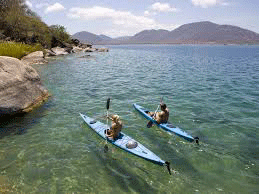 Australian Uranium Mining Company Accused of Contaminating Lake Malawi By Mayu Chang……Global Research, January 29, 2015 CorpWatch Paladin Energy, an Australian mining company, has been accused of discharging uranium-contaminated sludge into Lake Malawi, which supports 1.7 million people in three countries – Malawi, Mozambique and Tanzania. The company began uranium mining operations in Malawi in 2009 although it suspended operations last year after ore prices fell.
“It is rumored that Paladin secretly have started discharging the so called purified water. Reports from the Beach Village Chairman indicates that this started in late November,” wrote Rafiq Hajat of Malawi’s Institute for Policy Interaction on Facebook. “[At] a radius of 35 km from the Boma, you will be shocked to see fish of different species dead with some communities along the lakeshore collecting [the fish].”……………“Uranium is radioactive and that with open-pit mining, like the one to be conducted at Kayelekera, the soil drains into rivers and contaminates the water,” Titus Mvalo, a lawyer representing several civil society organizations in Malawi, told Inter Press Service in 2007. “When humans drink the water, it damages kidneys and causes cancer.”
At the time, the activist groups warned that the mine would pose a threat to Lake Malawi, Africa’s third largest freshwater lake, which is a major source of drinking water and fish for the country. Continue reading
Shameful hypocrisy of Campbell Newman on uranium mining for Queensland
Queensland Minister for Natural Resources Andrew Cripps has refused to rule out the export of uranium across the Great Barrier Reef.
The ALP and the Greens have clear policies supporting the reinstatement of the ban on uranium mining in Queensland, a position recently reaffirmed at the ALP State conference. The positions of the minor parties have been less clear, but we know the Katter Party and PUP have also voiced concerns about the resumption of uranium mining.
 Campbell Newman’s nuclear lies and Queensland’s radioactive future, https://independentaustralia.net/environment/environment-display/campbell-newmans-radioactive-queensland,7309 Independent Australia Dave Sweeney 29 January 2015 Queensland Premier Campbell Newman broke his 2012 election promise and overturned a longstanding ban on uranium mining in Queensland, and is now looking at exporting the radioactive material across the Great Barrier Reef.
THE LEGACY of uranium mining lasts longer than the promises of politicians. This lesson has particular resonance today as it wasn’t so long ago Premier Campbell Newman wrote to the Australian Conservation Foundation with a promise that only lasted a matter of weeks.
On 11 October 2012, Campbell Newman wrote(see letter below):
“I take this opportunity to reaffirm my statements, made before the last election, that the State Government has no plans to approve the development of uranium in Queensland.”
But on October 22, less than two weeks later, Cambell Newman moved quickly to overturn Queensland’s longstanding, popular and prudent ban on uranium mining.
So much for politicians’ promises. Unfortunately the legacy of uranium mining is much more consistent and long standing.
Fast forward to 2015 and the LNP’s uranium backflip remains, despite the fact no mandate has ever been sought or granted from Queensland voters on the issue.
In Townsville, uranium mining is a key issue for people who remember the debacle that occurred around the Ben Lomond (Harvey Range) uranium deposit back in 1975.
The mismanagement of the site drew such community ire that it is often recognised as sparking the growth of the Queensland anti-nuclear movement.
The entire project was a case study in poor management and neglect. Continue reading
The nuclear industry’s emphasis on climate change has merely promoted renewable energy
“The nuclear industry giving credence to climate change from fossil fuels has simply led to a stronger renewables industry. …….now renewables, often thought of as useful complements to nuclear, begin to threaten it in power markets when there is abundant power from renewables when the wind blows and the sun shines.”
U-turn to nowhere: Nuclear’s dire outlook U-turn to nowhere: Nuclear’s dire outlook Business Spectator, 27 January 2015Jim Green “……. a long-standing pattern of stagnation continues. Global nuclear capacity grew by 10.6% in the two decades from 1995-2014, and just 2.6% in the decade from 2005-2014.
The pattern of stagnation is likely to persist. Steve Kidd, a nuclear consultant who worked for the World Nuclear Association for 17 years, wrote in a May 2014 article:
“Upper scenarios showing rapid nuclear growth in many countries including plants starting up in new countries now look very unlikely……….”Despite 20 years of stagnation, the World Nuclear Association remains upbeat. Its latest report, The World Nuclear Supply Chain: Outlook 2030, envisages the start-up of 266 new reactors by 2030. The figure is implausible.
Nuclear Energy Insider was more sober and reflective in an end-of-year review published in December: “As we embark on a new year, there are distinct challenges and opportunities on the horizon for the nuclear power industry. Many industry experts believe that technology like Small Nuclear Reactors (SMR) represent a strong future for nuclear. Yet, rapidly growing renewable energy sources, a bountiful and inexpensive supply of natural gas and oil, and the aging population of existing nuclear power plants represent challenges that the industry must address moving forward.”
No real safeguards against India using Australian uranium for nuclear weapons
India will share the Indo-US formula on resolving the nuclear liability issue with France to resolve the issue of liability with the latter as well, sources said — this has come in the way of nuclear commerce with Areva, the French nuclear supplier.
 With Australia, the sources said, India will share the template of its administrative arrangements with Canada — and now the US — so that uranium from Australia can be supplied without further delay. India signed an uranium supply agreement with Australia last September, when Prime Minister Tony Abbott visited the country.
……….The US is said to be no longer insisting on tracking these supplies, required under its rules to ensure it is not being used for military purposes. -……http://indianexpress.com/article/india/india-others/india-looks-to-use-us-formula-to-convince-france-and-australia/
US-India nuclear deal, IF it ever comes off, will cost Indian tax-payers dearly
Financially, solar and wind energy are already becoming more attractive than nuclear. Electricity from these renewable sources cost Rs 8 and Rs 4.5 per unit respectively,according to a report by solar think-tank Bridge to India. Renewables are quicker to erect and are not as politically contentious as nuclear. In contrast, the Mithi Virdi project has run into serious opposition from local residents and farmers. If it is ever built, electricity from the Westinghouse reactors will cost Rs 12 per unit.

 The ‘breakthrough’ in Indo-US nuclear deal will bleed Indians every which way, Scroll In, The taxpayer will be made to pay to cover US companies’ untested technologies and the expensive electricity they generate. Nityanand Jayaraman, 29 Jan 15
Vague nuclear agreement between India and USA – more symbolic than real
no specific document was signed
India is already generating more power from wind turbines alone than from nuclear power and has announced a solar target of 100 gigawatt by 2022. So it is perfectly coherent that the joint US-India declaration contains one paragraph on nuclear cooperation and eight on clean energy.

 Breakthrough in US-India civil nuclear deal ‘more symbolism than reality’, DW 29 Jan 15 The US and India announced a “breakthrough” in resolving a liability spat that has stalled the implementation of a civil nuclear deal. But Mycle Schneider tells DW this is more about geopolitics than industrial reality.
“…….Mycle Schneider, an independent international consultant on energy and nuclear policy, says in a DW interview that there is no real market for foreign nuclear companies in India, unless they bring their own funding, adding that the recent announcement is more about presenting both countries as equal partners than it is about the vision of a future blooming Indian nuclear export industry.
DW: What exactly does the new nuclear deal entail?
Mycle Schneider: Very little has so far been published about it. First of all, it is unclear whether there is even a “new nuclear deal.” Usually, when heads of state meet, the occasion is used to sign agreements. However, on this issue, the US-India joint statement only says President Obama and Prime Minister Modi welcomed the “understandings reached” on the issues of civil nuclear liability and “administrative arrangements for civil nuclear cooperation.” Continue reading
Queensland Labor’s feeble effort on renewable energy
Queensland Labor talks bold, promises little on renewable energy TRISTAN EDIS Business Spectator, 27 JAN, The Queensland Labor Party released a policy statement on renewable energy last Friday full of platitudes with so much wriggle room that Treasury officials should have no difficulty hacking them apart if Labor ever manage to make it into government in the Queensland state election.
Of course Labor didn’t face much competition from Premier Campbell ‘We’re in the Coal Business’ Newman, who is yet to release any policy on reducing carbon emissions or promoting clean energy.
Framing the entire policy is a target of 50% renewable energy by 2030 – not to achieve it, but rather to study it. And in case you might have actually taken them seriously, they’ve also said that as part of achieving such a goal they’ll be establishing an auction to acquire 40 megawatts of renewable energy. Given the state already has 12,000 megawatts of scheduled power generating already installed, you can get a sense of just how serious they are about cracking that 50% target.
By the way, Queensland householders and businesses themselves managed to install 250MW of solar last year so you can imagine what a huge difference Labor’s auction will make. …….http://www.businessspectator.com.au/article/2015/1/27/renewable-energy/queensland-labor-talks-bold-promises-little-renewable-energy
Scientists warn on climate change – a hotter drier South Australia
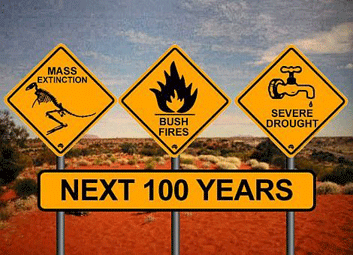 South Australia to get much hotter, drier, new climate change report reveals The Advertiser KATRINA STOKES JANUARY 27, 2015 SOUTH Australia is only going to get hotter and drier and more prevalent periods of drought and fire-related conditions will continue to increase, a report released today reveals.
The CSIRO and Bureau of Meteorology report says what climate change experts have been saying for a long time — climate change is real.
The experts predict Adelaide will experience an increase in the number of days above 35C from 20 in 1995 to 26 in 2030, to between 28 and 47 in 2090.
TO READ THE FULL REPORT CLICK HERE……..
ey predictions from the report include:
WINTER and spring rainfall in southern Australia is projected to decline, while changes in other areas are uncertain
THE time in drought will increase over southern Australia, with a greater frequency of severe droughts
BY 2090, Australian average temperatures are projected to increase by 0.6 to 1.7C for a low emissions scenario, or 2.8 to 5.1C under a high emission scenario
MORE hot days are like to occur as well as harsher fire weather, including an increase in the number of days with a “severe” fire danger rating
Climate Institute chief executive officer John Connor said the report findings demonstrated why it was in Australia’s best interest to “drive ambitious climate action”.
“This new data reinforces earlier analysis for Treasury (the government) that showed large chunks of the Australian economy will be whacked by global warming … sectors like agriculture, health and ecosystems are hit well beyond their ability to adapt,” he said……… http://www.adelaidenow.com.au/news/south-australia/south-australia-to-get-much-hotter-drier-new-climate-change-report-reveals/story-fni6uo1m-1227198291102?nk=12eb6391f5cbbe65f220fb12fca19ba4
Veterans of Christmas Island nuclear tests compensated by Fiji government
Fiji compensates nuke-test soldiers Rowan Callick Asia Pacific Editor Melbourne THE AUSTRALIAN JANUARY 30, 2015 FIJI will give $1.83 million today to the survivors among 70 soldiers exposed to radiation during British nuclear tests and to direct dependants of those who have died.
The servicemen sent to witness Operation Grapple on Christmas Island in 1958 were led by chief petty officer Ratu Inoke Bainimarama, the late father of prime minister and former military commander Frank Bainimarama, who will hand out cheques for $6300 to each of the 23 soldiers still alive. Dependants of the others will receive the same amount………..
The Fiji veterans are persisting with a legal case against the British government. http://www.theaustralian.com.au/news/world/fiji-compensates-nuke-test-soldiers/story-e6frg6so-1227201434006?nk=12eb6391f5cbbe65f220fb12fca19ba4
Problems of aging nuclear reactors make politicians and public wary of new ones!
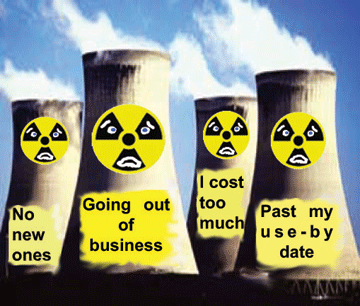 The nuclear industry has a simple solution to the problem of old reactors: new reactors. But the battles over ageing and decommissioned reactors − and the raiding of taxpayers’ pockets to cover shortfalls − will make it that much more difficult to convince politicians and the public to support new reactors.
U-turn to nowhere: Nuclear’s dire outlook U-turn to nowhere: Nuclear’s dire outlook Business Spectator, 27 January 2015Jim Green “……..The elephant in the room − ageing reactors The problem of ageing reactors came into focus in 2014 − and will remain in focus for decades to come with the average age of the world’s power reactors now 29 years and steadily increasing.
Problems with ageing reactors include:
– an increased risk of accidents (and associated problems such as generally inadequate accident liability arrangements);
– an increased rate of unplanned reactors outages (at one point last year, less than half of the UK’s nuclear capacity was available due to multiple outages);
– costly refurbishments;
– debates over appropriate safety standards for reactors designed decades ago; and
– the uncertainties and costs associated with reactor decommissioning and long-term nuclear waste management.
Greenpeace highlighted the problems associated with ageing reactors with the release of a detailed report last year, Continue reading
Melbourne’s Australia Day Parade disrupted by Aboriginal Rights Protest
Aboriginal rights protest disrupts Australia Day Parade in Melbourne, The Age January 27, 2015 Allison Worrall Hundreds of people marching for Aboriginal rights have disrupted official Australia Day celebrations in the Melbourne CBD.
The group – holding Aboriginal flags and chanting “always was, always will be Aboriginal land” – followed the parade down Swanston Street, flanked by police. Thousands of spectators watched the parade, which began with a flag raising ceremony at town hall attended by Victorian Governor Alex Chernov, Premier Daniel Andrews and Opposition Leader Matthew Guy.
The rally that followed was lead by two organisations: Warriors of Aboriginal Resistance and First Nations Liberation.
Organiser Meriki Onus, 27, said the group had earlier gathered at the steps of parliament house to lay flowers in commemoration of Aboriginal people who were killed during white settlement, the Stolen Generation and Aboriginal deaths in custody.
She said January 26 was a day of mourning for Aboriginal people.
“We don’t celebrate Australia Day, because Australia Day celebrates genocide,” Ms Onus said.
“Today is Invasion Day for Aboriginal people.”
As the vocal group marched from Parliament to town hall and on to Birrarung Marr, people chanted “No pride in genocide” and “Always was, always will be Aboriginal land.”
Placards carried in the procession included “End the NT intervention” and “Stop deaths in custody”……..http://www.theage.com.au/victoria/aboriginal-rights-protest-disrupts-australia-day-parade-in-melbourne-20150126-12ya7z.html
Repeal of carbon tax has not reduced electricity prices as much as Abbott promised
Carbon tax repeal saves less than promised, New Daily , Jan 29, 2015 KAITLIN THALS PM News Reporter The nation’s consumer watchdog reveals scraping the tax has not put less downward pressure on energy prices…..http://thenewdaily.com.au/news/2015/01/29/accc-carbon-tax-repeal-saves-less-promised/
1 This month
7 April – WEBINAR – Australia and the Doomsday Clock – Preventing nuclear war through NoFirstUse and other policies
Online | Tuesday April 7, 4:00-5:30pm, Australian Eastern Time / 8:00-9:30am Central Europe Time
– Access the registration link
15 April – Zoom –Nuclear Power is Not the Solution
Apr 15, 2026 01:00 AM in Canberra, Melbourne, Sydney

Join the International Physicians for the Prevention of Nuclear War (IPPNW) on Tuesday, April 14th for a timely webinar exploring the risks associated with nuclear power and challenging the myth that it offers a simple, safe, carbon-free solution to the climate crisis

21 April Webinar: No Nuclear Weapons in Australia
Start: 2026-04-21 18:00:00 UTC Canberra, Melbourne, Sydney (GMT+10:00)
End: 2026-04-21 19:30:00 UTC Canberra, Melbourne, Sydney (GMT+10:00)
Event Type: Virtual
A virtual link will be communicated before the event.
Host Contact Info: australia@icanw.org

of the week – Australians for War Powers Reform (AWPR)
To see nuclear-related stories in greater depth and intensity
 Antinuclear