Solar power systems in Australia save money for households, businesses, schools and community organisations
 Solar power systems can contribute significantly to reducing energy costs for a household, business, school or community organisation. And with consistent rising electricity prices, the benefits of solar will only continue to accumulate over the 25 year life of an installed system. “The benefits of solar can be multiplied when used in conjunction with other energy-saving measures
Instead of making it difficult, the Government should be making it easier for educational institutions, religious organisations and small businesses to cut their power bills,”
Why Supporting Renewable Energy in Australia Will Save Both Money and the Environment: Geelong Solar Power Company Reveals http://www.webwire.com/ViewPressRel.asp?aId=195168#.VMvuodKUcnk WEBWIRE – Tuesday, January 27, 2015
VICTORIA, Australia January 2015 – When Tony Abbot took his seat as Australian Prime Minister in September 2013, the Liberal Party took a conscious step away from prioritising climate change on the political agenda and backing the Renewable Energy Target scheme (RET scheme). Since then, it has become increasingly clear that the coalition is hesitant to support environmental progression in commercial industries, evidenced by the most recent proposal to cut the solar rebate to small and medium sized businesses, including schools and churches. Continue reading
Over 230 excellent business projects funded by Australian Renewable Energy Agency
 Australian Renewable Energy Agency Funding More Than 230 Projects http://cleantechnica.com/2015/01/30/australian-renewable-energy-agency-funding-230-projects/ January 30th, 2015 by Joshua S Hill
The Australian Renewable Energy Agency has invested $1 billion into more than 230 projects, fellowships, and scholarships throughout the country “that are paving the way for a more diverse energy future for Australia.”
In a press release on its website, the government agency publicized their efforts, despite the obvious roadblocks currently in place in Australian energy politics.
The news comes only a few days after the country’s Bureau of Meteorology and science agency, CSIRO, released a report which claimed Australia will be subject to massive current and future climate impacts.
According to the Australian Renewable Energy Agency (ARENA), it has invested $1 billion in a number of projects, of which 31 are already complete, and “with many more scheduled to reach key milestones and/or completion in 2015.”
“Each of these projects is producing valuable knowledge and outcomes that are being shared with the energy industry to help overcome challenges and advance renewable energy in Australia,” according to its site. Continue reading
Aboriginals, Maralinga nuclear bomb tests, and The Australian Nuclear Free Alliance.
“The elderly people had talked about the Nullarbor[12] dust storm, not knowing that they had seen the fall-out from Maralinga. I knew about Maralinga and started questioning the amount of cancer deaths…..More and more people were dying of leukemia and thyroid cancer
In terms of measuring radioactivity we are totally cut off from acquiring information because it is illegal to have a Geiger counter! We are particular concerned of the uranium mining industry, exploiting sands found near the former testing site. Plutonium testing took place at the Woomera rocket range site. The place is military territory and we do not know what actually is going on there.
 The Australian Nuclear Free Alliance. ANFA (http://anfa.org.au). “Our alliance is well connected and once a month the community leaders link up by phone and we talk about what to do next. During meetings, governmental people are absent. We have international visitors from France, Japan and so on. People from all over the world should know that we do exist, that we are humans (laughter).
THE CARETAKER AND THE PLAGUE: BRITISH NUCLEAR WEAPONS TESTING IN AUSTRALIA, Nuclear Age Peace Foundation, 30 Jan 15 by Ursula Gelis Ursula Gelis, Executive director of the ‘Global Women’s Association against Nuclear Testing’ works for the rights and needs of victims of nuclear weapons explosions and nuclear testing. Her partners are in Kazakhstan and other states, affected by the long-term effects of nuclear weapons testing. At the Vienna Conference on the Humanitarian Impact of Nuclear Weapons in December 2014[1], she interviewed an anti-nuclear activist and nuclear test victim from Australia.
The Plague column in Vienna convincingly depicts human suffering; in this case – the tragedy of the Black Death epidemic from 1679 in Austria which killed about 30 000 to 75 000 souls. A Black Death does not distinguish between a noble and a beggar, and a nuclear weapon explosion does not either.
In today’s Australia, Aboriginal communities are still suffering from European racism that came in the aftermath of Captain Cook (1770) who looked at the Aborigines as lucky people, even if they did not own many material goods! Continue reading
Indian Citizens’ Statement against Capitulation to the US on Nuclear Liability
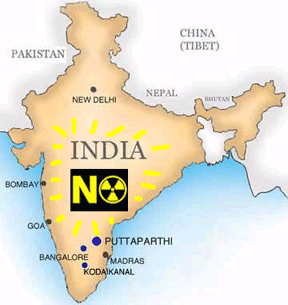 http://kashmirwatch.com/news.php/2015/01/30/indian-citizens-statement-against-capitulation-to-the-us-on-nuclear-liability.html Kumar Sundaram
We are deeply disturbed by media reports that the Indian government has capitulated to aggressive U.S. demands and agreed to a deal that indemnifies American nuclear vendors from the consequences of accidents caused by design defects in their reactors.
Preliminary reports suggest that the government has agreed to create an insurance pool, backed by public sector companies, so that any potential American liability can be redirected back to Indian taxpayers. This creates a “moral hazard”, where the Indian people could end up being responsible for mistakes made by a multinational corporation.
The 2010 Indian liability Act is already a weak law heavily biased towards the nuclear industry. It caps the total liability for an accident at a paltry Rs 1,500 crores and takes away the rights of victims to sue the supplier. The much-discussed supplier liability is very limited: the government alone, as the operator, has a right of recourse against the vendor.
So, we fail to understand the Modi government’s motivation for weakening this law even further. The U.S. has nothing attractive to offer in terms of nuclear commerce. The Indian government has agreed to purchase the AP1000 reactors from Westinghouse, and the Economic Simplified Boiling Water Reactor (ESBWR) from General Electric. Both these designs are untested. The ESBWR technology is so immature that the design received certification from the U.S. nuclear regulatory commission—the first step before a reactor can be constructed—only last September. Recent reports suggest that construction of AP1000 units has run into trouble in China.
Independent estimates suggest that the cost of electricity from these reactors may exceed Rs. 15 per unit. This is much higher than the tariff from competing sources of electricity.
Therefore, the reality behind the grandiose proclamations made by the Indian government is rather sobering. India has agreed to pay billions of dollars for immature American technology, and then ensured that American companies will not be held to account for any design defects.
We hope that progressive forces and concerned citizens throughout the country will unite to oppose this disturbing development.
Signatures: Continue reading
In 2015 Aboriginal rights movement is rising, with renewed strength
an Aboriginal Spring – has arisen where now there is the urgent call for more of the changes still  outstanding to be addressed for the descendants of the First Peoples.
The last remaining founder of the 1972 Aboriginal Tent Embassy, Michael Anderson, leader of the Euahlayi People, announced at the forecourt of Federal Parliament, “We will be back February 9 and we will stay.
From the western most region of the continent, an advocate of the Noongar people, Marianne Mackay journeyed six days to reach Canberra. “The Government wants to push our people  off our homelands to make it easier for the miners and big business. Our homelands will be dispossessed unless we stand up.”
In Australia, there is the Aboriginal rights struggle, The Stringer, by Gerry Georgatos January 30th, 2015 In Australia there is no greater rights struggle than the Aboriginal rights struggle. It is a human rights struggle where not only the First Peoples of this continent were violently and murderously dispossessed of their lands but since the advent of British colonialism onto their shores they were subjected to segregation, apartheid and the systematic destruction of their cultures and languages – more than 350 First Peoples’ nations and languages have been impacted.
On January 26, 1972, four young Aboriginal men pitched a beach umbrella on the front lawns of Australia’s Federal Parliament in Canberra, and then sat under the umbrella. They declared it Aboriginal Tent Embassy. This inspired a peaceful resistance movement, with at first hundreds and then thousands converging to Canberra to join them on the parliamentary lawns – setting up tents and camping. Their stances shone the lens of the media – domestic and international – onto the horrific social inequalities and disparities between the First Peoples of this continent and the rest of the population. Their stance contributed to the demise of the then incumbent Government. Some positive changes occurred but 43 years later for far too many of the descendants of the First Peoples little has changed while for many circumstances have worsened – to third world-akin conditions. Continue reading
The USA-India nuclear deal brings no benefits, and weakening Liability law brings danger.
The most baffling feature of the current agreement is that it holds no tangible benefits for India. The United States has offered to sell two reactor designs — both of which are expensive and untested.
Last week, the residents of Mithi Virdi wrote an open letter to Mr. Obama and Mr. Modi reminding them that the “gram panchayats of four most-affected villages … [have] passed a resolution declaring the entire … region as [a] nuclear free zone.” The leaders of the “world’s largest democracies” face a clear choice. They can channel billions of dollars into nuclear corporations by sacrificing safety and economic prudence. Or they can heed the democratic voices from Mithi Virdi and cancel these unnecessary deals.
 Nuclear deal no cause for celebration THE HINDU, SUVRAT RAJUM. V. RAMANA 31 Jan 15 Any understanding between Narendra Modi and Barack Obama on circumventing the Indian nuclear liability law to protect American reactor suppliers should be a matter of concern
At their recent meeting, Prime Minister Narendra Modi and President Barack Obama discussed methods of circumventing the Indian nuclear liability law to protect American reactor suppliers from the consequences of accidents caused by design defects. Although public details are scarce, if they have indeed reached an understanding on the issue, then this is not a cause for celebration; it should be a matter of deep concern.
The importance of supplier liability is illustrated by the Fukushima nuclear disaster in 2011. When the reactors were hit by the tsunami that year, the weakness of the General Electric (GE) Mark I design was cruelly exposed. The reactors’ inadequate containment was unable to prevent the spread of radioactivity when the cooling systems failed and pressure built up inside the reactors. Although this design defect was first noted about 40 years ago, just as the Fukushima reactors were commissioned, the industry resisted regulatory changes that could have ameliorated the disaster.
Framework of impunity
The Japan Center for Economic Research estimated that the cost of cleanup at Fukushima may reach $200 billion. A 2013 expert study “Accounting for long-term doses in worldwide health effects of the Fukushima Daiichi nuclear accident” published in the journal Energy and Environmental Science estimated that the disaster may lead to about a thousand excess deaths due to cancer. However, it is unlikely that GE will ever be held accountable for its poor design choice. Under Japanese law, the supplier is indemnified from liability for an accident. This is the framework of impunity under which nuclear suppliers like to operate.
Legal indemnity for suppliers creates a “moral hazard”— encouraging suppliers to take excessive risks since they don’t have to pay for the consequences. The case of GE not strengthening the Mark I containment is not an exception. Continue reading
Australian entrepreneurs ready for the solar energy revolution: let’s keep Renewable Energy Target
 There are over 2 million homes with solar PV or solar water heating installed on their homes, which equates to 24 per cent of all Australian homes. This growth, the shift in consumption patterns and changing paradigm of how our electricity industry delivers energy is a direct result of the Renewable Energy Target. It is making Australians more personally responsible for the way they consume electricity. The “age of entitlement” is over and the Renewable Energy Target is a positive driver.
India-USA nuclear deal looks like an economic disaster for India
I’m afraid the sums simply don’t add up for nuclear power, purely from an economic point of view. The fully loaded cost (including decommissioning and waste management) of a unit of power would be probably 100 times that of a unit of conventional power today.
On the other hand, it appears as though the time has come for solar power. Plummeting costs of photovoltaic panels, improvements in storage and transmission, and other technological factors now mean that solar lifecycle cost is approaching conventional costs in the West. Given India’s inherent availability of sunlight, I am of the opinion that we would be better off spending the billions needed for nuclear power on a crash program of research into solar power, and maybe even on subsidizing it heavily to kick-start it.

 Indo-US nuclear deal: Why is Modi pursuing what looks like a total loss in N-energy? First Post by Rajeev Srinivasan Jan 26, 2015 On 25 January, the airwaves were filled with self-congratulatory and self-satisfied messages about how “we” had “won” the “nuke deal”. Nobody was clear about what exactly we had won, and how, and why the Americans (superb negotiators) had apparently caved in to Indian demands. As I write this on Republic Day, there is still no concrete data. …….
Keen investor interest in India’s renewable energy sector
Investor commitments received for 1.3 lakh MW renewable energy: Piyush GoyalBy PTI | 30 Jan, 2015,MUMBAI: Even before the first-ever meet for attracting investment in renewable energy sector starts, the country has received commitments to create 1.30 lakh MW generation capacity, Power Minister Piyush Goyal said today.
“We have received commitment for investments for nearly 1.3 lakh MW of renewable energy from both the domestic and international players,” Goyal today said, speaking here on sidelines of an event organised by VASVIK. ……. http://economictimes.indiatimes.com/articleshow/46069893.cms?utm_source=contentofinterest&utm_medium=text&utm_campaign=cppst
Climate change already impacting Australia’s sports
 Grassroots sports at risk from heatwaves due to climate change, report warns, Guardian, Oliver Milman 31 Jan 15 Extreme heat policies of sports such as tennis, Aussie rules and cricket will have to find ways to better protect the wellbeing of competitors as temperatures rise Climate change will threaten the viability of grassroots sport in Australia, and elite tournaments will have to adapt to rising temperatures, extreme rainfall and shrinking snow cover, a report has warned.
The extreme heat policies of sports such as tennis, Aussie rules and cricket will have to “dramatically improve” to protect the health of competitors at all levels, the Climate Institute analysis concluded.
The report, featuring a foreword from former AFL chief executive Andrew Demetriou, warned that while elite sport might be able to adapt to a changing climate, the “ability to respond at local sporting grounds is more questionable”.
The Climate Institute compiled the report in the wake of the blistering heat that affected the Australian Open tennis tournament last year. Players and court staff fainted, water bottles melted and a participant even warned someone might die after temperatures hit 43C.
The Open has since introduced new protocols that require the match referee to consider suspending play if the ambient temperature reaches 40C.
But the Climate Institute warned that the heat policies of other sports were patchy, with a recent AFL match taking place in 38C heat and last year’s Tour Down Under having no heat stipulations, even though cycling races in certain states are normally halted in extremely high temperatures.
“Heat policies are a bit confused and ambiguous between state and national levels,” said John Connor, chief executive of the Climate Institute. ……………
elongated droughts in parts of Australia, coupled with extreme rainfall, will degrade community sporting grounds and even affect large stadiums, such as the Suncorp stadium in Brisbane, which was covered in 1.5m of water during the 2011 Queensland floods.
Some of the most dramatic changes could hit those who enjoy winter sports, with the CSIRO report warning of “very substantial decreases in snowfall, increase in melt and thus reduced snow cover”…….http://www.theguardian.com/environment/2015/jan/30/grassroots-sports-at-risk-from-heatwaves-due-to-climate-change-report-warns
1 This month
7 April – WEBINAR – Australia and the Doomsday Clock – Preventing nuclear war through NoFirstUse and other policies
Online | Tuesday April 7, 4:00-5:30pm, Australian Eastern Time / 8:00-9:30am Central Europe Time
– Access the registration link
15 April – Zoom –Nuclear Power is Not the Solution
Apr 15, 2026 01:00 AM in Canberra, Melbourne, Sydney

Join the International Physicians for the Prevention of Nuclear War (IPPNW) on Tuesday, April 14th for a timely webinar exploring the risks associated with nuclear power and challenging the myth that it offers a simple, safe, carbon-free solution to the climate crisis

21 April Webinar: No Nuclear Weapons in Australia
Start: 2026-04-21 18:00:00 UTC Canberra, Melbourne, Sydney (GMT+10:00)
End: 2026-04-21 19:30:00 UTC Canberra, Melbourne, Sydney (GMT+10:00)
Event Type: Virtual
A virtual link will be communicated before the event.
Host Contact Info: australia@icanw.org

of the week – Australians for War Powers Reform (AWPR)
To see nuclear-related stories in greater depth and intensity
 Antinuclear