Energy Resources of Australia, uranium miner, suffers another annual loss
 Uranium miner’s loss widens, Yahoo News 7 Feb 15 The operator of the Ranger uranium mine in Kakadu National Park has suffered another annual loss and expects the uranium market to remain challenging.
The Rio Tinto-owned Energy Resources of Australia made a $188 million loss in 2014, after suffering a loss of $136 million in 2013.
The company expects to increase its uranium production in 2015, after output was dented in 2014 because of the suspension of processing operations for more than six months after the failure of a leach tank in December 2013.
The company’s purchase of uranium oxide to fulfil sales dragged on its earnings……..https://au.finance.yahoo.com/news/uranium-miners-loss-widens-100814187.html
Australia should insist on weapons proliferation safeguards in any nuclear deal with India
Parliamentarians should consider that what Australia requires in its arrangement with India may have signal impact this May when the NPT’s 189 parties review the treaty. They might also consider that the international reputation of Australia’s uranium industry has increasingly depended upon transparent implementation of national policies, including on nonproliferation
Tracking India’s Imported Uranium Uranium suppliers should insist that India adhere to international standards for information sharing. The Diplomat By Mark Hibbs February  06, 2015 India is busily negotiating bilateral agreements with its nuclear trading partners to assure them that the uranium they supply to India will not end up in Indian nuclear weapons. This is a standard practice for states involved in nuclear cooperation, yet India has set out to weaken the information sharing provisions in its agreements with Canada, the United States, and soon Australia. Continue reading
South Australia held to ransom with privatised electricity distribution
Dennis Matthews , 7 February, 2015 South Australia’s electricity consumers have been held to ransom ever since the Olsen Government privatised the monopoly electricity distribution arm of ETSA and Rob Lucas gave the new owners a guaranteed return on investment. Chief beneficiary of this folly is a billionaire Chinese businessman (The Advertiser, 2/2/15) who must be wishing the whole of Australia was as naive.
It’s time to do a Playford and nationalise monopoly essential services that are holding SA to ransom. Sure, the SA Government might try to do the same as a private owner but there is a big difference. The SA Government is answerable to the consumer every four years and, as shown by the defeat of the Olsen Government and two successive Queensland governments, the public will not stand for such ideologically-driven nonsense.
The sooner we buy back the monopoly electricity distribution system the sooner confidence will return to both public and private consumers.
Tony Abbott completely out of touch: China about to launch a national carbon market
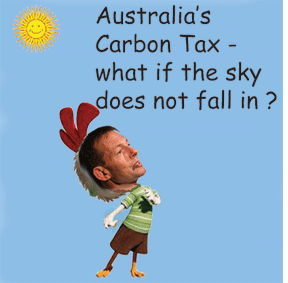 Tony Abbott denies China’s carbon trading plan shows he is out of step, Guardian, ‘More and more countries are going down the direct action path,’ prime minister says of grants aimed at lowering emissions. Oliver Milman @olliemilman 6 February
Tony Abbott has denied that China’s plan to launch a national carbon trading market shows he is out of step internationally on climate change, claiming his Direct Action policy is getting “more and more support” in Australia and abroad.
On Wednesday a Chinese government official said a national carbon market was likely to be launched by the middle of next year, along with an emissions cap for six sectors: power generation, metallurgical, nonferrous metal, building materials, chemicals and aviation………Abbott dismissed the suggestion that China’s actions showed the Coalition decision to dump Australia’s carbon pricing scheme in favour of his Direct Action plan ran against the tide of international efforts to reduce emissions…….
China, by comparison, has launched seven regional carbon markets since 2013, with Qingdao, a city of 9 million people, planning to join the scheme. It’ i estimated the pilot carbon markets cover around a third of China’s overall emissions, although the lack of a unified national system has led to variations in each of the markets.
The plan to introduce a national scheme will unify these regional markets, subject to approval by Chinese state authorities. The national market would eclipse the EU’s emissions trading scheme, which is now the world’s largest.
In September China put its name to a list of 73 countries that signalled support for putting a price on carbon. This list includes Germany, France, Britain, South Africa and New Zealand. It also includes US states such as California and Massachusetts, as well as more than 1,000 businesses.
Australia, which was the first country in the world to repeal a carbon price, is now working out its position on emissions cuts beyond 2020. Crunch UN climate talks in Paris this year will set out a new global deal on lowering emissions, with the aim of avoiding more than 2C of warming compared with pre-industrial times.
Analysis conducted by the CSIRO and Bureau of Meteorology states that Australia could warm by up to 5.1C by 2100 unless action is taken to curb emissions. This level of warming would have major ramifications for agriculture, human health owing to increased heatwaves, and coastal infrastructure owing to rising sea levels and extreme weather events.http://www.theguardian.com/environment/2015/feb/06/tony-abbott-denies-chinas-carbon-trading-plan-shows-he-is-out-of-step
Australian Labor Party keen to fight Malcolm Turnbull, but not to save Renewable Energy Target?
Would Malcolm Turnbull save the renewable energy target? REneweconomy, By Giles  Parkinson on 6 February 2015 “…………What is interesting to note is the response of Labor, who seem petrified by the prospect of Turnbull returning, and stomping over their middle ground. When in power, Labor lost sight of its policy development, and stopped selling its climate package, just so it could try to wedge Turnbull, the then Opposition leader. That worked out badly, for everyone except Tony Abbott and the climate deniers who put him in power.
Now, Labor has tried to wedge Turnbull again, even before he puts up his hand for Liberal Party leadership. This week, environment spokesman Mark Butler issued a press release labeling Turnbull a “fraud” on climate change, including a “best of” list of quotes highlighting Turnbull’s vocal gymnastics as he tried to marry his obvious disdain for Direct Action with his need to follow the party line.
“He might wear a nicer suit, but Malcolm Turnbull is as backwards as Tony Abbott when it comes to action on climate change,” Butler noted.
“This is despite Malcolm Turnbull declaring: ‘I will not lead a party that is not as committed to effective action on climate change as I am’.”
Yes, but getting agreement on the RET – and starting to tap into the $20 billion of investment that is in danger of disappearing overseas would be a good place to start. Labor had the opportunity to lock this issue away in 2012, but refused to take up the CCA’s recommendation that the next review be put off to 2016. http://reneweconomy.com.au/2015/malcolm-turnbull-save-renewable-energy-target-85370
Why the nuclear industry wages war on renewable energy, but not on gas
“One thing to understand about the nuclear industry is that nuclear is also the coal and natural gas industry”
These days natural gas-fired power is cheap, but wind is even cheaper.
 Even if renewables make up only a small amount of generation, they represent a shift to a more decentralized energy system, less reliant on big baseload coal or nuclear power plants
Why the nuclear industry targets renewables instead of gas,Midwest Energy news, on 02/06/2015 by Kari Lydersen Cheap natural gas has upended the nation’s energy landscape and made aging nuclear power plants increasingly uncompetitive.
Yet the nuclear industry, which generates almost a fifth of the nation’s energy, has declared war not on gas but on wind and solar, which represent about 4 and 0.2 percent of our energy mix, respectively. Continue reading
Renewable energy continues to thrive in Germany
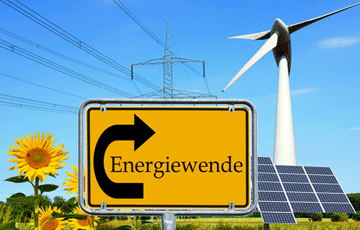 Germany had once offered aggressive incentives meant to support the adoption of solar energy, but the country’s feed-in tariffs had proven so successful that they were considered financially unstable for the government. Though these incentives have been reduced, solar energy continues to thrive throughout Germany.
Renewable energy continues to gain momentum in Germany,http://www.hydrogenfuelnews.com/renewable-energy-continues-gain-momentum-germany/8521078/ Stephen Vagus , Hydrogen Fuel News, 05 February 2015.
German Energiewende appears to be on track as the country continues to support clean power
Germany’s transition toward renewable energy, also called its Energiewende, has received some criticism over the past few years. The country is distancing itself from fossil-fuels and nuclear power, hoping to derive the majority of its electrical power from renewable sources in the coming years. A new report from Agora Energiewende, shows that the country’s transition may be right on track, despite concerns that the transition is too costly for the country.
Report predicts that Germany will receive 80% of its energy from renewable sources by 2050
New South Wales Greens propose using mining tax to fund renewables

 NSW Greens would use mining tax to fund renewable energy http://www.northernstar.com.au/news/mining-tax-would-fund-renewable-energy/2535116/
The Greens’ latest policy involves taxing mining companies an extra $250 million a year and investing the money into renewable energy and recycling.
The “Renew Regional NSW Fund” would supply $1 billion over four years for energy and water saving projects, waste management, small-scale renewable energy, and agriculture research.
Mr Buckingham alongside local Greens candidates Adam Guise and Tamara Smith were called on to explain why the coal industry would be needed to bankroll the fund. “We don’t want to base our economy on fossil fuels but what we want to do is make sure that as we make a transition out of coal, that the state benefits,” Mr Buckingham explained.
“The state is getting very, very little; the vast majority of profits go overseas, and we want to see those returned to the whole state, not just the mining regions.”
The mining industry contributes about $1 billion a year to the NSW economy, more than 90% from coal.
The Greens would raise this to about $1.25 billion by lifting royalties on the coal industry by 2%, and 1% on all other minerals.
Mr Buckingham said it was about creating an “alternative economic model” so the state’s economy wouldn’t be shocked when coal inevitably ends, also adding the royalty plunder might hasten its decline.
Residential solar PV is on a good wicket, but in Australia large scale renewables need the RET
How power companies, not the carbon tax, kept your electricity prices high
The tax arrangements keeping electricity prices high. This story starts with a tax and the fact that power companies have been allowed to invoice you for it, even though they do not necessarily pay it. It is a story, largely untold, about why power prices are still high despite the axing of the carbon tax – certainly much higher than they were five years ago.
1 This month
Chernobyl: The Lost Tapes – A good documentary on Chernobyl on SBS available On Demand for the next 3 weeks– https://www.sbs.com.au/ondemand/tv-program/chernobyl-the-lost-tapes/2352741955560
15 April – Zoom –Nuclear Power is Not the Solution
Apr 15, 2026 01:00 AM in Canberra, Melbourne, Sydney

Join the International Physicians for the Prevention of Nuclear War (IPPNW) on Tuesday, April 14th for a timely webinar exploring the risks associated with nuclear power and challenging the myth that it offers a simple, safe, carbon-free solution to the climate crisis

21 April Webinar: No Nuclear Weapons in Australia
Start: 2026-04-21 18:00:00 UTC Canberra, Melbourne, Sydney (GMT+10:00)
End: 2026-04-21 19:30:00 UTC Canberra, Melbourne, Sydney (GMT+10:00)
Event Type: Virtual
A virtual link will be communicated before the event.
Host Contact Info: australia@icanw.org

of the week – Australians for War Powers Reform (AWPR)
To see nuclear-related stories in greater depth and intensity
 Antinuclear