Last ditch: my submission to Royal Commission into nuclear energy.
To the Attorney-General Department,
I request that you consider the following Terms of Reference to be included for the Royal Commission into nuclear energy. The Royal Commission will be undermined if it doesn’t include the following Terms of Reference.
· The environmental impacts of uranium mining in South Australia. This would include especially the effects on South Australia’s water. South Australia is a water scarse State, and nuclear facilities requre huge amounts of water – both for uranium mining, and nuclear power. Cooling water from nuclear power plants result in heat pollution of water sources – rivers, or sea areas nearby. Radioactive waste contaminates groundwater, and would threaten Australia’s precious Great Artesian Basin.
.Foodstuffs from Australia are known to be clean and radiation free. This status would be threatened by nuclear operations, and lose Australia’s reputation for clean food exports. Nuclear environmental damage also threatens our tourism industry.
· Nuclear waste; the Royal Commission must look widely at nuclear waste management in South Australia, including uranium tailings. The Commission should examine proposals to host international nuclear waste and status of the waste industry globally.
. Safety. Though nuclear accidents are rare, their consequences are catastrophic. Terrorism is a risk – nuclear facilities and transport of radioactive materials are becoming an attractive target for terrorist attacks.
. Climate change. Climate change is bringing sea level rise which in turn would threaten nuclear facilities near the coast, such as at Port Adelaide. Risks of storm surges and even tsunamis cannot be discounted. Climate change will increase droughts, adding to the water shortage problems that already beset the nuclear industry. Climate change brings extreme weather, with greater risk to transport. The recent Malaysian airliner disappearance in the Indian ocean was almost certainly due to an unprecedented extreme weather event. As we must expect more of these extreme events, this brings into question the danger of transporting radioactive wastes over long distances. Australia is contracted to take back a relatively small amount of radioactive waste that originated from Lucas Heights. That is hazard enough, without contemplating an international waste repository as an import business.
· Legacy sites; South Australia’s contaminated nuclear sites including Maralinga, the Port Pirie Uranium Treatment Complex, and Radium Hill. There are unresolved concerns over the status of these sites (in relation to public health and environmental impacts) and the Royal Commission provides an opportunity to finally resolve these issues.
· Insurance, financial risk, public liabilities and subsidies; a comprehensive examination of the potential liability of the SA Government in the case of an incident or accident.
· Exploration of alternative energy sources to address the challenge of climate change, including the potential for growth in renewables and other low carbon technologies
Yours sincerely,
Noel Wauchope
Dr Jim Green – The SA Royal Commission and uranium enrichment
 Nuclear non-starter: Oversupplied, losing money and without a constituency, Climate Spectator, JIM GREEN 16 Feb 15 “… South Australian Premier Jay Weatherill announced a Royal Commission on February 8 to investigate options to expand the state’s involvement in the nuclear fuel cycle beyond uranium mining. There is some hope that a value-adding enrichment industry could compensate for the weakened uranium mining industry.
But the 2006 Switkowski report found that there was no realistic prospect of an enrichment industry in Australia, due to overcapacity at enrichment plants around the world. The SA Royal Commission will reach the same conclusion. Former World Nuclear Association executive Steve Kidd noted in Nuclear Engineering International in July 2014 that “the world enrichment market is heavily over-supplied”.
There are other reasons to be concerned about uranium enrichment … though it hardly matters given that it is an economic non-starter. Australia’s involvement in enrichment R&D began in 1965 with the ‘Whistle Project‘ in the basement of Building 21 at Lucas Heights, then run by the Australian Atomic Energy Commission. Those in the know were supposed to whistle as they walked past Building 21 and say nothing about the enrichment R&D. Why the secrecy? Because enrichment provides a direct path to nuclear weapons.
Forty years later, John Howard was likening uranium enrichment to value-adding to the wool industry. Perhaps Lucas Heights also had a secret program to knit woollen garments? Or perhaps not.
The enrichment R&D was publicly revealed in the Atomic Energy Commission’s 1967-68 Annual Report and plodded along until it was terminated in the mid-1980s. Nuclear power was growing steadily from the mid-1960s to the mid-1980s, yet Australia didn’t come close to establishing an enrichment industry. It’s hardly likely to happen when nuclear power capacity is stagnant, when the enrichment market is heavily over-supplied, when there is growing international momentum to curb the spread of sensitive nuclear technologies (enrichment and reprocessing), and when the atomic bomb lobby is far smaller and weaker than it was in the mid-1960s.
Clutching at straws, enrichment lobbyists argue that an Australian enrichment industry could supply nuclear power reactors in Southeast Asia. That argument would carry more weight if there were any power reactors in Southeast Asia.
Dr Jim Green is the national nuclear campaigner with Friends of the Earth, Australia. http://www.businessspectator.com.au/article/2015/2/16/energy-markets/nuclear-non-starter-oversupplied-losing-money-and-without
How come Tony Abbott is regarded as silly on everything else, but not on nuclear power?
Now why didn’t the mainstream media greet this one with a gale of laughter
South Australia’s nuclear inquiry is ‘a gale of commonsense’, Tony Abbott says Prime 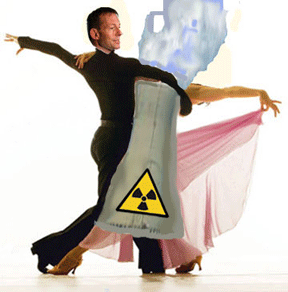
minister backs debate on use of nuclear energy in Australia and says: ‘If it’s right to mine it, why can’t it be right to use it?’ – http://www.theguardian.com/australia-news/2015/feb/15/south-australias-nuclear-inquiry-is-a-gale-of-commonsense-tony-abbott-says 15 Feb15
Autralian nuclear experts (nuclear advocates!) worried about uranium to India sales deal
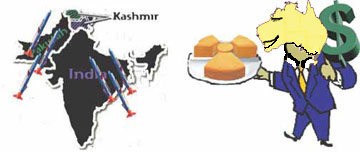 Risk Of Australian Uranium In Indian Nuclear Weapons Spark Worries, International Business Times, By Reissa Su on February 16 2015
 Australian uranium might end up in the hands of India as part of the country’s nuclear weapons program. Two experts on nuclear power believe the concessions agreed between the two nations could lead to this scenario.
Ronald Walker, a former Australian ambassador and chairman of the international Atomic Energy Agency, said the Abbott government’s deal to sell the country’s uranium to India has “drastically changed” Australia’s longstanding policy on safeguards. He added that the agreement has risked countries playing with nuclear weapons, reports The Guardian.
Risk of nuclear weapons building
Walker told a hearing of the parliamentary joint standing committee on treaties that deal with India is different from Australia’s 23 other uranium export deals. He believes the uranium agreement between Australia and India will only cause damage to the non-proliferation regime………. John Carlson, the head of the Australian Safeguards and Non-Proliferation Office between 1989 and 2010, shares the same view with Walker. He said it would be inexcusable for Australia to push through with the agreement. According to the provisions of the deal, Australian material can be used to make unsafeguarded plutonium that may potentially end up in India’s nuclear weapon program……..http://au.ibtimes.com/risk-australian-uranium-indian-nuclear-weapons-spark-worries-1421523
Continued mutation effects from radiation in Chernobyl area
 Strong effects of ionizing radiation from Chernobyl on mutation rates, Scientific Reports, Anders Pape Møller& Timothy A. Mousseau Scientific Reports 5, Article number: 8363doi:10.1038/srep08363 Received 25 September 2014 Accepted 16 December 2014 Published 10 February 2015
In this paper we use a meta-analysis to examine the relationship between radiation and mutation rates in Chernobyl across 45 published studies, covering 30 species. Overall effect size of radiation on mutation rates estimated as Pearson’s product-moment correlation coefficient was very large (E = 0.67; 95% confidence intervals (CI) 0.59 to 0.73), accounting for 44.3% of the total variance in an unstructured random-effects model. Fail-safe calculations reflecting the number of unpublished null results needed to eliminate this average effect size showed the extreme robustness of this finding (Rosenberg’s method: 4135 at p = 0.05). Indirect tests did not provide any evidence of publication bias.
The effect of radiation on mutations varied among taxa, with plants showing a larger effect than animals. Humans were shown to have intermediate sensitivity of mutations to radiation compared to other species. Effect size did not decrease over time, providing no evidence for an improvement in environmental conditions.
The surprisingly high mean effect size suggests a strong impact of radioactive contamination on individual fitness in current and future generations, with potentially significant population-level consequences, even beyond the area contaminated with radioactive material………http://www.nature.com/srep/2015/150210/srep08363/full/srep08363.html
Threat of nuclear war is now higher than during the Cold War – no “red telephone”
 Nuclear Specter Returns: “Threat of War Is Higher Than In The Cold War”, Prison Planet, Markus Becker Der Spiegel February 14, 2015 The Ukraine crisis has dramatically worsened relations between NATO and Russia. With cooperation on nuclear security now suspended and the lack of a “red telephone,” experts at the Munich Security Conference warn any escalation in tensions could grow deadly. Continue reading
Australia’s uranium industry in a sick and sorry state
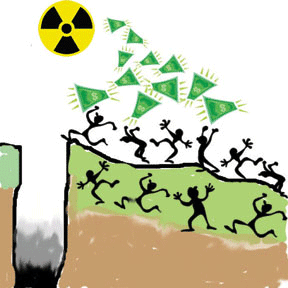 Australia’s uranium industry is in a sick and sorry state. Production of 5000 tonnes in 2014 was the lowest for 16 years. The industry generates less than 0.2 per cent of national export revenue and accounts for less than 0.02 per cent of jobs in Australia (about 1200 jobs).
The Ranger open-cut mine in the NT has been mined out and the planned Ranger 3 Deeps underground mine is subject to doubt and delay. Energy Resources of Australia has posted losses for each of the past five years, totalling $500 million. The uranium industry in the NT may come to an end when the last of the Ranger ore stockpile is milled in two years time.
In South Australia, the planned expansion of the Olympic Dam copper-uranium mine was cancelled in 2012, and hundreds of workers have been retrenched by BHP Billiton since then. The Honeymoon mine has been put into care-and-maintenance. Beverley Four Mile started production last year, at the same time as the nearby Beverley mine was put into care-and-maintenance. Instead of the usual fanfare, The Advertiser reported: “South Australia’s newest mine will lose money and won’t create any jobs.”
Nuclear non-starter: Oversupplied, losing money and without a constituency, Climate Spectator, JIM GREEN 16 Feb 15 As discussed in Climate Spectator recently, some nuclear insiders and lobbyists are starting to confront the reality that the global pattern of nuclear power stagnation is likely to continue. With the number of ‘operable’ power reactors declining from 443 to 437 over the past decade, the rhetoric about a nuclear renaissance is becoming hard to sustain.
Similar opinions about the uranium industry are becoming increasingly common. Continue reading
Australia’s peak medical research agency put under pressure about wind farms
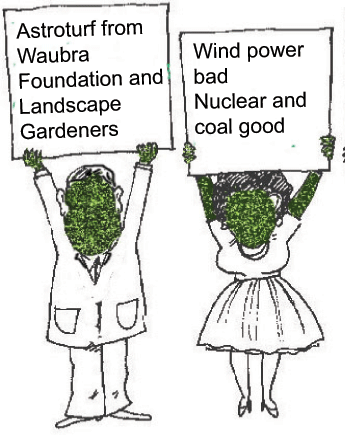 NSW, Victorian health officials objected to federal wind farm study conclusion, February 14, 2015 Peter Hannam Environment Editor, The Sydney Morning Herald Australia’s peak medical research agency recommended additional research into the effects of wind farms on health based on the “macro policy environment” rather than the scientific report they commissioned, ignoring objections from senior officials in the NSW and Victorian governments.
The NHMRC ought to be able to provide advice to government without fear or prejudice, but I’m not sure that it can
Peter Doherty, Nobe Prize winning researcher
According to emails seen by Fairfax Media, public health officers in the two states wanted the final statement accompanying the release of the National Health and Medical Research Council’s latest report on wind farms “to make it clear that the total available evidence (parallel and direct) suggest[s] little health risk.”……….
It is understood that the reference group of scientists that conducted the review did not get to review the statement.
The emails raise more doubts over the conclusions of the study ordered by the Abbott government, with the underlying report citing 1500 metres and three kilometres as possible distances of concern. So-called wind farm syndrome has been reported by some residents near turbines, with sleep deprivation, headaches and other effects reported.
“The NHMRC ought to be able to provide advice to government without fear or prejudice, but I’m not sure that it can,” Peter Doherty, a Nobel Prize-winning researcher, said…….
Greens senator Richard Di Natale said he was shocked at what appeared to be political interference.
“It’s scandalous and I’ll be following it up in the next Senate estimates. There’s a real concern here that we’re politicising what should be an independent science review.”
Higher priorities for the estimated $500,000 in funds to be allocated for the wind farm research include cancer, diabetes and many other subjects, Senator Di Natale said…….
Bruce Armstrong, chair of the study, said concerns over wind farm noise had “not come up through the normal scientific process.” http://www.smh.com.au/environment/nsw-victorian-health-officials-objected-to-federal-wind-farm-study-conclusion-20150213-13e8go.html
1 This month
15 April – Zoom –Nuclear Power is Not the Solution
Apr 15, 2026 01:00 AM in Canberra, Melbourne, Sydney

Join the International Physicians for the Prevention of Nuclear War (IPPNW) on Tuesday, April 14th for a timely webinar exploring the risks associated with nuclear power and challenging the myth that it offers a simple, safe, carbon-free solution to the climate crisis

21 April Webinar: No Nuclear Weapons in Australia
Start: 2026-04-21 18:00:00 UTC Canberra, Melbourne, Sydney (GMT+10:00)
End: 2026-04-21 19:30:00 UTC Canberra, Melbourne, Sydney (GMT+10:00)
Event Type: Virtual
A virtual link will be communicated before the event.
Host Contact Info: australia@icanw.org

of the week – Australians for War Powers Reform (AWPR)
To see nuclear-related stories in greater depth and intensity
 Antinuclear