Australia’s uranium industry in a sick and sorry state
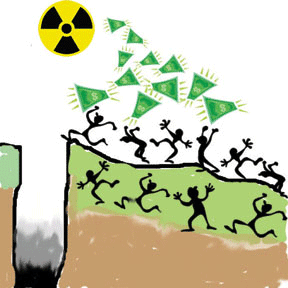 Australia’s uranium industry is in a sick and sorry state. Production of 5000 tonnes in 2014 was the lowest for 16 years. The industry generates less than 0.2 per cent of national export revenue and accounts for less than 0.02 per cent of jobs in Australia (about 1200 jobs).
The Ranger open-cut mine in the NT has been mined out and the planned Ranger 3 Deeps underground mine is subject to doubt and delay. Energy Resources of Australia has posted losses for each of the past five years, totalling $500 million. The uranium industry in the NT may come to an end when the last of the Ranger ore stockpile is milled in two years time.
In South Australia, the planned expansion of the Olympic Dam copper-uranium mine was cancelled in 2012, and hundreds of workers have been retrenched by BHP Billiton since then. The Honeymoon mine has been put into care-and-maintenance. Beverley Four Mile started production last year, at the same time as the nearby Beverley mine was put into care-and-maintenance. Instead of the usual fanfare, The Advertiser reported: “South Australia’s newest mine will lose money and won’t create any jobs.”
Nuclear non-starter: Oversupplied, losing money and without a constituency, Climate Spectator, JIM GREEN 16 Feb 15 As discussed in Climate Spectator recently, some nuclear insiders and lobbyists are starting to confront the reality that the global pattern of nuclear power stagnation is likely to continue. With the number of ‘operable’ power reactors declining from 443 to 437 over the past decade, the rhetoric about a nuclear renaissance is becoming hard to sustain.
Similar opinions about the uranium industry are becoming increasingly common. Energy consultants Julian Steyn and Thomas Meade wrote in Nuclear Engineering International last October:
The uranium market is characterised by oversupply, which is forecast to continue through most the current decade. The oversupply situation has been exacerbated by the greater-than-initially-expected decline in demand following Fukushima as well as the increase in primary supply during the same period. Existing production capacity and output from mines under development could cause total supply to exceed demand through the year 2020.
And in November 2014, investment strategist Christopher Ecclestone from Hallgarten & Company wrote:
There has indeed been a nuclear winter verging on an Ice Age over the last few years with bad news heaped upon bad news within the context of a pretty dismal financing situation for mining all around. … The yellow mineral had made fools and liars of many in recent years, including ourselves.
Still, there is some hype around uranium, some of it based on implausible projections of nuclear growth. But even those prone to hype are mostly arguing that the uranium industry has to pick up because it couldn’t get any worse. Thus uranium mining executive Jim Paterson wrote in December:
I believe it is an absolutely stunning time to be an investor in our business. But not stunning like how you feel after being punched in the nose repeatedly for almost four years, as participants in our industry have been. Rather, the valuations of the companies in the uranium sector are so deeply discounted, while the decade’s long runway to demand growth is so clearly marked in front of us, that the opportunity for future gains is stunning.
Paterson emphasises China’s “staggering” nuclear power growth plans. But according to Australian investment bank Macquarie, there are “serious question marks” about China’s uranium requirements:
China is clearly the most positive story globally when it comes to nuclear-power-capacity expansion. The concern, however, is that China has already procured a substantial amount of uranium well in excess of what it has consumed and that this advance purchasing might limit its need to enter the market to source material over the next few years.
Macquarie believes that China has enough uranium stockpiled to meet domestic demand for about seven years at forecast 2020 consumption rates − which is around three times greater than the current consumption rate.
China is not the only country with large stockpiles. Raymond James analyst David Sadowski said in March 2014 that “many utilities are sitting on near-record piles” of uranium. RBC Capital Markets analysts said in June 2014 that worldwide supply currently exceeds demand, and that it does not expect the uranium industry’s situation to improve until at least 2021 because of accumulated inventories.
Japan is estimated to have stockpiles of around 100 million pounds of uranium oxide. To put that in perspective, world uranium requirements last year amounted to around 171 million pounds. It will likely take a decade − perhaps two − before Japan’s stockpile is consumed given the protracted nature of the reactor restart process in the aftermath of the Fukushima disaster. None of Japan’s 48 reactors is operating, and even if they were all operating it would take five years to consume 100 million pounds of uranium oxide…..
Australia’s uranium industry is in a sick and sorry state. Production of 5000 tonnes in 2014 was the lowest for 16 years. The industry generates less than 0.2 per cent of national export revenue and accounts for less than 0.02 per cent of jobs in Australia (about 1200 jobs).
The Ranger open-cut mine in the NT has been mined out and the planned Ranger 3 Deeps underground mine is subject to doubt and delay. Energy Resources of Australia has posted losses for each of the past five years, totalling $500 million. The uranium industry in the NT may come to an end when the last of the Ranger ore stockpile is milled in two years time.
In South Australia, the planned expansion of the Olympic Dam copper-uranium mine was cancelled in 2012, and hundreds of workers have been retrenched by BHP Billiton since then. The Honeymoon mine has been put into care-and-maintenance. Beverley Four Mile started production last year, at the same time as the nearby Beverley mine was put into care-and-maintenance. Instead of the usual fanfare, The Advertiser reported: “South Australia’s newest mine will lose money and won’t create any jobs.” http://www.businessspectator.com.au/article/2015/2/16/energy-markets/nuclear-non-starter-oversupplied-losing-money-and-without
No comments yet.
1 This month
15 April – Zoom –Nuclear Power is Not the Solution
Apr 15, 2026 01:00 AM in Canberra, Melbourne, Sydney

Join the International Physicians for the Prevention of Nuclear War (IPPNW) on Tuesday, April 14th for a timely webinar exploring the risks associated with nuclear power and challenging the myth that it offers a simple, safe, carbon-free solution to the climate crisis

21 April Webinar: No Nuclear Weapons in Australia
Start: 2026-04-21 18:00:00 UTC Canberra, Melbourne, Sydney (GMT+10:00)
End: 2026-04-21 19:30:00 UTC Canberra, Melbourne, Sydney (GMT+10:00)
Event Type: Virtual
A virtual link will be communicated before the event.
Host Contact Info: australia@icanw.org

of the week – Australians for War Powers Reform (AWPR)
To see nuclear-related stories in greater depth and intensity
 Antinuclear
Leave a comment