South Australian Labor – a nuclear waste dump to fix money problems?
 Isn’t that just a lovely idea? Have South Australia’s labor politicians no brains? It”s like advocating cigarette smoking in order to fix obesity ( an idea I pinched from that great South Australian, Dr Helen Caldicott)
 Labor eyed outback nuclear waste ‘windfall’ to wipe out state debt http://www.theaustralian.com.au/national-affairs/state-politics/labor-eyed-outback-nuclear-waste-windfall-to-wipe-out-state-debt/story-e6frgczx-1227224599605 Michael Owen SA Bureau Chief ADELAIDE Sarah Martin Political Reporter
The revelation comes after Premier Jay Weatherill last week announced a royal commission into nuclear power, saying it was time for a “mature” discussion about the potential to expand the state’s role in the fuel cycle.
However, the most senior South Australian Liberal, Christopher Pyne, yesterday rejected Mr Weatherill’s inquiry, putting him at odds with Tony Abbott.
“We have all the energy we need here in Australia … whether it’s coal energy — I do not support an extension to nuclear energy,” the Education Minister told ABC radio.
The Prime Minister has backed the royal commission, saying Mr Weatherill had offered “a gale of common sense”.
Mr Weatherill was Premier when then employment minister Tom Kenyon presented the “silver bullet” proposal to a cabinet planning day, arguing that a pro-nuclear policy to build on the state having one of the world’s largest uranium mines, Olympic Dam, would turn around the state’s finances. It flags the problems of spiralling debt of more than $10 billion, “no sign of a turnaround in budget” and flagging confidence in the economic future of the state as reasons for building a nuclear storage facility.
“Rather than suffering a ‘death by a thousand cuts’ in the lead up to 2014, a single decision could turn the budget on its head,” the document says.
A series of bilateral deals with targeted nations such as Taiwan, South Korea, Japan and the US are flagged to provide “an unprecedented revenue windfall” in exchange for taking thousands of tonnes of nuclear waste.
“It is proposed this windfall be used to wipe out state debt, and implement a state infrastructure fund to enable a huge program of building works to drive the economy and deliver a boom to the state well in excess of any ‘mining boom’,” the report says.
Hosting Australia’s low-level waste would be conditional on allowing imported waste — a “non-negotiable aspect of the arrangement”.
Yesterday, Mr Kenyon — who remains a backbench MP — said all ministers received the November 2012 document, but he would not comment on cabinet deliberations.
“I think it has a lot of potential for the economy and I will certainly be putting that to the royal commission,” he said.
Mr Weatherill told The Australian yesterday that Mr Kenyon had been a “long-time advocate for increased involvement in the nuclear fuel cycle”.
“There are many views both in the Labor Party and in the wider community on this issue and I would ask anyone interested to make a submission to the royal commission,” Mr Weatherill said.
Mr Kenyon’s proposal raises the idea of locating the storage facility at sites previously earmarked by the commonwealth for a nuclear dump site, despite these being fiercely opposed by former Labor premier Mike Rann in 2004
Port Adelaide doesn’t want a nuclear reactor – “Put it in Port Augusta”
Port Adelaide community leaders say they don’t want a nuclear power plant in the heart of the Port KURTIS EICHLER PORTSIDE MESSENGER FEBRUARY 18, 2015
THE Port Adelaide Mayor and a local MP say they do not want a nuclear reactor built in their patch.Port Adelaide Enfield Mayor Gary Johanson and State Labor Port Adelaide MP Susan Close say any such plan for the heart of the Port would not be viable.
Mr Johanson said because the district was only 14km from the city it should not be an option for generating nuclear energy.He said Port Augusta, 322km north of Adelaide, was a better and more “convenient” option for the state.
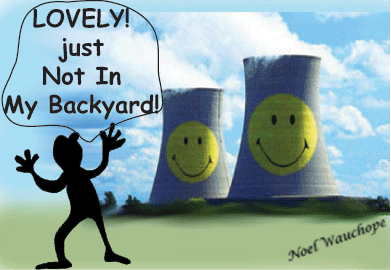
While Mr Johanson would not be drawn on the viability of storing the state’s nuclear waste on the Le Fevre Peninsula, he said a power plant would not work even if it did create jobs………
“There are benefits in job creation in other areas such as freight but I don’t think it is feasible to have a nuclear power plant in the Port,” Mr Johanson said.
“I can’t see you would want to build it anywhere in metropolitan Adelaide.” Mr Johanson said most Port Adelaide residents would not want to live near a nuclear reactor……..
Dr Close agreed the Port was ill-suited for nuclear power. “The idea of a nuclear plant in the Port is a ridiculous and inflammatory suggestion and I don’t support it,” she said.Local real estate agent Rob McLachlan said a nuclear power plant in the heart of the Port would not attract people to live in the area.
Port Augusta mayor Sam Johnson did not return calls before the Portside Messenger’s deadline. http://www.adelaidenow.com.au/messenger/west-beaches/port-adelaide-community-leaders-say-they-dont-want-a-nuclear-power-plant-in-the-heart-of-the-port/story-fni9llx9-1227223707411
Australia’s treaty to sell uranium to India is ‘not fit for ratification’ – pro nuclear experts say
 Australia-India nuclear treaty ‘not fit for ratification Financial Review : 19 FEB 2015 BY GEOFFREY BARKER A parliamentary committee is being urged to reject ratification of the proposed nuclear cooperation treaty with India because it is “bad for our security”. Experts say Australia would be seen as having “caved in” over non-proliferation standards if the ratification of the treaty Australia-India nuclear co-operation proceeds.
All of the world’s nuclear reactors face urgent need of safety checks – Belgium’s nuclear regulator
 4514865 18 February 2015 The Belgian Federal Agency for Nuclear Control has called for thorough inspections of nuclear plants worldwide following detection of multiple cracks in critical components of two reactors in Belgium.
Belgian Federal Agency for Nuclear Control director-general Jans Bens has urged for careful inspection of all the 430 nuclear facilities globally.
Steel nuclear reactor pressure vessels in Doel 3 and Tihange 2 plants were found to be affected in 2012, which had been dismissed as manufacturing defects by the operator of the reactors, Electrabel.
Further tests in 2014 at the facilities indicated advanced embrittlement of the sample steel vessels.
Operations at both the facilities stopped in March 2014.
Unexpected cracking in the vessels can be caused due to corrosion from normal operation.
The presence of highly radioactive nuclear fuel cores in the vessels raises the risk of accidents during malfunction, and it is assumed that this could be an issue with all nuclear power generation facilities worldwide.
Greenpeace Belgium energy campaigner Eloi Glorieux said: “What we are seeing in Belgium is potentially devastating for nuclear reactors globally due to the increased risk of a catastrophic failure.
“Nuclear regulators worldwide must require reactor inspections as soon as possible, and no later than the next scheduled maintenance shutdown. If damage is discovered, the reactors must remain shut down until and unless safety and pressure vessel integrity can be guaranteed. The nuclear industry, already in crisis, is faced with an ageing nuclear reactor fleet at increasing risk of severe disaster.”
The 435 commercial nuclear reactors operational across the world had an average age of around 29 years old.
Out of the operational nuclear reactors, nearly 170 reactors have been functioning for 30 years or more, and 39 reactors are aged above 40 years.
The Australian Government’s moment of truth on nuclear disarmament
The Australian government faces a moment of truth – will we continue to hide behind the myth of “extended nuclear deterrence”, willing to risk our true security and the incineration of millions in our name, or will we finally step up and get on the right side of history?
Malcolm Fraser was prime minister from 1975 to 1983. Tilman Ruff is Associate Professor at the Nossal Institute for Global Health.
 2015 is the year to ban nuclear weapons http://www.theage.com.au/comment/2015-is-the-year-to-ban-nuclear-weapons-20150219-13jali.html February 19, 2015 Malcolm Fraser and Tilman Ruff
World’s first wave-energy farm connected to grid is switched on in Western Australia.
“We’ve specifically designed the technology to be scalable and one of the main aims of this project was to show you could plug multiple wave units together and have them operating in sync.
“This technology… can operate in a variety of water depths, swell directions and seafloor conditions and can generate power for both onshore and offshore consumption,”
 WA wave energy project turned on to power naval base at Garden Island ABC News 18 Feb 15, The world’s first wave-energy farm connected to the electricity grid has been switched on in Western Australia.
The project by Perth-based Carnegie Wave Energy will provide renewable electricity for Australia’s largest naval base, HMAS Stirling, on Garden Island.
The same system is also used to run a small desalination plant, which will be used to supply up to one-third of the base’s fresh water needs. Continue reading
USA: White House dumps support for ‘clean coal’
 On Feb. 3, the Department of Energy announced it was withdrawing support. Environmentalists who want investment in renewable power technologies rather than fossil energy cheered the decision. “We don’t need it, and we can’t afford it,” Bruce Nilles, head of the Sierra Club’s Beyond Coal campaign, says of carbon-capture projects
Dry Future for Adelaide ( very unwise to bring water wasting nuclear industry)
Makes you question the intelligence of South Australia’s businessmen and politicians – even contemplating the high water use, and high water-polluting industries of nuclear industries, and expanding uranium mining
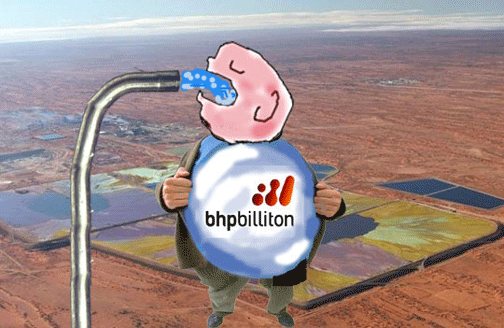
This means Adelaide needs to start planning climate change adaption strategies for its water supply now, in combination with reducing greenhouse gas emissions.
Declining supply
The finding is based on one of the most detailed modelling efforts that has been conducted into the water security of an Australian city. Based on the outputs of 15 recent global climate models combined with downscaling rainfall to the catchment scale and hydrological modelling, we assessed how changes in rainfall and evaporation and transpiration (water evaporating from plants) will affect runoff in the Onkaparinga Catchment. Historically, this catchment has supplied on average about 50% of Adelaide’s water supply, with the remainder supplemented by pumping from the Murray River.
The findings suggested that a high level of confidence can be placed in projections of a decline in runoff. In fact, 98% of the model simulations suggested a decrease in runoff by the end of the century (the remaining 2% suggest little change).
However, the magnitude of change is highly uncertain – some projections suggest only small levels of change; others as much as 75% or more.
Dealing with the dry
The results paint a bleak future, but there are things we can do. The most obvious solution is to collectively reduce our greenhouse gas emissions. By looking at a low-emission trajectory (i.e. one that assumes that society will take active measures to reduce emissions) the reduction of reservoir inflows might only be 25%.
As well as reducing emissions, we need to start preparing to adapt to a drier future…….http://theconversation.com/adelaide-is-facing-a-dry-future-it-needs-to-start-planning-now-37750
ABC reporter tours shattered Fukushima nuclear power plant
Entry to closed areas would lead to instant death
The only way TEPCO can control the meltdowns in 1, 2 and 3 is to pump water in to cool them, but the water becomes highly radioactive and mixes with the massive amount of groundwater that flows into the reactors from the surrounding hills.
Locals distrust TEPCO, say future is ‘hopeless’
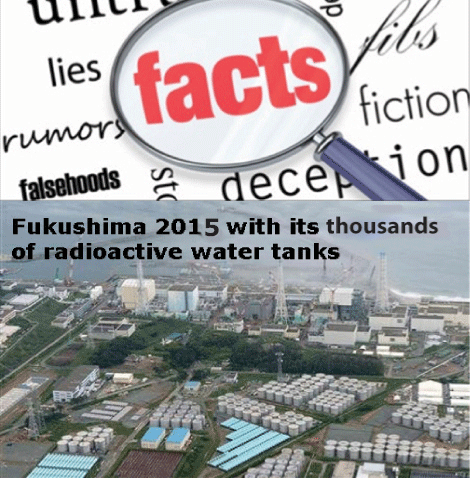
Inside Fukushima: ABC tours crippled power plant as Japan prepares to restart nuclear industry http://www.abc.net.au/news/2015-02-18/japan-prepares-to-restart-their-nuclear-power-program/6142528 Exclusive by North Asia correspondent Matthew Carney Almost four years after the Fukushima disaster, Japan is about to restart its nuclear industry.
The 2011 meltdowns at the tsunami-hit plant prompted a shutdown of all Japan’s nuclear power stations and saw the power station’s operator TEPCO accused of cover-ups and gross negligence.
TEPCO says radiation levels at Fukushima have significantly decreased and major steps have been taken to decommission the molten reactors.
Others say the plant cannot be fixed and thousands of people will never be allowed to return to their homes because of high radiation.
With vacuum-sealed protection gear and special breathing apparatus, TEPCO gave the ABC an exclusive tour of the crippled plant. Continue reading
Australian government delay on Renewable Energy Target is stifling projects
 “This review started on 17 Feb 2014, and one year since that review commenced it really needs to be resolved so this project and other projects can proceed.”
“If you have a review every two years, and then it takes a year to undertake the review, there’s not much gap between one review and the other, so a key change that’s required in this legislation is to remove those two-yearly reviews.”
Wind farm owner calls for resolution one year after start of Renewable Energy Target review http://www.abc.net.au/news/2015-02-18/wind-farm-owner-calls-for-resolution-12-months-on-from-start-of-/6141408 By Kerrin Thomas The new owner of an undeveloped wind farm on the Northern Tablelands says the Government’s review of the Renewable Energy Target has gone on for long enough.
It’s been 12 months since the review started, and under the current legislation the Target is reviewed every two years.
Goldwind Australia last year purchased the White Rock Wind Farm project, between Glen Innes and Inverell, and is working to prepare the Construction Environmental Management Plan, and the next round of community engagement will take place over the coming months.
The wind farm has development approval.
The company’s Managing Director John Titchen said industry uncertainty created by the review could impact the project, and the RET review needs to be finalised. Continue reading
Queensland’s new Labor government acts to save the Great barrier Reef
 Great Barrier Reef polluters face tougher action under Queensland’s new government Labor government appoints state’s first ever reef minister as it steps up plan to avoid the UN listing the ecosystem as ‘in danger’ Guardian, Oliver Milman, 18 Feb 15 The Queensland government may adopt tough new regulations to tackle the amount of pollution flowing onto the Great Barrier Reef, with the state’s first ever reef minister vowing to strengthen protections to avoid the ecosystem being listed as “in danger” by the UN.
85 USA right-wing Tea Party groups join push for solar energy
Floridians for Solar Choice, the group behind the initiative, is an inchoate alliance of libertarians, Christian Coalition conservatives, liberal environmentalists, and eighty-five Tea Party groups
 Greening the Tea Party, New Yorker BY CAROLYN KORMANN 18 Feb 15 The solar-energy business is booming. The average cost of installing solar panels has dropped by half since 2010, and a new solar electric system is now installed somewhere in the United States every four minutes.
The growth extends well beyond the rooftops of American homes and small businesses; last week, Apple announced that it is investing in an eight-hundred-and-fifty-million-dollar solar farm in Monterey County, California, which it says will power its operations in the state by the end of 2016. Although solar is still small, supplying less than one per cent of the country’s electricity, its growth has alarmed the energy industry’s old guard—coal, oil, and utility companies. Continue reading
Australia’s anti coal and gas activists are within their rights to claim charity status
Anti-mining activists say they are within their rights to claim charity status ABC Rural By Babs McHugh 19 Feb 15, “……. Anti-mining and gas group says it’s fighting for all Australians
Phil Laird is the national coordinator of Lock The Gate, an anti-coal mining and anti-coal seam gas industries group which has charitable status.
“What we’re doing is we’re supporting legitimate business such as those on the Liverpool Plains,” he said, in reference to the Shenhua Watermark coal mine that has recently been given the green light by the New South Wales Government.
“We’re working on behalf of Australians.”
Mr Laird said LTG members were furious about the call by the NSW Minerals Council to strip them of their charity status.
“What Lock the Gate does is provide an umbrella group for community groups that need a voice at the national and political level,” he said.
Although the group has long been protesting at the site of mining projects that have passed all state and federal requirements and criteria, Mr Laird is adamant they are within the original spirit of the definition of a charity, which is to “do no harm”.
“It’s the laws that need to change,” he said. “What we’re advocating for is for local communities, to protect their homes and their families and their livelihoods.
“We do that every day and anyone that thinks protecting farmland and water aquifers is doing harm is obviously on the wrong page.” http://www.abc.net.au/news/2015-02-18/calls-for-activists-to-be-stripped-of-charity-status/6130604
1 This month
7 April – WEBINAR – Australia and the Doomsday Clock – Preventing nuclear war through NoFirstUse and other policies
Online | Tuesday April 7, 4:00-5:30pm, Australian Eastern Time / 8:00-9:30am Central Europe Time
– Access the registration link
15 April – Zoom –Nuclear Power is Not the Solution
Apr 15, 2026 01:00 AM in Canberra, Melbourne, Sydney

Join the International Physicians for the Prevention of Nuclear War (IPPNW) on Tuesday, April 14th for a timely webinar exploring the risks associated with nuclear power and challenging the myth that it offers a simple, safe, carbon-free solution to the climate crisis

21 April Webinar: No Nuclear Weapons in Australia
Start: 2026-04-21 18:00:00 UTC Canberra, Melbourne, Sydney (GMT+10:00)
End: 2026-04-21 19:30:00 UTC Canberra, Melbourne, Sydney (GMT+10:00)
Event Type: Virtual
A virtual link will be communicated before the event.
Host Contact Info: australia@icanw.org

of the week – Australians for War Powers Reform (AWPR)
To see nuclear-related stories in greater depth and intensity
 Antinuclear