Dry Future for Adelaide ( very unwise to bring water wasting nuclear industry)
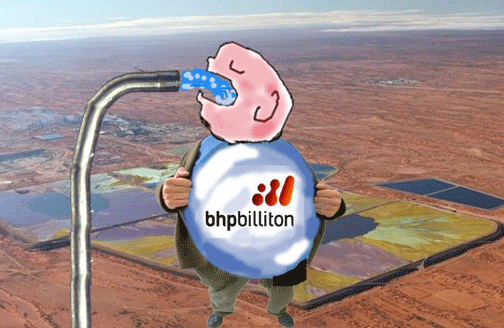
 Makes you question the intelligence of South Australia’s businessmen and politicians – even contemplating the high water use, and high water-polluting industries of nuclear industries, and expanding uranium mining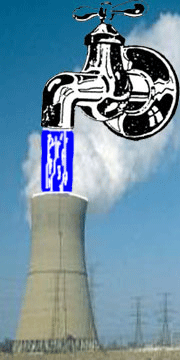
This means Adelaide needs to start planning climate change adaption strategies for its water supply now, in combination with reducing greenhouse gas emissions.
Declining supply
The finding is based on one of the most detailed modelling efforts that has been conducted into the water security of an Australian city. Based on the outputs of 15 recent global climate models combined with downscaling rainfall to the catchment scale and hydrological modelling, we assessed how changes in rainfall and evaporation and transpiration (water evaporating from plants) will affect runoff in the Onkaparinga Catchment. Historically, this catchment has supplied on average about 50% of Adelaide’s water supply, with the remainder supplemented by pumping from the Murray River.
The findings suggested that a high level of confidence can be placed in projections of a decline in runoff. In fact, 98% of the model simulations suggested a decrease in runoff by the end of the century (the remaining 2% suggest little change).
However, the magnitude of change is highly uncertain – some projections suggest only small levels of change; others as much as 75% or more.
Dealing with the dry
The results paint a bleak future, but there are things we can do. The most obvious solution is to collectively reduce our greenhouse gas emissions. By looking at a low-emission trajectory (i.e. one that assumes that society will take active measures to reduce emissions) the reduction of reservoir inflows might only be 25%.
As well as reducing emissions, we need to start preparing to adapt to a drier future…….http://theconversation.com/adelaide-is-facing-a-dry-future-it-needs-to-start-planning-now-37750
No comments yet.
1 This month
7 April – WEBINAR – Australia and the Doomsday Clock – Preventing nuclear war through NoFirstUse and other policies
Online | Tuesday April 7, 4:00-5:30pm, Australian Eastern Time / 8:00-9:30am Central Europe Time
– Access the registration link
15 April – Zoom –Nuclear Power is Not the Solution
Apr 15, 2026 01:00 AM in Canberra, Melbourne, Sydney

Join the International Physicians for the Prevention of Nuclear War (IPPNW) on Tuesday, April 14th for a timely webinar exploring the risks associated with nuclear power and challenging the myth that it offers a simple, safe, carbon-free solution to the climate crisis

21 April Webinar: No Nuclear Weapons in Australia
Start: 2026-04-21 18:00:00 UTC Canberra, Melbourne, Sydney (GMT+10:00)
End: 2026-04-21 19:30:00 UTC Canberra, Melbourne, Sydney (GMT+10:00)
Event Type: Virtual
A virtual link will be communicated before the event.
Host Contact Info: australia@icanw.org

of the week – Australians for War Powers Reform (AWPR)
To see nuclear-related stories in greater depth and intensity
 Antinuclear
Leave a comment