The next step in South Australia’s Nuclear Farce
OK – Now it has turned up on http://yoursay.sa.gov.au/blogs/draft-terms-of-reference
 The Premier’s media release says that you can find the Terms of Reference at www.yoursay.sa.gov.au.
I couldn’t find anything there about the subject. Perhaps later?
Symptomatic of the clumsy and inept rush that characterises this tacky Royal Commission idea.
Also no mention of personnel – other than the pro nuclear former S.A Governore Kevin Scarse. (at right) Independent, my foot!
Anyway – here are the Draft Terms of Reference Continue reading
South Australia’s Premier Jay Weatherill announces the Terms of Reference for Royal Commission
Nuclear royal commission draft terms of reference announced by SA Premier Jay Weatherill http://www.abc.net.au/news/2015-02-23/nuclear-royal-commission-terms-of-reference-jay-weatherill/6224192 South Australia’s nuclear royal commission is to inquire into enrichment, storage of waste and power generation, but not uranium mining.
The State Government has r eleased draft terms of reference and announced there would be public consultation until March 13.
Premier Jay Weatherill said the inquiry would focus on three key areas, but the terms of reference had deliberately been kept general.
“These are the broadest possible terms of reference … they won’t be settled for a further week,” he said.
“The only caveats really are the non-military uses will be the only things explored and it’s not our intention to suggest any retreat from the current involvement in uranium mining.”
The Premier said it would be the broadest possible analysis of South Australia’s involvement and potential for future involvement in the nuclear fuel cycle.
“We think it’s important to go through what is a thorough process of debate and discussion in the community about this important issue,” he said.
When asked if the state were mindful of a looming federal deadline to deal with the issue of nuclear waste storage, he said: “We don’t think this is something that should be rushed.
“The Commonwealth’s been talking about nuclear waste storage for decades so I don’t think our timeline is going to threaten any key decisions.”
Before the year is out, nuclear fuel rods that are being reprocessed by the French are due to be returned to Australia and by 2020 more nuclear waste being reprocessed in the United Kingdom is due to be returned as well.
The Adelaide Advertiser a not very credible mouthpiece for the nuclear lobby
Dennis Matthews 23 Feb 15 It’s that time of year again and we have a new addition to an already overcrowded programme.
The Shady Nuclear Circus (The Advertiser, 23/2/15), ably assisted by the well-known Liberal-Labor comedy duopoly, bravely ignoring the Zwitkowski flop under the direction of John Howard but encouraged by their reception in Fisher is back in town.
 It’s main attractions are the publicly funded Weatherill command performance and a previously unknown company of self-styled expert clowns who are reputedly not in it for any profit.
Emboldened by his dubious success in Fisher, the cash-strapped Weatherill appears to be trying to woo the public by a full-frontal assault on their sensibility, apparently in the hope of distracting them from more serious deficiencies in his other ventures.
Fortunately there are much more professional and enjoyable performers, such as the Sunny Energy Ensemble, which make the Shady Nuclear Circus irrelevant.
A Dangerous Farce – South Australia’s Nuclear Royal Commission
 SA nuclear royal commission a farce, Independent Australia 22 February 2015 The South Australian government’s royal commission into our nuclear future is a farce, and a dangerous farce, warns Noel Wauchope.
FIRST OF ALL, it is not the province of one State to determine by a State royal commission that a nuclear industry should be introduced in Australia. That is a protected issue as a ‘A Matter of National Environmental Significance’ under the National Environment Protection and Biodiversity Conservation Act 1999.
Secondly, this royal commission would be a mammoth waste of money for South Australia The cost would run into hundreds of $millions. The Royal Commission into Institutional Responses to Child Sexual Abuse was allocated over $434 million in 2013 for its first four years of operation. Given that nuclear issues are the province of national law, not South Australian, this is a totally unnecessary expense.
Thirdly, the ‘public involvement‘ in the terms of reference for this royal commission is a farce in itself. Just look at how this was dealt with by the South Australian government:
8 February:
The announcement was made. Despite the fact that this whole initiative is clearly of national importance, it has received minimal publicity outside Adelaide. The Adelaide Advertiser ran a poll. The Adelaide Advertiser is pretty much regarded as the nuclear lobby’s free propaganda vehicle. No surprise if their readership turns up the required positive result.
9 February:
Consultations began on the Terms of Reference for the royal commission. Premier Jay Weatherill touted nuclear power for climate change action, though he said it was not economically viable. The better options, he said, were importing and storing radioactive waste, and uranium enrichment.
Pro-nuclear former governor, Kevin Scarce, was appointed as “independent” head of the inquiry. No mention of what scientists, etc. might be on the panel.
16 February:
(closing day for comments on the Terms of Reference for the royal commission)
There is no need for a royal commission into the nuclear industry for Australia. Nuclear proponent, Ziggy Switkowski, concluded in the 2006 Switkowski Report that the industry is not economically viable here. Nuclear reactors often far exceed their construction budgets. The last nuclear power plant built in Canada cost AUD$15.1 billion.
Mr. Switkowski predicted the capital cost at $4-6 billion for our first 1000MWe reactor.
However, we already know that, despite some pious statements by Jay Weatherill about nuclear power’s ability to reduce greenhouse gas emissions, action on climate change is not the motivator for this new inquiry.
According to a report by The Australian on 10 February 2015:
‘He [Premier Jay Weatherill] said he was open to the prospect of remote parts of the state hosting a nuclear waste deposit but played down the prospect of a power plant being built.
“I think that’s the least likely outcome of the royal commission,” he told ABC radio on Monday.
“I think what’s most likely is that it will be regarded as not viable for either the state or the nation.” ‘
In the same interview on ABC’s The World Today, Weatherill’s enthusiasm for storing the world’s nuclear waste is clear: ……..https://independentaustralia.net/environment/environment-display/sa-nuclear-royal-commission-a-farce,7399
The Religious Right in USA is turning to Solar Energy

Roberta Combs, president of the group, titled her post “For God and Country, Indiana and America Need Better Energy Policies,” writing,
Indiana’s utilities are interested in keeping us reliant on traditional fuel sources that hurt our national security and weaken our economy. We must allow homes, businesses, public organizations, and churches to create local, American power by installing solar.
As conservatives, we stand up for our country’s national security and the health of our economy. And, as Christians, we recognize the biblical mandate to care for God’s creation and protect our children’s future
Solar energy’s new best friend is … the Christian Coalition WP By Chris Mooney February 20 The politics of solar power keeps getting more and more interesting. Continue reading
Dirty, Unsafe, Unsound, Uneconomic – yes – that’s the nuclear industry chain
The case to expand the nuclear industry in South Australia and the world is weak. It stands neither on its life-cycle carbon dioxide emissions, nor increased safety, nor economy. New nuclear technologies under construction are far over budget and over time. Future nuclear technologies are not close to being commercially available.
These and other nuclear issues are discussed in more detail in Chapter 6 of my bookSustainable Energy Solutions for Climate Change.
Uncritical acceptance of the claims of nuclear proponents would set back safer, cleaner, faster and cheaper methods of mitigating climate change.
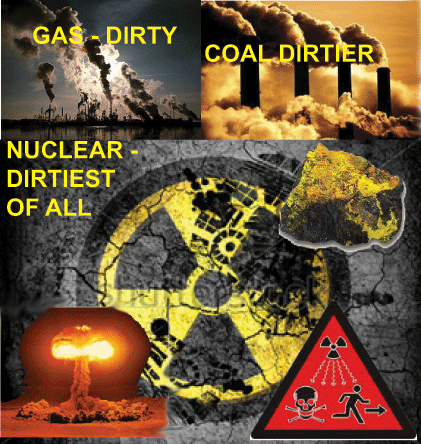 Nuclear Energy Is Dirty, Unsafe And Uneconomic: Environmental Scientist https://newmatilda.com/2015/02/21/nuclear-energy-dirty-unsafe-and-uneconomic-environmental-scientist by Dr Dr Mark Diesendorf , Associate Professor and Deputy Director within the Institute of Environmental Studies at the University of NSW..At present there is no market for expanding South Australia’s uranium mining and exports. In 2012, BHP Billiton put on hold its expansion plan for the Olympic Dam uranium-copper mine and since then has shed hundreds of jobs. That there is an excess of uranium enrichment capacity in the world is even acknowledged by the World Nuclear Association.
And, as explained below, wind energy is already much less expensive than nuclear and, on current trends, large solar power stations based on photovoltaic modules will also be cheaper within the 15-year period that it would take to plan and build a nuclear power station in Australia.
We should add to the 15 years the indefinite time-period it would take to gain public acceptance.
Looking beyond South Australia to the world, there seem to be three shaky legs upon which proponents attempt to stand their campaign to expand nuclear energy:
1. Nuclear energy has allegedly no or low greenhouse gas emissions.
2. New nuclear reactor technologies are allegedly safer than the present generation of reactors.
3. New and existing reactors are allegedly cheaper than other low-carbon technologies, notably renewable energy.
Let’s examine these claims. Continue reading
Governments have protected the nuclear industry by covering up meltdowns
“It’s disappointing,” said Bill Magavern, director of Sierra Club California. “I have a strong suspicion that EPA is being silenced by those in the federal government who don’t want anything to stand in the way of a nuclear power expansion in this country, heavily subsidized by taxpayer money.”
 Governments Have Been Covering Up Nuclear Meltdowns for Fifty Years to Protect the Nuclear Power Industry http://www.washingtonsblog.com/2011/03/governments-have-been-covering-up-nuclear-meltdowns-for-fifty-years-to-protect-the-nuclear-power-industry.html by WashingtonsBlog
Santa Susana As a History Chanel special notes, a nuclear meltdown occurred at the world’s first commercial reactoronly 30 miles from downtown Los Angeles, and only 7 miles from the community of Canoga Park and the San Fernando Valley area of Los Angeles. Specifically, in 1959, there was a meltdown of one-third of the nuclear reactors at the Santa Susana field laboratory operated by Rocketdyne, releasing – according to some scientists’ estimates – 240 times as much radiation as Three Mile Island.
But the Atomic Energy Commission lied and said only there was only 1 partially damaged rod, and no real problems. In fact, the AEC kept the meltdown a state secret for 20 years.
There were other major accidents at that reactor facility, which the AEC and Nuclear Regulatory Commission covered up as well. See this.
Kyshtm
Two years earlier, a Russian government reactor at Kyshtm melted down in an accident which some claim was even worse than Chernobyl. Continue reading
Anxiety in UK over possibility of drone terror attacks on nuclear facilities
UK nuclear sites warned over drone terror attack, By CAROLINE WHEELER Sunday Express 22 Feb 15
BRITAIN’S nuclear plants are at risk from a terrorist strike by unmanned drone aircraft, writes Caroline Wheeler.Such an attack could kill tens of thousands of people, a Government adviser has warned. But authorities are “burying their heads in the sand,” according to John Large.

His call for an urgent security overhaul comes as fi gures showed nuclear power plants suffered 37 security breaches last year – the highest numberalso been breached a dozen times since 2011, including by at least one drone.
Islamic State terrorists have already recruited chemical weapons specialists and counterterrorism experts say they are intent on building a “dirty bomb”.
Last night Mr Large, a nuclear engineer who has carried out work for Britain’s Atomic Energy Authority, demanded a major exercise to test the resilience of the nation’s power stations against acts of terrorism.
Mr Large, who has advised the French government after a growing number of mysterious unmanned flights over that country’s nuclear plants, said drones also pose a risk to the UK’s 16 operational reactors.“On application to UK nuclear power plants, I believe that much the same security and vulnerability issues apply,” he told the Sunday Express.
“The accessibility of the UK plants to small UAV’s [unmanned airborne vehicles] is relatively unimpeded.”
Asked whether a security review was needed in the wake of the terrorist attacks in Denmark and France, Mr Large said: “Absolutely yes.” Too much focus is placed on the risk assessment surrounding accidents at nuclear power stations, rather than terrorist threats, Mr Large said.
The consequences of the attack scenarios he examined would range from one casualty to tens of thousands of deaths, he added.
The last nuclear power plant built in the UK was completed in the 1990s but the Government is planning a new generation of reactors, starting with Hinkley Point C in Somerset. Last night Tory MP Mark Pritchard, a member of the Joint Committee on the National Security Strategy, said Mr Large’s recommendations would be taken “very seriously”…….http://www.express.co.uk/news/uk/559718/Nclear-plants-are-at-risk-from-a-terrorist-strike-by-unmanned-drones
Private funding of science research adds to decline of Australia’s science credibility
Respected ecologist Dr Alec Costin concerned by state of scientific endeavour in Australia
One of the nation’s most respected ecologists says he is worried about the state of scientific endeavour in Australia. …
“Politicians now are using science as a means for getting themselves re-elected, and they are using scientific information as a means for getting themselves elected, and it is rarely in the complete context,” he said. “It is rather sensational and without going into detail I think the reality of climatic change is being used far more indiscriminately at a political level than it should be.”
Dr Costin says he also has deep reservations about the growing trend in Australia towards privately funded research by the CSIRO and universities….
Some solar panels are shoddy quality: vast majority are good quality
 Solar experts claim multi-billion dollar subsidies wasted on cheap and dodgy panels, The Age February 22, 2015 Heath Aston Political reporter More Australians are buying cheap rooftop solar panels that fail long before their promised lifespan, prompting claims a federal rebate scheme needs to be overhauled to prevent dodgy systems receiving public subsidies.
Solar industry experts say lax rules covering the scheme – which provides incentives of up to $4350 for a $5500 rooftop system – mean it is not always delivering the environmental benefits promised.
They blame an explosion of cheap, mainly Chinese-produced solar panels that have flooded the market over the past five years that are failing to provide the 15 years of clean power expected. Installers in four states told Fairfax Media that the worst systems stopped working within 12 months, with others “falling apart” within two or three years.
Clean Energy Council chief executive Kane Thornton played down the scale of failures and warned against blaming production faults on systems from one country.
He said the “Chinese success story” had led to prices for solar tumbling dramatically, allowing more households to invest in green energy.
“If someone is getting a subsidy there is an expectation that the benefit to the environment and society equals or outweighs that cost. There are cases of systems not running for 15 years and people have got rid of them, but from our point of view most will run for 25 years,” he said.
“There are cases that come up just like in any industry, but failure rates are low.”…….
Nigel Morris, a solar industry analyst and consultant to the Clean Energy Council, said he wasn’t aware of any statistics that showed a widespread problem.
“Is the industry perfect? Absolutely not. Do we occasionally have quality issues with product and installations? Yes, we do … There is evidence to say it is not endemic.” http://www.theage.com.au/environment/solar-experts-claim-multibillion-dollar-subsidies-wasted-on-cheap-and-dodgy-panels-20150221-13kqub.html
A recent Choice survey found, while more than 80 per cent of solar system owners were satisfied with what they had bought, 17% of owners of Chinese-made solar systems and 11 per cent of those with a German inverter had experienced problems of some kind.
1 This month
7 April – WEBINAR – Australia and the Doomsday Clock – Preventing nuclear war through NoFirstUse and other policies
Online | Tuesday April 7, 4:00-5:30pm, Australian Eastern Time / 8:00-9:30am Central Europe Time
– Access the registration link
15 April – Zoom –Nuclear Power is Not the Solution
Apr 15, 2026 01:00 AM in Canberra, Melbourne, Sydney

Join the International Physicians for the Prevention of Nuclear War (IPPNW) on Tuesday, April 14th for a timely webinar exploring the risks associated with nuclear power and challenging the myth that it offers a simple, safe, carbon-free solution to the climate crisis

21 April Webinar: No Nuclear Weapons in Australia
Start: 2026-04-21 18:00:00 UTC Canberra, Melbourne, Sydney (GMT+10:00)
End: 2026-04-21 19:30:00 UTC Canberra, Melbourne, Sydney (GMT+10:00)
Event Type: Virtual
A virtual link will be communicated before the event.
Host Contact Info: australia@icanw.org

of the week – Australians for War Powers Reform (AWPR)
To see nuclear-related stories in greater depth and intensity
 Antinuclear