Baby teeth study showed effects of nuclear radiation on heath
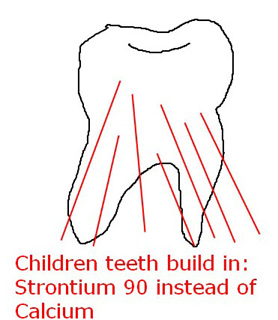 They found that the radioactive strontium-90 levels in the baby teeth of children born from 1945 to 1965 had risen 100-fold and that the level of strontium-90 rose and fell in correlation with atomic bomb tests.
Early results from the Baby Tooth Survey, and a U. S. Public Health Service study that showed an alarming rise in the percentage of underweight live births and of childhood cancer, helped persuade President John F. Kennedy to negotiate a treaty with the Soviet Union to end above-ground testing of atomic bombs in 1963.
St. Louis Baby Tooth Survey, 1959-1970, Washington University School of Dental Medicine Though many members of the group were vocally against nuclear testing, CNI never took an official position for or against the testing of nuclear weapons. Scientific facts were assembled, studied by the Committee and its Scientific Advisory Group, and then made available to the public through regular bulletins, newsletters, and a speaker’s bureau….
….The Baby Tooth Survey was initiated in December 1958 as one of the activities of the Greater St. Louis Citizen’s Committee for Nuclear Information (CNI). The Committee was organized in April 1958 by a group of scientists and public-minded citizens who felt that the community should be given accurate information on the known effects of nuclear energy and radiation. Founding members included Mrs. Edna Gellhorn, a tireless and effective worker for civic causes in the city of St. Louis, the state of Missouri, and the nation for sixty years; Barry Commoner, professor of Plant Physiology at Washington University; John M. Fowler, a Washington University physicist; the Reverend Ralph C. Abele, head of the Metropolitan Church Federation; and Alfred S. Schwartz, assistant professor of Clinical Pediatrics at Washington University School of Medicine.
The Greater St. Louis Citizen’s Committee for Nuclear Information (CNI) initiated and conducted the collection of teeth in the St. Louis area, assisted by area dentists who collected and submitted teeth. A large and active group of CNI volunteers coordinated the distribution of tooth collection forms to all St. Louis City and County schools, private and parochial schools, libraries and even drugstores throughout the area. Assistance came from church and social organizations and Boy Scout, Girl Scout, YMCA and YWCA groups. Under the direction of Dr. Louise Z. Reiss, the project collected and catalogued almost 15,000 baby teeth in its first year. By the end of Baby Tooth Survey in 1970, almost 300,000 teeth had been collected and analyzed. Other Baby Tooth Surveys were formed, patterned after the St. Louis program, including ones in New York, the five Gulf Coast states, Canada, and Germany.
Washington University School of Dentistry professors Harold L. Rosenthal, John T. Bird, and John E. Gilster conducted the scientific study of the baby teeth. They found that the radioactive strontium-90 levels in the baby teeth of children born from 1945 to 1965 had risen 100-fold and that the level of strontium-90 rose and fell in correlation with atomic bomb tests. Early results from the Baby Tooth Survey, and a U. S. Public Health Service study that showed an alarming rise in the percentage of underweight live births and of childhood cancer, helped persuade President John F. Kennedy to negotiate a treaty with the Soviet Union to end above-ground testing of atomic bombs in 1963. http://beckerexhibits.wustl.edu/dental/articles/babytooth.html
No comments yet.
1 This month
7 April – WEBINAR – Australia and the Doomsday Clock – Preventing nuclear war through NoFirstUse and other policies
Online | Tuesday April 7, 4:00-5:30pm, Australian Eastern Time / 8:00-9:30am Central Europe Time
– Access the registration link
15 April – Zoom –Nuclear Power is Not the Solution
Apr 15, 2026 01:00 AM in Canberra, Melbourne, Sydney

Join the International Physicians for the Prevention of Nuclear War (IPPNW) on Tuesday, April 14th for a timely webinar exploring the risks associated with nuclear power and challenging the myth that it offers a simple, safe, carbon-free solution to the climate crisis

21 April Webinar: No Nuclear Weapons in Australia
Start: 2026-04-21 18:00:00 UTC Canberra, Melbourne, Sydney (GMT+10:00)
End: 2026-04-21 19:30:00 UTC Canberra, Melbourne, Sydney (GMT+10:00)
Event Type: Virtual
A virtual link will be communicated before the event.
Host Contact Info: australia@icanw.org

of the week – Australians for War Powers Reform (AWPR)
To see nuclear-related stories in greater depth and intensity
 Antinuclear
Leave a comment