Will South Australia’s Royal Commission be genuinely independent, or just excuse for importing radioactive trash?
If the Royal Commission brings a genuine spirit of independence and rigour, and is willing to take evidence on the nuclear sector’s performance in Australia and overseas, the report will provide a valuable contribution to domestic energy and industry policy.
An inquiry into how to get to zero emissions electricity as cheaply and rapidly as possible would have made a far more timely and valuable contribution to debates over energy policy and rebooting South Australia’s manufacturing sector than another rake through the slowly cooling ashes of the nuclear dream. Nonetheless, the lid has been lifted once again, and we can only hope that the Royal Commissioner is willing to take an unblinking look at the evidence, so that the failed hopes and broken promises of the atomic age can be set to rest once and for all
the probability that this whole exercise is designed to build the case for a national or international radioactive waste dump.
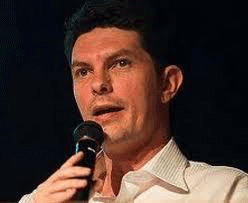 Nuclear Industry On Trial? Scott Ludlam Hopes So, New Matilda, 26 Feb 15 The debate about nuclear power in South Australia needs to be had, if only to put the issue to bed once and for all, writes Scott Ludlam.
At first glance, the decision to call a Royal Commission into nuclear technology in South Australia seems like a curious aberration from the ‘Yes Minister’ rule of inquiries: never call one unless you know in advance what it will tell you.
At the outset of this most polarising of debates, I’d like to propose a truce; particularly with those whose pro-nuclear views are motivated by the overwhelming imperative of climate change. If we respect that not all nuclear advocates intend to contaminate the gene pool and plunge us into nuclear winter, I’d ask in return that you consider the possibility that the anti-nuclear case is based on rational assessment of risks and performance, rather than pure emotion as is sometimes asserted.
For those whose motivation is a safe climate, this is a disagreement over means, not ends.
If the Royal Commission brings a genuine spirit of independence and rigour, and is willing to take evidence on the nuclear sector’s performance in Australia and overseas, the report will provide a valuable contribution to domestic energy and industry policy.
It will paint a picture of an industry in terminal decline; a uranium market in a state of chronic oversupply; 60 years of high-level nuclear waste still awaiting a coherent management solution; ongoing contamination hazards at destroyed reactor sites; unresolved weapons proliferation risks from ‘civilian’ enrichment facilities in Iran; a stalled disarmament agenda and a handful of countries persevering with new plants plagued by cost overruns and safety fears.
Dismissing these lines of evidence as ‘emotional’ is a curiously hollow response given the unambiguous nature of the data.
The ‘World Nuclear Status Report’ is a meticulous country-by-country, plant-by-plant summary, compiled and updated annually by a team of independent researchers, and for years it has shown the industry marching obliviously towards the edge of a cliff.
Hundreds of reactors built in the 1970s and 1980s are now due or overdue for closure, a number that dwarfs the new projects under construction since the industry flat-lined in the 1990s.
Nuclear nations face a complex and costly choice: run these obsolete plants well past their ‘safe’ used-by date, embark on ruinously expensive new construction projects against strong domestic opposition, or choose a completely different course.
The financial markets made up their mind after the Three Mile Island meltdown in 1979: new construction practically ceased in North America and Europe. The technology remains a creature of massive state subsidies, liability exemptions and command economies, a dependence which will only deepen if half-serious proposals to double-down with formidably dangerous plutonium-burning technology come to fruition.
If the Royal Commission is prepared to build future projections on past performance, it will discover a domestic uranium sector that is leaving tens of millions of tonnes of carcinogenic wastes for future populations to deal with, and a sorry history of community division and dispossession.
If resource wealth is the key to Aboriginal advantage and self-determination, it has to be asked why the Mirarr people’s experience of 20-years of uranium mining on their country at Ranger in Kakadu drove them to fight tooth and nail to prevent the opening of a new mine up the road at Jabiluka……….
…..Not through any artifice of emotion or ideology, but by market realities, community opposition and technological obsolescence, the nuclear age is ending – apart from the intergenerational heartache of long-term waste storage and conditioning, which is only just beginning.
This, presumably, is the real motivation behind the Royal Commission. The global enrichment market is oversaturated, and no-one credibly believes nuclear power is a realistic proposition for the sparse South Australian grid.
That leaves only the probability that this whole exercise is designed to build the case for a national or international radioactive waste dump.
Western Australians went through this in 1999, when the Pangea Proposal for an international dump disclosed the reason the industry seeks remote, high-isolation disposal sites.
Practically, it is so dangerous that when the spent fuel inevitably burns its way through engineered containment barriers, it will be as far from human populations as possible. Not surprisingly, communities at Cosmo-Newberry and Pangurr reacted strongly against this perception that their country looked like a conveniently blank space on maps drawn up by bureaucrats in London and Zurich.
This ‘terra nullius’ disposal option was morally and technically bankrupt in 1999, and it still is today. Bitter conflicts over national nuclear dumps at Billa Kalina and Muckaty show the futility of trying to impose remote dumps on unwilling communities.
An inquiry into how to get to zero emissions electricity as cheaply and rapidly as possible would have made a far more timely and valuable contribution to debates over energy policy and rebooting South Australia’s manufacturing sector than another rake through the slowly cooling ashes of the nuclear dream. Nonetheless, the lid has been lifted once again, and we can only hope that the Royal Commissioner is willing to take an unblinking look at the evidence, so that the failed hopes and broken promises of the atomic age can be set to rest once and for all https://newmatilda.com/2015/02/26/nuclear-industry-trial-scott-ludlam-hopes-so
No comments yet.
1 This month
7 April – WEBINAR – Australia and the Doomsday Clock – Preventing nuclear war through NoFirstUse and other policies
Online | Tuesday April 7, 4:00-5:30pm, Australian Eastern Time / 8:00-9:30am Central Europe Time
– Access the registration link
15 April – Zoom –Nuclear Power is Not the Solution
Apr 15, 2026 01:00 AM in Canberra, Melbourne, Sydney

Join the International Physicians for the Prevention of Nuclear War (IPPNW) on Tuesday, April 14th for a timely webinar exploring the risks associated with nuclear power and challenging the myth that it offers a simple, safe, carbon-free solution to the climate crisis

21 April Webinar: No Nuclear Weapons in Australia
Start: 2026-04-21 18:00:00 UTC Canberra, Melbourne, Sydney (GMT+10:00)
End: 2026-04-21 19:30:00 UTC Canberra, Melbourne, Sydney (GMT+10:00)
Event Type: Virtual
A virtual link will be communicated before the event.
Host Contact Info: australia@icanw.org

of the week – Australians for War Powers Reform (AWPR)
To see nuclear-related stories in greater depth and intensity
 Antinuclear
Leave a comment