South Australian government wanting to radioactively pollute Aboriginal land yet again?
“You know you feel gutted when they want to bring the nuke agenda back on,” she said. “The place has already been contaminated.
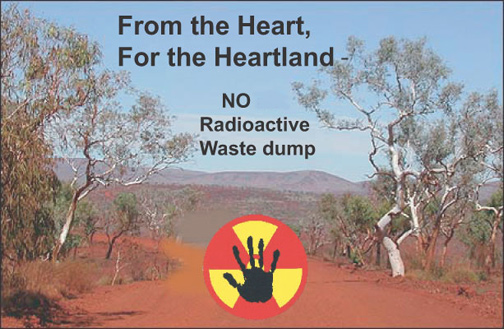
Maralinga could be flagged as nuclear dump site, opponent says in wake of SA royal commission, ABC News, 28 Feb 15 By Wendy Glamocak Less than four months after land used for nuclear testing in the 1950s was officially handed back to its traditional owners in full, nuclear is back on the agenda at Maralinga in South Australia.
Most of Maralinga’s 103,000 square kilometre lands were handed back to the Maralinga-Tjuarutja people in the 1980s, and in 2009, a 3,000 square kilometre site known as Section 400 that had been heavily contaminated by radiation and hazardous chemicals, was also handed back.
In November last year, the Defence Department officially gave the Maralinga-Tjarutja full control and unrestricted access to the lands.
Those connected to the land are worried that a newNuclear Fuel Cycle Royal Commission announced recently by Premier Jay Weatherill will see the land flagged as a potential site for a nuclear waste dump.
Karina Lester is the daughter of Yammi Lester, a man who said he was blinded by atomic tests on the site half a century ago. She said her grandmother was part of the Kupa Piti Kungka Tjuta, a council of senior Aboriginal women from northern SA who fought against the Howard Government’s plans in 1988 to build a national radioactive waste dump near Woomera.
After strong opposition from the local community, and from former SA premier Mike Rann, who won a High Court challenge against the proposal, the plan was abandoned in 2004.
Ms Lester said many custodians of the land were worried that the royal commission set up by Mr Weatherill meant they would soon have another fight on their hands.
“You know you feel gutted when they want to bring the nuke agenda back on,” she said. “The place has already been contaminated.
“Traditional owners are trying to move on from what happened back in the ’50s, but to perhaps propose that it’s a site for the waste, I think, is just another kick in the guts to the traditional owners up there at Maralinga-Tjaratja.
“Enough’s enough.”
Language difficulties could ‘stand in the way’
Ms Lester said many traditional owners will want to make a submission to the royal commission but she was worried language difficulties would stand in their way.
The Premier’s office did not respond to ABC questions on Ms Lester’s concerns……..http://www.abc.net.au/news/2015-02-28/maralinga-could-be-flagged-as-nuclear-dump-site-opponents-say/6270848
The Adelaide Advertiser starts publicity campaign for nuclear reprocessing?
 A pious article reminds South Australians that yes, there were health concerns about uranium mining, and yes nuclear waste is a serious problem.
But by the end of this article – we are told that South Australia “is an idea site for nuclear waste disposal, both national and international — with the potential for huge financial returns.”
and that “The international nuclear industry has made enormous advances in the past 30 years and many of the concerns raised by Mr Rann may have been addressed.”
and that these concerns “should be addressed, and hopefully dispelled, by the Royal Commission.”
 It sounds to me as though the Advertiser, scripted by the nuclear lobby, is softening readers up for the idea of a nuclear reprocessing industry, with the rationale of (supposedly) curing the world’s nuclear waste problem
Rex Jory: SA is an ideal site for nuclear waste disposal, Adelaide Advertiser, 1 Mar 15 “……..As an adviser to former Labor Premier, Don Dunstan, Mr Rann studied aspects of the nuclear industry in Europe and the United States and in the early 1980s wrote a 32 page soft-covered book outlining his concerns about SA’s potential involvement in the nuclear industry.
Mr Rann, now Australian Ambassador to Italy, may have revised some of his beliefs, yet his book raises serious issues which the community and the Labor Party cannot easily ignore. No matter what recent advances have been made in nuclear safety, what was true, or perceived to be true, in 1980 cannot now be rejected without questioning 35 years later. Continue reading
Queensland wind farm decision due this month, but anti-wind lobby is active
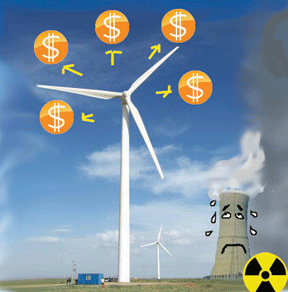 Decision on controversial Tableland wind farm due mid-March http://www.cairnspost.com.au/news/cairns/decision-on-controversial-tableland-wind-farm-due-mid-march/story-fnjpusyw-1227242229621 DANIEL BATEMAN THE CAIRNS POST FEBRUARY 28, 2015
A CONTROVERSIAL wind farm planned for the Tableland could be approved within the next two weeks. The Palaszczuk Government is expected to make a decision about the Mt Emerald wind farm, four years after the project was first tabled.
A spokeswoman for Deputy Premier Jackie Trad said the Minister’s call-in of the development application was due in mid-March.
Developers for the $380 million project gave the Government until the end of February to approve the wind farm, which was awaiting a ministerial decision before the election was called. The development, to be built near Walkamin, between Atherton and Mareeba, is to include up to 63 turbines on towers about 80m-90m tall, with about 50m blades.
The farm, a joint venture between Ratch Australia and Port Bajool, has the potential to generate enough electricity to power at least 75,000 homes.
It is estimated 158 jobs could be created during the development’s two-year construction phase.
Ratch Australia spokesman Geoff Dutton said representatives from the company’s Brisbane office had recently met with the newly elected Government to brief it on the project.“I think Ratch would be delighted in getting an answer after four years of hard work,’’ he said.
“We’re very hopeful the wind farm will be approved. Continue reading
The unique danger of nuclear radiation
 US Gov’t: Radioactive material from reactors is 2 billion times more toxic than industrial poisons — Harm caused by nuclear disaster “greater than for any work of man” other than atomic bomb — Top Expert: Radiation “like explosions going off in cell… blows hole in DNA” (VIDEO)http://enenews.com/govt-document-radioactive-materials-reactors-2-billion-times-toxic-common-industrial-poison-harm-nuclear-disaster-greater-work-man-other-atomic-bomb-top-expert-radiation-like-explosions-going-ce?utm_source=feedburner&utm_medium=email&utm_campaign=Feed%3A+ENENews+%28Energy+News%29
Dr. Bill McBride, UCLA School of Medicine Vice Chair for Research in Radiation, Principle Investigator of UCLA’s Center for Medical Countermeasures Against Radiation — National Institutes of Health, Jan 27, 2014 (emphasis added):
- 19:45 – There are some unique things about ionizing radiation when it comes to the interaction with biological systems… Energy is deposited ubiquitously in cells and in tissues… in little packets of energy… These [are] like many explosions going off in the cell… If you can think of these little explosions going off all over a cell, if it happens to take place in DNA, there’s really quite a high chance this will blow a hole in the DNA. Ionizing radiation is a very powerful cytotoxic agent… You get these lesions which are formed within DNA which are really quite complex lesions… We’re talking 0.0000000000000001 seconds for the ionization to take place… Cell cycle arrest, cell death by apoptosis or mitotic catastrophe… take place very rapidly after exposure.
- 37:30 – What’s happening following ionizing radiation? You get these little explosions going off very rapidly… But mitochondria get hit as well… With time, you actually get these mitochondria leaking more free radicals than [the] ionizing radiation, by orders of magnitude… This concept is one which is growing very strongly in radiation biology now. The effects are not all over in 24 hours… you initiate a cascade of biological responses which can go on for a long period of time, even years.
- 46:00 – You get long-term immune dysfunction… If you inject flu virus into mice [it] will eventually kill the [irradiated] animals… in normal animals this isn’t the case. So the immune system is compromised for long periods of time after radiation exposure.
- 51:00 – The concept is that we’re generating damage which is cascading forward to mitochondria and other cellular structures, in addition to DNA… Radiation is not just a powerful cytotoxin, it initiates signaling cascades that are taking place against a radiation damage background… Radiation damage is often remembered within the cells. We’ve shown, at least in brain and lung and other tissues, you get these kind of pro-inflammatory responses… This is underlying a lot of effects in radiation exposure.
- 52:00 (appears to be on verge of crying) – At UCLA we have over 100 people who are in our center… They’re interested in radiation now — they never were before. I think that we’re kind of moving animal models slowly forward to things which are really kind of very precise and very accurate and I think do reflect a lot of things that we will see in humans… who’ve been exposed to radiation.
U.S. Atomic Energy Commission (pdf), 1968: The total amount of debris released during routine atomic processes and conceived as possible from accidents is minuscule when compared with the amount of pollutants produced throughout the world by combustion. The extraordinarily poisonous nature of the radioactive materialsinvolved, however, dictates that even small quantities be treated with respect. For instance, it has been estimated that some of the radioactive materials found in a reactor are 3 million to 2 billion times as toxic as chlorine, the most common poison used by industry... if it were possible for all the many controls and safety features in a large power reactor to fail so as to produce a disastrous release of radioactivity, this release could conceivably kill thousands… Although, in actual practice, such an accident is made to have a vanishingly small probability of occurring, the theoretical potential for such an accident is probably greater than for any work of man other than the explosion of a fission or fusion weapon.
Nuclear industry is desperate – ramps up its media hype
 The nuclear industry’s sense of desperation is palpable. Activists need to understand what the industry obviously knows: it’s in serious trouble. This is our time to really join together, ramp up our efforts, and kick more of these reactors over the edge; they’re already teetering. They’re dangerous, they can’t provide cost-effective electricity, they don’t have a solution to their radioactive waste and they exist now only because they were built decades ago and the utilities want to milk them for everything they can before they surrender to the inevitable and have to begin spending huge sums of money again–but this time it won’t be to build new reactors, it will be to decommission their dinosaurs.
 You know the nuclear industry is desperate when… Greenworld April 1, 2014 You know the nuclear power industry is getting desperate when it solicits its CEOs to start piling on ghost-written op-eds in publications chosen for their reach to key audiences. And you know the industry is really desperate when it brings out big guns like a couple of paid-for former U.S. Senators to support nuclear power in The Hill newspaper, which, as its name implies, is aimed at current legislators. And you know the industry is super desperate when it pulls out none other than Rudy Giuliani, who continues stuffing his wallet with nuclear-powered green. Continue reading
A plea for ethics, science, investigative journalism
 Not In Our Name, Kickstarter 1 March 15 by Chris Hill A film telling how a nation went to war against its own veterans and scientists, and kept its head in the tar sands on climate change.
About this project How many wrong decisions can one nation endure? Every week there’s a new story that shows a shocking lack in judgment or ethics on the part of the government. It’s open season on the environment, on science, on the rights of veterans, and it shames us all.
Media in disarray Cuts to investigative journalism by most media outlets (including Canada’s CBC, which has been decimated by recent government funding cuts) are allowing many stories to remain under-covered, or untold altogether.
Media consolidation has meant there are fewer voices reporting, with ever-tightening restrictions on what they can say. This is a critical threat to democracy, and it’s the principal motivation for this film. Independent voices must pick up the slack.
Science Abandoned The Canadian tradition of being at the forefront of scientific research and innovation, critical to the nation’s prosperity, has been all but abandoned. The Harper government has pulled the plug on any science that doesn’t conform to its specific oil and gas agenda, and it has effectively muzzled scientists by forbidding them from speaking out to the press.
Critical programs that monitored the melting arctic, smoke stack emissions, food inspections, water quality, oil spills and climate change have been systematically dismantled. Continue reading
Japan developing alternatives to nuclear energy, and with energy conservation
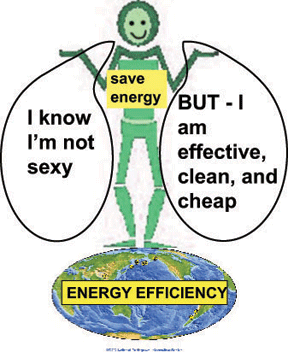
 Humble light bulb helps Japan fill nuclear gap New Zealand Herald, 27 Feb 15 Japan’s push to keep power flowing after it shuttered its nuclear program may best be illustrated by 73 million light bulbs.
That’s the number of LED bulbs sold in Japan since the start of 2012, representing about 30 per cent of all bulbs sold there. The LEDs, which consume a fifth of the energy used by standard lights, are key to the country’s strategy to make energy use more efficient, even as it pursues alternative sources such as solar power.
Four years after the Fukushima nuclear meltdown spurred the closure of Japan’s many reactors, knocking out 30 per cent of Japan’s power supply, the drive to reduce energy consumption has sparked a national campaign that includes everything from improved insulation for homes to train stations powered by the braking of subway cars and vending machines that recycle waste heat and generate power with solar panels on top.
“There’s no doubt Japan has some of the most advanced technologies in energy saving,” Continue reading
1 This month
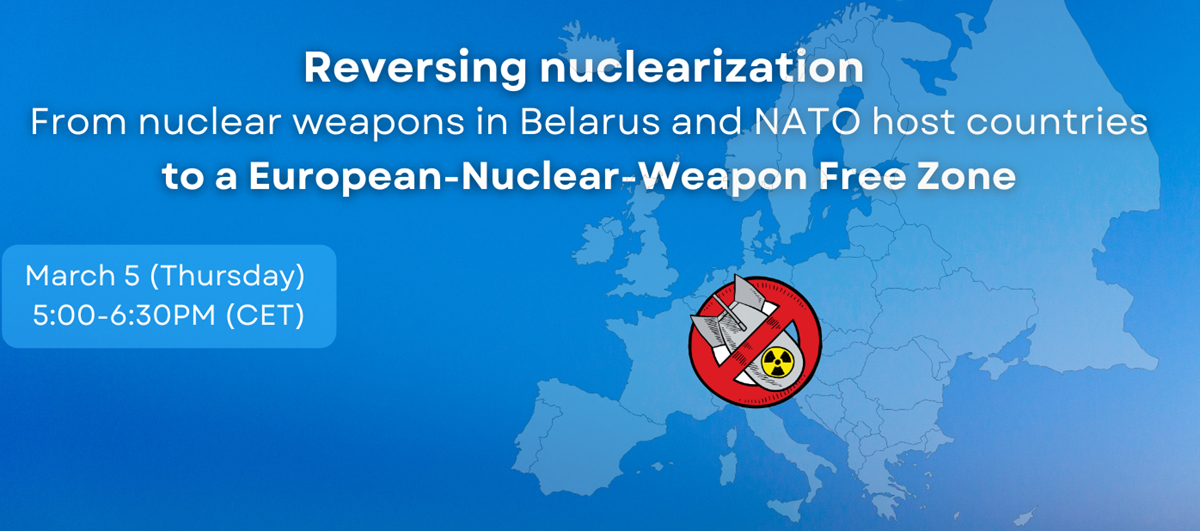
6 March -Online – Reversing nuclearization:
From nuclear weapons in Belarus and NATO host countries to a European-Nuclear-Weapon Free Zone
Mar 6, 2026 03:00 AM in Canberra, Melbourne, Sydney

of the week – Australians for War Powers Reform (AWPR)
To see nuclear-related stories in greater depth and intensity
 Antinuclear