South Australian Federal Liberal MP Rowan Ramsey wants nuclear waste dump in Grey electorate.
Lib MP happy to store nuclear waste 9 News 6 Mar 15 Federal Liberal backbencher Rowan Ramsey says he’d happily store nuclear waste on his South Australian farm.

The federal government has called for landholders to nominate sites for a national dump to store nuclear waste generated by medical, research and industrial processes.
Mr Ramsey, whose massive electorate of Grey covers almost 92 per cent of SA, says there’s nothing to fear about nuclear waste.
“I am very relaxed about the idea that they might find a good site in my electorate again,” he told ABC radio on Thursday……
The state Labor government’s royal commission into the nuclear industry is looking at the prospects of nuclear waste facilities in SA.
But with the inquiry set to stretch into 2016, it’s unlikely SA will endorse a site before the federal government’s nomination process closes on May 5. http://www.9news.com.au/national/2015/03/05/12/37/lib-mp-happy-to-store-nuclear-waste#IEXPPdGpfI11lEs0.99
South Australia shows the way with a floating solar energy plant
Australian-first floating solar farm due to begin construction in SA ABC News By Matthew Doran, 5 Mar 15 An Australian-first floating solar power plant is expected to be operational in South Australia by early April, with construction about to begin. (Below – a floating solar energy plant in France)
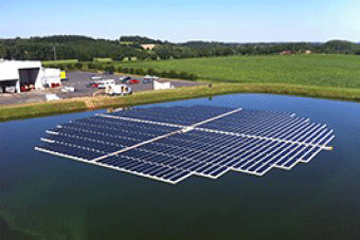
The plant will float on a wastewater treatment facility in Jamestown in the state’s mid north. Felicia Whiting of Infratech Industries said the plant was designed so that much of the construction could be carried out offsite and slotted together at the facility. “We should see some plant on the site within about two weeks,” Ms Whiting said.
She also explained that as the solar panels were floating they would be kept cool by the water mass, making them about 57 per cent more efficient than land-based solar panels. “It prevents water evaporation up to 90 per cent of the surface area covered, and for dry states and dry climates that’s a big water saving measure,” Ms Whiting said.
“It prevents the outbreak of blue-green algae by keeping the surface water cool, which is for treated wastewater an issue in water quality. “By preventing photosynthesis, the energy from the sun goes into the panel rather than into the water.”……
Ms Whiting said that once operational, the plant would become Infratech’s showpiece for export around the world.”We’ve invested our whole research and development program in this technology over the past two years in South Australia,” she said.
“We have other councils waiting to have a look at this and see how it might be adapted to a water basin or a community wastewater management scheme.
“We are using Australian engineering and it’s an Australian supply chain – that will be taken internationally.” http://www.abc.net.au/news/2015-03-05/australian-first-floating-solar-farm-for-sa/6281374
Shoddy Intergenerational Report ignores climate change
Climate Change? What Climate Change! And Other Tales From The Intergenerational Report New Matilda, 5 Mar 15 By Ben Eltham A report that predicts the future and ignores climate change is a farce, writes Ben Eltham “……a government report that looks forward to 2055 is ambitious. But that’s the premise of today’s 2015 Intergenerational Report.
Can we really take seriously a government document that attempts to see 40 years into the future?
No, we can’t. Of course we can’t.
We know this because the report ignores climate change.

Climate is mentioned only 12 times in a 175-page report. You could argue that for this government, the less said on climate the better. Even so, this is cloud-cuckoo stuff.
There is no discussion of the potential costs of climate change to government spending, for instance in the cost of more frequent extreme weather events and natural disasters. There is no discussion of the potential for taxing carbon emissions to meet Australia’s future budgetary challenges. And there is no discussion of the potential future impacts of global carbon deals on a resource-intensive Australian economy.
With a kind of Orwellian satire, the report even spruiks for the Abbott government’s risible Direct Action carbon subsidies. On page 40, the IGR argues that the government’s $2.55 billion emissions reduction fund will somehow get us to our 5 per cent 2020 emissions reduction target.
It’s at the point where the IGR lists the federal government’s “strong decisions in managing the Great Barrier Reef” that the whole thing descends into farce…….
Climate change is the dominant geopolitical fact of the future. It will bend the future more surely than tax takes or pension liabilities. It will reshape the global economy, threaten food yields, increase natural disasters, lay waste to Australia’s region and generate hundreds of millions of refugees. ….
You don’t have to take such shoddy work seriously, and as a busy citizen, you shouldn’t. The Intergenerational Report is not a serious attempt to make projections about government policy. It is an ornament, a prop in a policy theatre, a bell-and-whistle for the next Treasury lockup.
Like most such reports, the IGR will be quickly forgotten. https://newmatilda.com/2015/03/05/climate-change-what-climate-change-and-other-tales-intergenerational-report
Western Australian government approves Cameco’s Kintyre uranium mine , (with weak conditions)
Cameco’s Kintyre uranium mine in Pilbara conditionally approved by WA Government ABC News By Ebonnie Spriggs and Lucie Bell, 5 Mar 15 A proposed uranium mine in Western Australia’s Pilbara region has been granted conditional environmental approval by the State Government……Cameco Australia, is proposing to construct and operate the Kintyre open-cut uranium mine 270 kilometres north east of Newman.
The joint venture project with Mitsubishi Development would include an airstrip, processing plant, waste rock dump, tailings storage facility, offices, accommodation and a haul road.
The company plans to truck uranium oxide concentrate from the site, at the western edge of the Great Sandy Desert in the east Pilbara, to the Port of Adelaide.
WA Environment Minister Albert Jacob has now conditionally approved the project.
It is understood Kintyre will be subject to conditions including those relating to mandatory reporting, the protection of fauna, public availability of data and radiation risks……
It is understood the project will now be subject to approval by the Federal Environment Minister Greg Hunt, who is expected to respond within 30 days. http://www.abc.net.au/news/2015-03-05/kintyre-uranium-mine-in-wa-pilbara-gains-conditional-approval/6284264
Australia has quietly stopped testing foodstuffs from Japan

Australia Silently Stopped Testing of Food Imports http://fukushima-news-en.senmasa.com/post/112680359130/australia-silently-stopped-testing-of-food-imports [Mathaba News Network]Australia has ceased all testing of food imports from Japan, other Asian countries food also contaminated, ongoing leakages from Fukushima nuclear plant The north Pacific Ocean is already contaminated by large amounts of toxins and pollution from dumping .
Legal cases could delay Japan’s nuclear restarts by years

 Japan court battles could delay nuclear restarts further
*Injunctions could delay nuclear restarts by years
* Activist lawyers to contest every unit that passes safety checks
* Judge in Takahama case same that ruled against Ohi restart
By Mari Saito and Kentaro Hamada TOKYO, March 5 (Reuters) – The fight over restarting Japan’s nuclear industry is moving to the courts, where power companies face the risk of further delays in firing up idled reactors if judges side with local residents worried about nuclear safety.
Four reactors owned by two utilities cleared regulatory safety checks in recent months, potentially soon ending more than a year without atomic power in Japan, the first such spell in the four decades the nation has been using nuclear energy.
And while ruling politicians and Japan’s bureaucracy are pushing the restarts, the judiciary – which typically sided with power companies before the 2011 Fukushima nuclear disaster – may be shifting its attitude. Continue reading
USA lawsuit against transporting nuclear waste
 Former Idaho Governors Aim to Stop Nuclear Waste Shipments MagicValley.com KEITH RIDLER Associated Press OISE (AP) 5 Mar 15 | Former Idaho Govs. Phil Batt and Cecil Andrus have filed a notice of their
  intent to sue the federal government over proposed shipments of spent commercial nuclear fuel rods to Idaho.
The former governors sent the notice Thursday to the U.S. Department of Energy seeking to halt the shipments scheduled to arrive in June and December at the Idaho National Laboratory in eastern Idaho.
Batt, a Republican, and Andrus, a Democrat, both fought commercial nuclear waste shipments during their terms that spanned portions of the 1970s, 1980s and 1990s, culminating with a 1995 agreement, often called the Batt Agreement. That agreement bans commercial nuclear waste shipments and requires cleanup of nuclear waste stored at the Idaho National Laboratory.
Specifically, the governors contend in the possible lawsuit that the Department of Energy will be violating federal environmental laws by shipping the waste to Idaho………http://magicvalley.com/news/local/govt-and-politics/update-former-idaho-governors-aim-to-stop-nuclear-waste-shipments/article_433b083e-c369-11e4-926a-83ba5c8b914a.html
Clean-up of UK nuclear site now costing 53 billion pounds sterling
 Sellafield clean-up costs rise to £53bn, says NAO BBC News 4 Mar 15 The cost of decommissioning and cleaning up the Sellafield nuclear site in Cumbria has increased by £5bn to £53bn, says the National Audit Office.
Margaret Hodge MP, chair of the Public Accounts Committee (PAC) which commissioned the report, said the cost hike was “astonishing.”
A year ago, the Nuclear Decommissioning Authority, the body responsible for the clean up, said the cost would be £48bn.
The work is also behind schedule, the report said.
The Authority gave the £9bn Sellafield clean-up contract to Nuclear Management Partners (NMP), but following criticism of NMP’s competence, decided in January to cancel the contract.
“It is galling that breaking the contract will cost the public purse £430,000,” said Mrs Hodge, whose committee recommended the Authority consider doing this a year ago.
‘Escalation’
The Nuclear Decommissioning Authority, the Department of Energy and Climate Change, NMP, and Sellafield Ltd. are due to appear before the Committee on 11 March.
Mrs Hodge said she expected them to “tell me how the escalation in cost of cleaning up Sellafield will be stopped and performance put back on track.”
Chris Jukes, regional officer of the GMB union, said: “GMB has been absolutely clear all along that the NMP model did not work at Sellafield…….
The total cost of cleaning up the UK’s 17 nuclear sites is “around £70bn”, the NAO says.
Sellafield is the “UK’s largest and most hazardous nuclear site”, including two nuclear fuel reprocessing plants, waste management and storage plants, as well as storage ponds and silos containing waste from the UK’s first nuclear plants.
The Authority aims to clear the site by 2120. http://www.bbc.com/news/business-31725365
Dismal future for nuclear power in USA
 Nuclear Power Firms Feel Squeeze Cost overruns, delays plague current projects, clouding development of future reactors WSJ, By REBECCA SMITH rebecca.smith@wsj.com
Future nuclear power plant development in the U.S. looks dismal as cost overruns and multiyear delays plague four new reactors under construction in Georgia and South Carolina.
Southern Co. , the Atlanta-based power utility that dominates much of the Southeastern U.S., recently told Georgia regulators that costs have ballooned by $1.4 billion for its minority stake in the Vogtle nuclear power plant expansion in Waynesboro, Ga. The company’s Georgia Power utility is now on the hook to spend $7.5 billion for its 46% share, while municipal utilities own the rest.
Southern is trying to recoup some of the cost from its vendors, but the company recently notified the state utility commission that it may try to pass on much of the expense to customers, protecting its shareholders from the hit.
The company’s disclosure shines a light on a persistent industry problem. What was once seen as a major strength of new nuclear reactor designs—a streamlined construction method —is now proving to be an Achilles’ heel……http://www.wsj.com/articles/nuclear-power-firms-feel-squeeze-1425591380
Deep hole method for disposing of SOME nuclear radioactive wastes
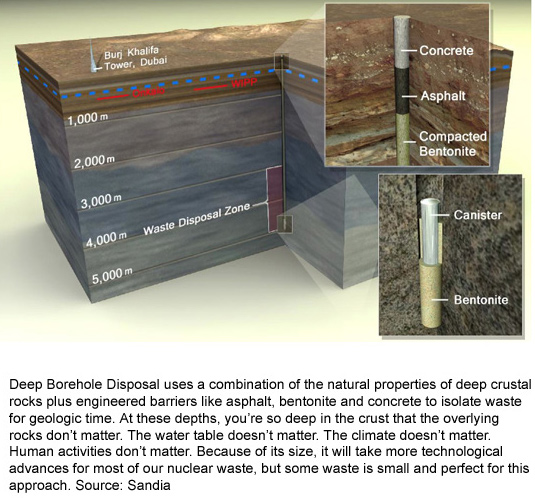
 Can’t We Just Throw Our Nuclear Waste Down A Deep Hole? http://www.forbes.com/sites/jamesconca/2015/03/05/cant-we-just-throw-our-nuclear-waste-down-a-deep-hole/ James Conca 5 Mar 15 Um…yes, we can. It’s called Deep Borehole Disposal and is pretty easy for some nuclear waste. Especially some highly radioactive materials that have sat in some fairly small capsules for almost 40 years.
This was exactly the topic of discussion in Washington this week when Secretary of Energy Ernest Moniz answered questions from Rep. Dan Newhouse (R-WA) at a House Science, Space and Technology committee hearing (Tri-City Herald).
The answer from Moniz was positive. He discussed a pilot project that would demonstrate the idea of deep borehole disposal using these capsules.
Deep borehole disposal is simple. Drill a very deep hole – 3 miles or so – put the waste in it and fill it up with some special layers, but mainly crushed rock and cement. As geologists, we know how many millions of years it takes for anything to get up from that depth in the Earth’s crust.
Thorium nuclear reactors – an expensive waste of time
 Why are we not using Thorium instead of Uranium for power? https://in.answers.yahoo.com/question/index?qid=20150303142722AA751rC “I have followed this technology for some years with interest. It has merits and one great demerit – it is very costly – at least twice the cost of most renewables. So why go this route? The so called renaissance of uranium reactors has become a fiasco. The Finnish project with Areva was to cost $2500 per Mwe for the first prototype,with $1200 per Mwe in the following standardized units.The reality is 3 years behind schedule, 77% over budget with no hope of completion at less than a 100% overrun, and standardized successors now priced at $5000 per Mwe, four times the hoped for cost.
There is no reason whatever to claim thorium based reactors will be any cheaper. We cannot afford to waste precious time and money on nuclear, but should have a crash implementation of commercializing renewables like wind and solar thermal electric.”
Government’s Intergenerational report is a junk document and should be rewritten
Green groups slam report as inadequate ELISE SCOTT AAP MARCH 05, 2015 Daily Telegraph, “………despite the report being a snapshot of the next 40 years, it fails to detail any post-2020 emission reduction goals or the long-term costs of climate change.
Climate Institute chief John Connor believes the report shines a spotlight on the inadequacies of government policies and ignores economic challenges and opportunities.It refers to recent analysis that shows changes in the frequency of extreme weather but contains just one sentence about future impacts.”It’s almost breathtaking,” Mr Connor told AAP.”It’s woefully inadequate. It doesn’t even deal with this generation of policy, let alone the next.
 “The Australian Greens are demanding the report be rewritten.”This is a junk document and should be tossed away,” leader Christine Milne told reporters in Canberra.Senator Milne wanted to see “serious modelling” on the costs of global warming.The absence of long-term projections is a shared concern of the World Wildlife Foundation and the Australian Conservation Foundation.ACF spokesman Josh Meadows said climate change was the one area that could be planned for, yet the report ignored forward-thinking completely……..
Mr Connor welcomed the government’s acknowledgement the international community had committed to limiting global warming to 2C.The intergenerational report produced by Labor in 2010 found unmitigated climate change would leave Australian GDP in 2100 about eight per cent lower than the level it would be in the absence of climate change. http://www.dailytelegraph.com.au/news/breaking-news/green-groups-slam-report-as-inadequate/story-fni0xqi3-1227249614927
Marcia Langton doesn’t get it right on mining agreements
 Marcia Langton should go back to the drawing board on mining agreement praise Australian Conservation Foundation, March 6, 2015 Declaring mining agreements a success in Aboriginal communities after reviewing less than two percent of agreements seems a stretch, writes Dave Sweeney
Earlier this month mining executives mingled with politicians in federal Parliament’s Mural Hall as Indigenous Affairs Minister Nigel Scullion launched a new publication from the Minerals Council of Australia.
From Conflict to Cooperation, by Melbourne University’s Professor Marcia Langton, sets out to examine the “transformations and challenges in the engagement between the Australian minerals industry and Australian Indigenous peoples”.
Professor Langton’s main contention is that there has been an enormous improvement in relations and outcomes between miners and Aboriginal peoples over the past two to four decades. Aboriginal communities have experienced significant economic benefit and these now need to be consolidated through regulatory reform and a new economically driven Aboriginal financial trust and organisational structure.
Professor Langton has fulsome praise for the collaborative, indeed transformative, nature of the new era of Industry-Indigenous relationships and lauds mining companies and executives.
Two aspects of this paper are surprising.
One, Professor Langton sharply identifies the institutional bias and capacity constraints that work against Aboriginal communities and organisations in complex negotiations processes, yet she still claims the system delivers.
Two, her enthusiasm about the benefits of mining agreements is based on surprisingly scant information.
Late last decade the Native Title Working Group identified obstacles that frequently get in the way of successful agreements between Indigenous communities and mining companies. The working group noted that “there are only a limited number of good agreements to provide models… The reasons for the absence of more agreements containing substantial financial and other benefits for traditional owners after almost 15 years of the operation of the Native Title Act 1993 (NTA) is, in itself, deserving of inquiry”.
Indeed, it still is. This fact is highlighted by the confusing data on Aboriginal employment in the resources sector and the lack of detail on economic benefits.
The plentiful talk of jobs and dollars is not backed up with many hard facts.
Mining Agreements are rarely agreed and seldom seen. In the everyday world an agreement is a deal based on shared understanding, but in the world of the Native Title Amendment Act (1998) and the mining sector it means the right to negotiate, but not to say no……..https://www.acfonline.org.au/news-media/acf-opinion/marcia-langton-should-go-back-drawing-board-mining-agreement-praise
1 This month

of the week – Australians for War Powers Reform (AWPR)
To see nuclear-related stories in greater depth and intensity
 Antinuclear