Murky dealings in Western Australia’s Kintyre uranium mine proposal
Do the Martu people really want uranium mined nearby their communities? It does not sound like it but their permission is ‘official’…….
Wiluna Elder Geoff Cooke will fight to the end to prevent mining on his Country.
“We are the custodians of the land. Uranium is a poison. Our rivers will be poisoned. Our trees will be poisoned. Our food will be contaminated. Our people will become sick.

Uranium mine proposal approved – on Martu Country, The Stringer, by Gerry Georgatos March 7th, 2015 Western Australia’s largest national park is facing its biggest threat – uranium mining. Last Thursday, the State’s Environment Minister approved a uranium mine proposal while in the background an investigation is plodding along into allegations of improper dealings by some Traditional Owners.
Anti-uranium campaigner and conservationist Mia Pepper said, “The Minister, Albert Jacobs, approved the proposed uranium mine at Kintyre, a unique ecosystem that was excised from the Karlamilyi National Park to allow mining.” In the Northern Territory, Jabiluka was excised from the World Heritage listed Kakadu. When it comes to uranium mining – and mining in general – anything can happen, even in the middle of a world famous and world heritage listed national park.
“Uranium mining would impact on scarce water resources and a number of significant and vulnerable species including the bilby, marsupial mole and rock wallaby, ” said Ms Pepper.
The Federal Environment Minister, Greg Hunt, will decide the final approval check, but it is a given. The national park and Kintyre are surrounded by Martu communities. It is Martu Country but for those with the huge quid in mind, it is uranium country. The Parnngurr community has been fighting against the uranium proposal. Continue reading
India’s renewable energy revolution: what does it mean for Australia?
 India has detailed a radical shake-up in energy policy which has ramifications for Australia.
India’s intrepid and well-articulated energy policy stands in stark relief to Australia. If our national energy policy were actually articulated, it might be “let’s keep on digging ever bigger holes in the ground, cross our fingers and hope for the best”.
By 2020, the country aims to have electrification of the remaining 20,000 villages, including by way of off-grid solar.
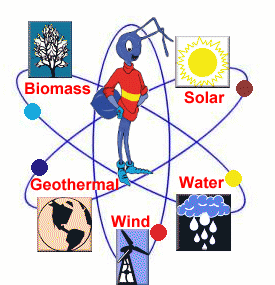
In its plan to increase renewable energy capacity by 175GW by 2022 (from its current 34GW), the Indian budget is targeting 100GW of solar, 60GW of wind, 10GW of new biomass and 5GW of run-of-river hydro installs.
 The sun isn’t shining on ‘old energy’ sectors, The Age, March 9, 2015 Michael West Business columnist “.…..Electricity prices have run too high. Renewable energy is rapidly getting cheaper, more efficient, and power companies are desperately trying to lock in customers and stave off the incursion from renewables………
Deutsche Bank released a research report last month which predicted solar energy was well on its way to replacing conventional fuels as the major source of energy in the world, generating $5 trillion in revenue by 2030. That’s $5000 billion.
At the moment, there are 130GW of solar installed; 1 per cent of the $2 trillion annual global electricity market.
By 2050, Deutsche said, solar would have captured 30 per cent of the market.
The rise in renewable efficiency has been spectacular. “Grid parity” is nigh; Continue reading
Canada’s nuclear company Lavalin makes Canada lead in World Bank’s corruption list
 Why have Australian politicians Labor Treasurer Tom Koutsantonis (South Australia) and Liberal federal Trade Minister Andrew Robb chosen Canada’s nuclear bureaucracy to take part in South Australia’s Royal Commission into Nuclear Power?
Canada’s Corrupt Corporations: World Bank’s Corrupt Companies Blacklist, Dominated By Canada By Global Research News, January 05, 2015 The Huffington Post Canada has the dubious honour of being home to the largest number of firms on a World Bank blacklist of corrupt companies.
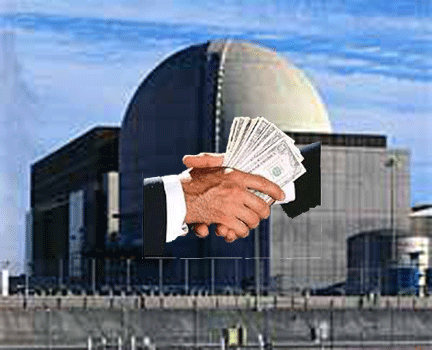 But virtually all of that can be attributed to one Canadian company — SNC Lavalin, the construction and engineering giant whose name is becoming a paragon of Canadian corruption.
Of the more than 600 companies now listed as barred from doing business with the World Bank over corruption, 117 are Canadian, the most of any one country. And of those, 115 represent SNC-Lavalin and its subsidiaries, the Financial Post reports.
Among the listed SNC subsidiaries are Candu Energy, which designs CANDU nuclear reactors, and Evergreen Rapid Transit Holdings, the SNC-Lavalin company established to build Vancouver’s new Sky Train line.
The World Bank’s head of corruption investigations, James David Fielder, told the paper the SNC subsidiaries’ inclusion was due to “a World Bank investigation relating to the Padma Bridge project in Bangladesh where World Bank investigators closely cooperated with the Royal Canadian Mounted Police in an effort to promote collective action against corruption.”……
Bangladesh is not the only place where SNC-Lavalin is alleged to have engaged in bribery.
The company’s former CEO, Pierre Duhaime, was arrested last year on corruption charges related to $56 million in “questionable payments” believed linked to some of the company’s overseas operations. Duhaime was arrested again earlier this year in connection with allegations of corruption surrounding a contract to build a new facility for the McGill University Health Centre (MUHC) in Montreal.
SNC-Lavalin’s links to the former Gadhafi regime in Libya are said to have been so close that the company offered one of the dictator’s sons a vice-president position in 2008, according to news reports.
SNC-Lavalin is also alleged to have been engaged in corrupt practices in Algeria. http://www.globalresearch.ca/canadas-corrupt-corporations-world-banks-corrupt-companies-blacklist-dominated-by-canada/5422924

Don’t let big business control small scale energy systems
 we will need to reduce the power and influence of the fossil fuel companies, kicking their representatives out of government and moving subsidies away from polluting fuels and towards clean energy. Divestment campaigns shouldn’t just call for an end to fossil fuel funding but galvanize a shift in public investments into cleaner alternatives: not corporate renewable schemes but community energy, sustainable local transport and energy efficiency projects.
We can’t just sit back and expect the falling price of solar and wind to sweep away the old energy order. Renewable energy could be a powerful tool for dismantling the current failed system – but we need to use it wisely, and not let it fall into the wrong hands!
 Whose renewable future? New Internationalist MARCH 2015 Is big business poised to capture the renewables revolution? Danny Chivers draws up the battle lines. “……..This increasing reliance on companies, not governments, as providers of energy services and infrastructure is driven by a global economic system based on market ‘liberalization’, profit maximization and endless growth. It’s a trend that we need to reverse if we want renewable energy truly to be a force for good.
Luckily, alternative models are appearing all over the world. Renewable energy co-operatives have hundreds of thousands of members and are building and installing their own solar, wind and small-scale hydro projects from Indonesia to Costa Rica. Continue reading
ABC Radio broadcast on “Merchants of Doubt”
 AUDIO ABC Radio National Science Show program broadcast http://www.abc.net.au/radionational/programs/scienceshow/merchants-of–doubt/6286330 7 March 2015
The book Merchants of Doubt is now a film. In Merchants of Doubt, historians Naomi Oreskes and Erik Conway explain how a loose-knit group of high-level scientists, with extensive political connections, ran effective campaigns to mislead the public and deny well-established scientific knowledge over four decades. In chapters addressing tobacco, acid rain, the ozone hole, global warming, and DDT, Oreskes and Conway expose this dark corner of the American scientific community, showing how the ideology of free market fundamentalism, aided by a too-compliant media, has skewed public understanding of some of the most pressing issues of our era. (from merchantsofdoubt.org)
1 This month

of the week – Australians for War Powers Reform (AWPR)
To see nuclear-related stories in greater depth and intensity
 Antinuclear