South Australian voters reject expansion of nuclear industry
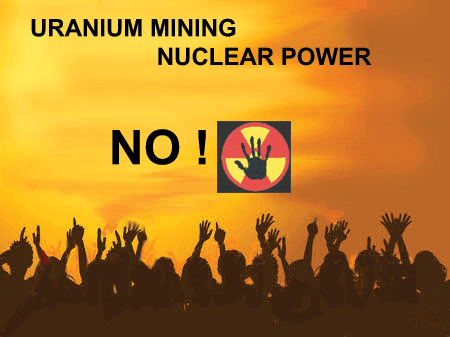 Voters reject Premier Jay Weatherill’s agenda to transform the state, Adelaide Advertiser PAUL STARICK THE ADVERTISER MARCH 13, 2015 A majority of respondents reject plans to switch South Australia’s time zone, downgrade hospital emergency departments, create more “super” schools, expand the nuclear industry and overhaul tax…….
Key findings of the survey, which involved people being interviewed at numerous times and locations across metropolitan Adelaide and regional SA, were:
ALMOST 70 per cent opposed furthering SA’s role in the nuclear industry, including a power station, waste dump or enrichment facility…..
Nuclear waste storage banned by law in South Australia
 South Australia Nuclear Waste Storage Facility (Prohibition) Act 2000 An Act to prohibit the establishment of certain nuclear waste storage facilities in South Australia; and for other purposes.
—Objects of Act The objects of this Act are to protect the health, safety and welfare of the people of South Australia and to protect the environment in which they live by prohibiting the establishment of certain nuclear waste storage facilities in this State.
nuclear waste means— (a) Category A, Category B or Category C radioactive waste as defined in the Code of Practice; or (b) any waste material that contains a radioactive substance and is derived from— (i) the operations or decommissioning of— (A) a nuclear reactor; or (B) a nuclear weapons facility; or (C) a radioisotope production facility; or (D) a uranium enrichment plant; or (ii) the testing, use or decommissioning of nuclear weapons; or (iii) the conditioning or reprocessing of spent nuclear fuel;
nuclear waste storage facility means any installation for the storage or disposal of nuclear waste; public authority has the same meaning as in the Environment Protection Act 1993; radioactive substance means any substance that spontaneously emits ionizing radiation. 5—Act binds Crown This Act binds the Crown in right of the State and, in so far as the legislative power of the State permits, in all its other capacities……..
13—No public money to be used to encourage or finance construction or operation of nuclear waste storage facility Despite any other Act or law to the contrary, no public money may be appropriated, expended or advanced to any person for the purpose of encouraging or financing any activity associated with the construction or operation of a nuclear waste storage facility in this State……
Asia Pacific Greens call for a nuclear free region
 Green Parties call for a nuclear free region on anniversary of Fukushima, Global Greens 10 March, 2015 “……The Green Parties of the Asia Pacific region offer our sincere condolences for the tragedy suffered, and our solidarity with the people and Green Party of Japan.
We use this anniversary to remind the Governments of the world, that it is the responsibility of all nations to ensure the safety of our planet.
There is no doubt, the suffering for the Japanese people has been immense, especially for those living in and around Fukushima, and it is not yet over. The world has already witnessed suffering following nuclear disasters in Chernobyl (Ukraine), Khystym (Russia), Sellafield (United Kingdom), and Three Mile Island (USA). However, there are currently 71 new nuclear plants under construction around the world, the majority of which are in the Asia Pacific region (China 26, Taiwan 2, India 6, Japan 2, Pakistan 2, South Korea 5). (3)
It is time we fully committed to a nuclear-free world.
Whether your country is listed as one of these constructing further nuclear plants or not, we are all implicated in the nuclear supply chain – through uranium mining, refining, power generation, radioactive waste, nuclear weapons, or through complicity by not discouraging the practice of our trading partners.
 Green Parties around the globe oppose the expansion of nuclear power and are working to rapidly phase it out. Nuclear energy is not the emissions-free solution that the world needs to address climate change, in fact, it is a net producer of greenhouse gases.(4)
As we have seen with Fukushima, the human and planetary costs are too high, and when examining the nuclear supply chain, it is simply ineffective at reducing emissions.
We need to stay focused on transitioning to clean renewable energy sources – these are not only safer, but offer a more equitable solution. We can achieve economic development with genuine quality of life through a sustainable smart green economy. Examples of this kind of development include community-based, co-operative, renewable energy operations complemented by reduced energy consumption through electricity saving government policies.
At this critical moment, we ask the people Asia Pacific to call on their governments to:
- Commit to a nuclear-free world.
- Move to clean equitable renewable energy solutions for your country
- Provide democratic process in citizens’ referenda on nuclear power.
- Ensure information transparency, participatory democracy, social and environmental justice for residents living near power plants and nuclear waste fields.
- Prioritise in decision-making the wellbeing of our planet and future generations.
Signatories:
The Asia-Pacific Greens Federation (APGF) Coordination Committee
The APGF’s members are:
- Australia: Australian Greens
- India: Uttarakhand Parivartan Party (UKPP)
- Indonesia: Sarekat Hijau (Indonesian Green Union)
- Japan: Greens Japan
- Korea, Republic of: Green Party Korea
- Mongolia: Mongolian Green Party
- Mongolia: Civil Will Green Party of Mongolia
- Nepal: Nepali Greens (Green Civil Society)
- New Zealand: Green Party of Aotearoa New Zealand
- Pakistan: Pakistan Green Party
- Taiwan: Green Party Taiwan http://www.globalgreens.org/news/green-parties-call-nuclear-free-region-anniversary-fukushima
Hans-Peter Schnelboegl’s submission on draft Terms of Reference for Nuclear Royal Commission
the Royal Commission itself may act in breach of the “Nuclear Waste Storage Facility (Prohibition) Act” by promoting radioactive waste storage in SA.
Submission on draft Terms of Reference to the SA Royal Commission on our role in nuclear energy
The draft Terms of Reference for the Royal Commission are heavily leaning in favour of new nuclear ventures rather than investigating the issue impartially:
The first paragraph includes supportive phrases like:
“whether there is any potential for the expansion”
”any circumstances necessary for such an increase”
“opportunities created by expanding”
“the measures that might be required to facilitate and regulate that
increase in activity”
This is balanced by just one cautious phrase:
“any risks … created by expanding”
The other paragraphs of the draft ToR’s show a similar imbalance.
I request that the ToR’s be expanded to explicitly include
Precautionary Principle
Intergenerational Equity
Long-term Consequences
Public and Workers’ Health
Impacts on Freedom and Democracy
Nuclear versus Alternative energy sources – comparison of cost and risks
The reasons are in short:
It is well known that the nuclear industry involves severe dangers from radiation exposure. Radiation can not be perceived by any of the human senses. The health consequences of exposure to radiation are,
in most cases, experienced much later when no connection to the exposure is drawn.
Furthermore, nuclear ventures are characterised by the potential for severest nuclear accidents and incidents like The nuclear bombing of Hiroshima and Nagasaki where hundreds of thousands of inhabitants were incinerated in an instant or slowly died from burns, cancers …
The explosion of a nuclear reactor at Chernobyl. Scientists using mainly epidemiological data have shown that by 2004 already 1 million people had died from the consequences of the accident. This number is growing.
The meltdown of four Fukushima reactors fuelled by Australian uranium.
The resulting contamination of our oceans, especially the Pacific Ocean, is steadily increasing.
Uranium mining in Australia has a deadly impact on mine workers, nearby residents and, most of all, on future generations.
For decades Australian governments have refused to establish a database for uranium mine workers’ health, and the currently partially established database seems skewed like the draft terms of this Royal
Commission.
It seems mining companies are now using highly sensitive blood tests to detect cancers and weakened defences against cancers early, and then simply terminate employment.
Much worse than the impact on mine workers will be the impact on future generations using contaminated groundwater and/or being exposed to radioactive dust storms dispersing the fine radioactive materials in tailings dams.
This is compounded by the fact that the hazards of radiation and the proper maintenance of radiation hot spots will be forgotten within a few hundred years. Already today local kids and tourists are swimming in contaminated mining dams.
The Impacts on Freedom and Democracy stem mainly from the strong public opposition to any nuclear industries and the subsequent attempts by governments to quell that opposition.
This happened when the French government developed its vast nuclear industry: Widespread opposition and protests were suffocated by horrendous police brutality permanently damaging French democracy.
In South Australia, police brutality led to the locking up of peaceful protesters in a shipping container at the Beverley uranium mine site – in full sun, for hours without water and toilets. This resulted in a
million dollar court verdict against the South Australian government, i.e. the SA taxpayer.
Those responsible for ignoring the public’s opposition to uranium mining and approving the hazardous mine, for brutally suffocating peaceful protests with methods akin to torture, they were neither jailed nor fined.
Another SA example of destructive impacts of nuclear industries on freedom and democracy is the special status of the Olympic Dam mine: A number of public rights have been suspended for the mine.
For example FoI: The SA government is not allowed to pass on information from the mine without the consent of the mine. This is highly relevant when it comes to the frequent accidents and incidents
at the site. I remember two major fires of very large storage ponds for used process chemicals (kerosene and the like) and numerous pipes resulting in a plum of thick smoke passing over SA. There was very
little or no reliable information available about the radioactive contents of the smoke.
Further, Aboriginal heritage protection and certain environmental regulations have been suspended for the Olympic Dam uranium mine.
And finally, the Royal Commission itself may act in breach of the “Nuclear Waste Storage Facility (Prohibition) Act” by promoting radioactive waste storage in SA.
Queensland Labor says NO to uranium mining
 Labor says no to uranium mining in Queensland, Brisbane Times, Amy Remeikis Queensland state political reporter 14 Mar 15 Labor plans on scuttling a Queensland industry before it even begins.
The Newman Government announced it would overturn the long-time ban on uranium mining in 2012 and opened applications in August 2014.
Queensland’s Mary Kathleen Mine, near Mount Isa, closed in 1982, seven years before uranium mining was banned in the state……..
a spokesman for the new government said uranium mining would once again be kiboshed in Queensland.
Andrew Cripps ( Mines Minister in the previous Liberal government) said it would not have any impact.
“The Department of Natural Resources and Mines has not received one single application for a uranium mining lease since the previous LNP government’s regulatory framework for uranium mining started on 31 July 2014,” he said……………http://www.brisbanetimes.com.au/queensland/labor-says-no-to-uranium-mining-in-queensland-20150313-143pzi.html
Australia’s remote ecosystems need the care of Aboriginal communities
 Remote indigenous communities are vital for our fragile ecosystems – The Conversation http://bsllibrary.org.au/equity-and-climate-change/remote-indigenous-communities-are-vital-for-our-fragile-ecosystems-the-conversation-52920/ MARCH 13TH, 2015 Extract from an article by Craig Moritz, Emilie-Jane Ens and Jon Altman
Amid the questioning of government support for remote Aboriginal communities and what Prime Minister Tony Abbott called the “lifestyle choices” of those who live there, the growing role of Aboriginal management of large areas of remote Australia has been overlooked.
There are 1,200 small, discrete Indigenous communities in regional and remote Australia with various sources of income, including federal government “Working on Country” funding, as well as meagre and tightly regulated welfare payments. They fulfil a key role in populating large areas of outback Australia …
Outback Australia has high biodiversity and would otherwise be unoccupied – and so open to a host of threats including intense and widespread wildfires and invasive species. There is also a long-standing recognition of outstations as important to maintaining the connection of remote-living Aboriginal people to their culture and customary responsibilities.
More than a third of Australia is recognised as Aboriginal owned and managed land, mainly in very remote regions. Given ancestral connections and Aboriginal people’s customary obligations to Country (the land with its inherent natural, cultural and spiritual meaning), they are the best placed to look after it, it is a practice that can be very important to them.
SOURCE: Moritz, Craig; Ens, Emilie-Jane and Altman, Jon. “Remote indigenous communities are vital for our fragile ecosystems.” The Conversation 13th March 2015
Utah’s dilemma over depleted uranium wastes

 Will Utah bury nation’s leftover depleted uranium?
 Renewable Energy Target to be raised in Norway and Sweden
Norway and Sweden agree to raise renewable energy target http://af.reuters.com/article/energyOilNews/idAFL5N0WF0YY20150313 OSLO, March 13 (Reuters) – Norway and Sweden agreed on Friday to increase a joint 2020 renewable energy target by almost 8 percent under a subsidy scheme which could lead to higher energy prices for consumers.
Under the new target, the two Nordic countries aim to raise the amount of electricity they produce in total from renewable energy sources such as wind, hydro or biomass to 28.4 terawatt-hours (TWh) per year by 2020 from 26.4 TWh. Continue reading
Crash of truck carrying radioactive material, in Bosnia
 Van transporting radioactive material crashes in Bosnia Rt.com 13 Mar 15, A van carrying radioactive isotope Iridium-192 has crashed in north Bosnia, local media reported. The vehicle ran off the road after colliding with a car.
The police blocked the area around the crash site. Bosnia’s nuclear safety agency reported that no radiation leak had been detected.
The van was transporting “apparatus with radioactive material” from the Vinca Institute of Nuclear Sciences, the Banja Luka-based Nezavisne Novine newspaper reported.
After the collision, the van overturned. The radioactive material, however, which is in a solid state and poses no risk of large-scale contamination, remained contained, the authorities said……..
The driver of the car was killed in the crash, while the van driver and a passenger traveling with him survived.
Iridium-192 is a radioactive isotope with a half-life of 73.83 days. It is also a strong gamma ray emitter and is commonly used as a gamma ray source in radiography and radiotherapy as a radiation source.
According to the UN, Iridium-192 is the isotope that most frequently goes missing when radioactive materials are used to make a dirty bomb.http://rt.com/news/240425-bosnia-herzegovina-nuclear-crash/
Nuclear waste that originated in Lucas Heights is due to return to Australia soon
 Why don’t people realise the distinction between the relatively small amounts of nuclear waste (originating at Lucas Heights) that Australia is contracted to take back, and the greedy dream of some to import nuclear wastes from other countries?
Four shipments of Australian radioactive waste was sent to France for “reprocessing” between 1999 and 2004, and the first of it will be returned by sea to Australia between September and March 2016.
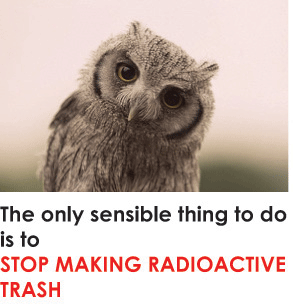 More time needed to plan for nuclear waste dump: councils, SMH, March 13, 2015 – Peter Ker Resources reporter Councils interested in housing Australia’s radioactive waste dump have complained the Abbott government’s tender period is too short for them to make a decision, inclusive with their communities, on the divisive issue.
The government has given landowners and communities two months to nominate as the best location for the national waste facility, which will permanently house intermediate level nuclear waste produced at the Lucas Heights reactors in southern Sydney. Continue reading
Toro Uranium CEO Vanessa Guthrie hanging out for that distant day when uranium prices might rise
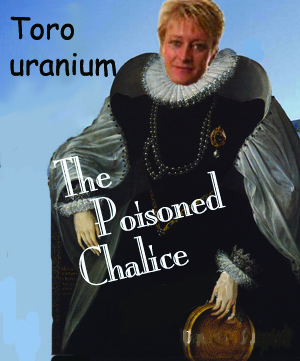 Toro Energy Managing Director Dr. Vanessa Guthrie Says Be Patient and Persistent in Tough Times, Uranium Investing News,March 13, 2015, Toro Energy Ltd. (ASX:TOE) Managing Director Dr. Vanessa Guthrie says what makes Toro Energy stand out from any other uranium company in its class is that, “we are the only project approved, ready to go, and the most advanced in terms of engineering and resource studies in Australia. [And]
all we are now waiting for is the time to come back… the market to come back, with the uranium price, which will actually put Wiluna into production.” In the last 12 months, major funds have invested in Toro Energy: $5 million from RealFin Capital Partners, and a $20 million investment from The Sentient Group.http://uraniuminvestingnews.com/
South Australia warned on the risks of the nuclear industry
‘Don’t underestimate risks’: Fukushima investigator’s words of advice for South Australia’s nuclear industry, SMH 13 Mar 15, A Fukushima nuclear disaster investigator has warned South Australians to consider risks carefully before getting involved in an expanded nuclear industry.
A royal commission will look into the potential to expand South Australia’s role in the nuclear industryfrom next week and will include the consideration of power generation.
Professor Nobumasa Akiyama was a member of the independent investigation panel into the triple nuclear meltdown at Fukushima, Japan, four years ago this week, which started following damage caused by a tsunami.
Some 120,000 people are still unable to return to their homes because of high radiation levels.
Professor Akiyama had a word of warning for South Australians. “Think about the unthinkable,” he said.
“I think that’s the important principle, to think about the risk of the nuclear power plants.”
He said Japanese people had underestimated the risk…… “In the case of Japan, people experienced the Chernobyl and Three Mile Island accidents, but saw it as the accidents of others.
“A nuclear accident anywhere is a nuclear accident everywhere.”
New South Wales election candidates called upon to declare their policy on wind farms

 Wind farm industry weighs into New South Wales election campaign http://www.abc.net.au/news/2015-03-13/wind-farm-industry-weigh-into-nsw-election/6314658 ABC Rural By Michael Condon The wind farm industry has called on all New South Wales election candidates to declare whether or not they support wind farms being built.
Andrew Bray, national co-ordinator of the Wind Alliance, said wind farms were a perfect fit on many farms and could really boost jobs and economic activity in rural areas.
“Voters have the right to know how the candidates stand on wind farms and whether they will support wind turbines being built,” he said. “New wind projects are really drivers for regional economies.
“There is a real strong natural wind resource around New South Wales and that wind resource can be developed and harnessed to create jobs and also to provide energy that is clean and not damage 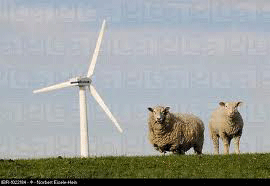 farmland.
“Wind farms coexist really well with grazing, in particular, and it doesn’t use water and it is no threat to the water table, compared with coal seam gas or mining operations.
“It is the kind of energy-producing technology that can work well with farming land.”
Mr Bray said wind farms were supported by candidates of all political persuasion, not just the Greens or Labor. Federally Queensland Coalition MP Warren Enstch had been very supportive as had Rob Stokes, a NSW state Liberal.
Mounted police, canine squad & dozens of police move Aboriginal protestors at Perth’s Heirisson Island
 Heirisson Island Aboriginal protest: Police move in to clear campers, ABC News 13 Mar 15 By Rebecca Trigger Angry scenes erupted at Perth’s Heirisson Island today as police and the city moved to dismantle an Aboriginal camp, set up in response to the State Government’s plan to close remote communities.
Dozens of officers, including mounted police and the canine squad moved in on the island at about 3:00pm, Continue reading
Melbourne rally in protest at plan to close remote Aboriginal communities
Aboriginal rally brings Melbourne CBD to standstil SAMANTHA LANDY HERALD SUN MARCH 13, 2015 HUNDREDS of Aboriginal rights activists have shut down Melbourne’s CBD in a protest against the planned closure of remote indigenous communities in Western Australia. The demonstrators brought Swanston St to a standstill during the evening peak, disrupting traffic and almost a dozen tram routes for about an hour and a half from 6pm…….
Ms Onus said Mr Abbott’s comments that living in remote communities was a “lifestyle choice” were “blatantly racist”. “These people live where their ancestors have been for tens of thousands of years,” she said.
“There will be (thousands of) Aboriginal refugees if these communities close. “We know what happens to homeless Aboriginal people — they’re often criminalised. “They’re gonna end up in prisons and hospitals and homeless shelters.”
Ms Onus said protests were also being held in other capital cities.
Victoria Police spokesman Adam West said there were no incidents during the protest.samantha.landy@news.com.au http://www.heraldsun.com.au/news/victoria/aboriginal-rally-brings-melbourne-cbd-to-standstill/story-fni0fit3-1227261910970
1 This month

of the week – Australians for War Powers Reform (AWPR)
To see nuclear-related stories in greater depth and intensity
 Antinuclear