Timeline for the struggle for Aboriginal land rights
Aboriginal people have a responsibility to live on Country
Closing the divide between all Australians, The Age, March 13, 2015 Justin Mohamed
Aboriginal organisations and communities have raised strong concerns about the impact community closures will have.It is not purely an economic equation. Continue reading
A new project off the coast of Australia may make wave power a reality
Renewable energy Looks swell, The Economist 14 Mar 15 A new project off the coast of Australia may make wave power a reality
Mar 14th 2015 NO LAND stands between Antarctica and Australia’s west coast—just a vast ocean, rippled and rocked by the Roaring Forties. For centuries these westerlies, which blow between latitudes 40° S and 50° S, powered ships sailing from Europe to Asia. These days, they are also creating waves in the world of renewable energy. At the end of February, a demonstration project designed to use the ocean swell they produce went live. As a result Australia’s largest naval base now gets part of both its electricity and its fresh water courtesy of the ’Forties.

Carnegie Wave Energy, in Perth, has been working since 1999 on what it calls CETO technology. Ceto was the ancient Greek goddess of sea monsters, and Carnegie’s particular monsters are buoys that resemble giant macaroons. They float a metre or two below the ocean’s surface, bobbing up and down in the swell and generating electricity as they do so. The current version, CETO 5, has a capacity of 240kW per buoy. Three of the beasts are now tethered to the sea bed 3km from HMAS Stirling, on Garden Island. They also help to run a desalination plant on the base, for fresh water is a valuable commodity in Western Australia’s arid climate………
Carnegie aspires to bigger and better buoys it hopes will generate a megawatt each when launched in 2017. These versions, CETO 6, will be 20 metres across and will produce electricity inside themselves instead of at an onshore power plant. That means no pipe is needed; a submarine power cable will do instead……….
Carnegie also has its sights on markets farther afield. Military bases around the world need secure supplies of energy and water. And wave energy is attractive to island countries like the Maldives that must, at the moment, import fossil fuel at some expense. Whether submarine wave power of this sort will ever become truly mainstream is moot. But Carnegie is showing that, in appropriate circumstances, it could indeed have the wind behind it. http://www.economist.com/news/science-and-technology/21646176-new-project-coast-australia-may-make-wave-power-reality-looks-swell
1 This month
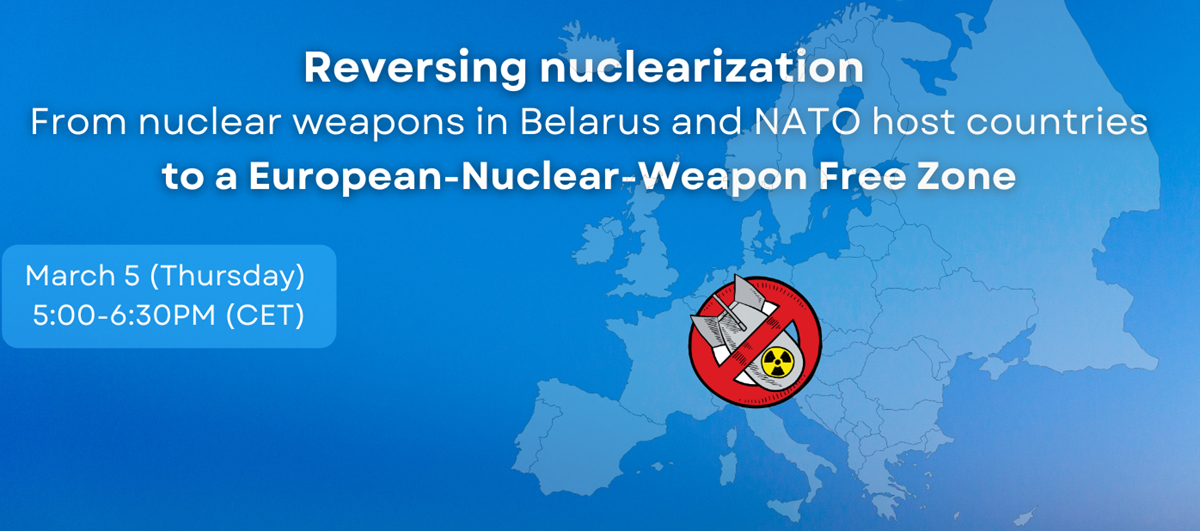
6 March -Online – Reversing nuclearization:
From nuclear weapons in Belarus and NATO host countries to a European-Nuclear-Weapon Free Zone
Mar 6, 2026 03:00 AM in Canberra, Melbourne, Sydney

of the week – Australians for War Powers Reform (AWPR)
To see nuclear-related stories in greater depth and intensity
 Antinuclear