Waste burial problem from small nuclear reactors is the same as from large ones
 1. Small Reactors and the UK’s Long-Term Nuclear Strategy. nuClear News, March 2015 “……Waste Implications The Committee on Radioactive Waste Management (CoRWM) has looked at the waste implications of a 75GW programme [ i.e Small Modular Reactor or PRISM] which would be equivalent to a programme of over 50 new large-scale reactors.
 It said that since the Government has, so far, been mainly talking about the waste inventory from only a 16GW nuclear new build programme, it should consider defining a maximum size for a deep geological facility (GDF) and make clear that we might need multiple GDFs. (15)
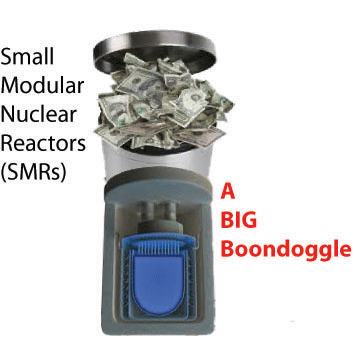 first someone needs to build a massive supply chain. Money for that would presumably come from customer orders – if there were any. The problem is it appears that no one actually wants to buy one
Australian government downplays climate change, invites sceptic to talk on foreign aid
 Critics concerned as government invites climate ‘policy sceptic’ Bjorn Lomborg to address aid staff, The Age March 23, 201 Markus Mannheim One of the world’s most prominent climate contrarians will address Australian diplomats and aid staff on Monday – an invitation that has rankled the opposition and environmental activists……Dr Lomborg is best known for his books
“climate-change alarmists” of focusing on worst-case scenarios and ignoring more positive data……Labor’s foreign affairs spokeswoman, Tanya Plibersek, questioned Dr Lomborg’s involvement.
“It’s up to Julie Bishop to explain why she made this choice,” she said.
“In particular, what kind of message does it send to our Pacific Island neighbours, who say dealing with the effects of climate change are some of the biggest challenges they face?”…….
Climate Council chief executive Amanda McKenzie also opposed the government’s decision to invite Dr Lomborg, saying he had “a history of downplaying the consequences of climate change and also of cherry-picking data”. http://www.theage.com.au/federal-politics/political-news/critics-concerned-as-government-invites-climate-policy-sceptic-bjorn-lomborg-to-address-aid-staff-20150322-1m4tor.html
Climate change, extreme heat and bushfires in WA
 The heat is on: climate change, extreme heat and bushfires in WA http://apo.org.au/research/heat-climate-change-extreme-heat-and-bushfires-wa
- Western Australia is experiencing a long-term increase in average temperatures and in 2014 the state recorded its highest ever annual average maximum temperature.
- The number of heatwave days in Perth has increased by 50% since 1950.
- Nine of Western Australia’s hottest Januarys on record have occurred in the last 10 years.
- The number of days per year
with severe fire danger weather is projected to almost double in south west Western Australia by 2090 if global carbon emissions are not drastically reduced.
Recent fires in Western Australia have been influenced by record hot dry conditions.
- The long-term trend to hotter weather in Western Australia has worsened fire weather and contributed to an increase in the frequency and severity of bushfires.
- The concept of a normal bushfire season is rapidly changing as bushfires increase in number, burn for longer and affect larger areas of land.
- By 2030, the number of professional firefighters in WA will need to more than double to meet the increasing risk of bushfires.
3. The economic, social and environmental costs of increased extreme heat and bushfire activity is likely to be immense.
- In Perth, from 1994-2006, there were over 20 heat attributable deaths per year. If average maximum temperatures were 2°C warmer, this number would almost double to 40 deaths.
- Some of Western Australia’s most fire-prone regions may become unlivable as the risks to lives and property caused by bushfires continue to increase.
- Without effective action on climate change, there will be 20 times the number of dangerous days for outdoor workers by 2070, reducing productivity.
4. Tackling climate change is critical to protecting Western Australia’s prosperity.
- As a nation we must join the global effort to substantially reduce emissions and rapidly move away from fossil fuels to renewable energy if we are to limit the severity of extreme heat and bushfires both in Western Australia and nationally.
UK government finds that small nuclear reactors are more costly than large ones
 1. Small Reactors and the UK’s Long-Term Nuclear Strategy. nuClear News, March 2015 “……..A recent House of Commons Energy and Climate Change Committee investigation into small reactors looked at SMRs but also PRISM reactors – 311MW sodium-cooled fast reactors being promoted as a way of using up the plutonium stockpile at Sellafield – and reactors fuelled by thorium rather than uranium. Small Modular Reactors (SMRs) SMR proponents suggest that mass production of modular reactors could reduce costs, but others agree that SMRs are likely to have higher costs per unit of output than conventional reactors. (5) Even if SMRs could eventually be more cost-effective than larger reactors due to mass production, this advantage would only come into play if large numbers of SMRs were ordered. But utilities are unlikely to order an SMR until they are seen to produce competitively priced electricity. This Catch-22 suggests the technology will require significant government financial help to get off the ground.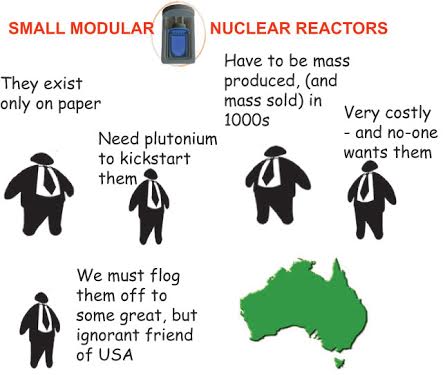
France’s new law for solar or plant rooftops
 France Says New Roofs Must Be Covered In Plants Or Solar Panels http://thinkprogress.org/climate/2015/03/20/3636746/franch-rooftops-go-green/ BY ARI PHILLIPS MARCH 20, 2015
THE SKY’S THE LIMIT UNDER FRANCE’S NEW GREEN ROOFTOP LAW.According to a new French law approved on Thursday, rooftops on new buildings in commercial zones across France must either be partially covered in plants or solar panels.
Green roofs, which cover rooftop space with a layer of grasses, shrubs, flowers, and other forms of flora, offer a number of benefits. They create an insulating effect, reducing the amount of energy needed to heat or cool a building depending on the season. They increase local access to green space, which often comes at a premium in urban environments. They retain rainwater, thus decreasing runoff and any related drainage issues. They provide a space for urban wildlife, such as birds, to congregate and even nest, and they reduce air pollution by acting as natural filters.
Approved by French Parliament, the law was scaled back from initial proposals by environmental groups asking for green roofs to cover the entire rooftop surface of all new buildings. The compromise gave businesses a choice to install solar panels instead or to only cover part of the roof in foliage.
Even in a trimmed-down form, the law is trailblazing and will both change the urban landscape of cities across France as well as potentially inspire other countries to follow suit, especially with the United Nations’ climate summit coming to Paris at the end of the year.
France has lagged behind other major European countries like Germany, Italy and Spain in solar power development. As of last summer, France had just over five gigawatts of photovoltaic capacity, accounting for around one percent of total energy consumption. Germany has nearly 40 GWs installed. France is heavily reliable on nuclear power for its energy, and nuclear generation in 2012 made upabout 83 percent of the country’s total generation.
1 This month
15 April – Zoom –Nuclear Power is Not the Solution
Apr 15, 2026 01:00 AM in Canberra, Melbourne, Sydney

Join the International Physicians for the Prevention of Nuclear War (IPPNW) on Tuesday, April 14th for a timely webinar exploring the risks associated with nuclear power and challenging the myth that it offers a simple, safe, carbon-free solution to the climate crisis

21 April Webinar: No Nuclear Weapons in Australia
Start: 2026-04-21 18:00:00 UTC Canberra, Melbourne, Sydney (GMT+10:00)
End: 2026-04-21 19:30:00 UTC Canberra, Melbourne, Sydney (GMT+10:00)
Event Type: Virtual
A virtual link will be communicated before the event.
Host Contact Info: australia@icanw.org

of the week – Australians for War Powers Reform (AWPR)
To see nuclear-related stories in greater depth and intensity
 Antinuclear