Direct Inaction – Tony Abbott’s climate strategy on behalf of the coal industry
 View from the Street: So, who lost the NSW election the most?, Canberra Times March 29, 2015 – Andrew P Street “…….There have been many, many, many many many many many many many criticisms of Direct Action, the non-climate-change-addressing centrepiece of the government’s climate change policy.
Some have criticised the cost – $2.5 billion – rather than the non-cost of the previous policies such as emissions trading and the carbon not-actually-a-tax; systems which relied on market forces rather than government funding – which is odd, since historically that’s been the Liberal Party’s preferred solution for just about everything esle.
There have been criticisms based on the fact that the planned handing of this public money to private polluting concerns in order that they then reduce emissions does not appear to come with any clear conditions, such as having to give that money back if they then decide to not use it to reduce emissions.
And now “Environment” Minister Greg Hunt has proposed one better: that the energy industry shouldn’t be expected to do anything like, say, reduce the amount of pollution they create in order to get their hands on the cash.
It’s an interesting take on the whole “emissions reduction” model. Climate Institute deputy chief executive Erwin Jackson expressed that more bluntly: “It’s a climate policy you have when you don’t want to reduce emissions.”
The argument from the government is that asking the energy sector to reduce emissions would be just unfair, since it might force them to use more expensive methods to generate electricity which would make power more expensive. Of course, that $2.5 billion fund was entirely designed to compensate companies for the costs of making exactly those sorts of changes, but now Hunt appears to be arguing that asking polluters to actually do something after they’d gone to the trouble of accepting all that free money would seem churlish.
And, of course, we might politely point out – yet again – that Australia could go all-renewable pretty much tomorrow if we wanted. And, of course, that we’re going to be forced to do so at some point anyway.
Still, there’s no reason to rush into doing something sensible and necessary. And hey, what have future generations ever done for Australia’s bottom line, huh?……http://www.canberratimes.com.au/comment/view-from-the-street/view-from-the-street-so-who-lost-the-nsw-election-the-most-20150329-1mafpd.html
Nuclear industry poses threats to wine industry, in USA, – and South Australia?
A 2012 report prepared for the Washington State Wine Commission indicates that the state is the “second largest wine producer in the U.S., after California.” Internationally, Washington State is the third-largest exporter of food and agricultural products, according to state officials, with leading products including fresh fruit, vegetables, dairy products, and seafood.
What is not on the Tri-Cities website, however, is a copy of the DOE report released last year that indicated trace amounts of the radioisotope tritium were found in wine samples collected near Hanford in 2013 “that could have potentially originated from the Hanford Site.” Tritium is considered one of the least-threatening radioisotopes because it generally passes from the body quickly, but it still can increase cancer risk because it releases radiation
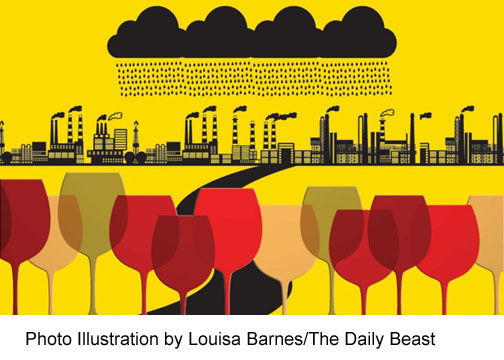
 ATOMIC WINE Wine Country’s Nuclear Threat, The Daily Beast , Bill Conroy. 03.28.15 A nuclear facility in Washington state’s prime wine country is leaching radioactive groundwater and is one natural disaster away from Fukushima 2.0. The Hanford Site, a former nuclear-weapons production facility located in southeastern Washington State near the Oregon border, is one natural disaster away from a Fukushima-like catastrophe, according to environmental groups who also claim the site—which sits near some of the state’s best vineyards—is leaking radioactive groundwater into the nearby Columbia River. Continue reading
Nothing changes. ‘Nuclear Village’ is still controlling Japan
the corruption and collusion of Japan’s nuclear village led to numerous accidents before the Fukushima disaster.
And the corruption and collusion of Japan’s nuclear village was a root cause of the Fukushima disaster itself. On that point the Nuclear Accident Independent Investigation Commission could not have been blunter: “The accident was the result of collusion between the government, the regulators and TEPCO, and the lack of governance by said parties.”
A big part of the post-Fukushima spin is that lessons were learned from the nuclear disaster and improvements made. But the real lesson from this saga is that the nuclear industry – in Japan at least – has learned nothing from its catastrophic mistakes.
As Yotaro Hatamura says, an accident will surely happen again.
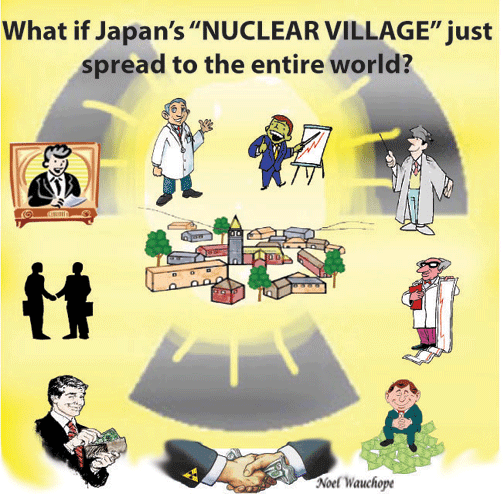
After Fukushima: Japan’s ‘nuclear village’ is back in charge, Ecologist Jim Green28th March 2015 Public opposition to nuclear power in Japan remains strong, writes Jim Green, but piece by piece, Shinzo Abe’s right-wing government has been putting the country’s infamous ‘nuclear village’ back in control – boosted by draconian press censorship laws, massive interest-free loans, and a determination to forget all the ‘lessons’ of Fukushima. Is another big accident inevitable?
Public opposition to reactor restarts (and the nuclear industry more generally) continues to exert some influence in Japan.
Five to seven of the oldest of Japan’s 48 ‘operable’ reactors are likely to be sacrificed to dampen opposition to the restart of other reactors, and local opposition may result in the permanent shut down of some other reactors.
Currently, all 48 of Japan’s ‘operable’ reactors are shut down – and the six reactors at Fukushima Daiichi have been written off.
However, slowly but surely, the corrupt and collusive practices that led to the Fukushima disaster are re-emerging. The ‘nuclear village’ is back in control……..
The Basic Energy Plan approved by Cabinet in April 2014 contains nothing more than a meaningless nod to widespread public anti-nuclear sentiment, stating that dependence on nuclear energy will be reduced ‘to the extent possible’. Continue reading
South Australia needs a statesman like Harry Reid, who prevented nuclear waste importing into Nevada
 There will be a lot written about Harry’s advocacy on behalf of Nevada, and for those efforts he deserves a standing ovation. His actions will resonate for generations. Our grandchildren’s grandchildren will have been kept protected from the threats of nuclear waste. They won’t know who to thank, so on their behalf: Thank you, Harry.
They have considerably to celebrate, and we — and our youngsters and grandchildren — have considerably to be thankful for, including a legacy that will attain far into future generations of Nevadans.
The senator’s list of accomplishments, from preserving the environment to assisting bring overall health care to millions with his championing of the Reasonably priced Care Act, will absolutely frame his legacy. But his everlasting accomplishment story will surely be his good results in staring down the nuclear power business and maintaining Nevada totally free of the highly radioactive nuclear waste that outsiders wanted to ship from distant states and bury inside Yucca Mountain. Continue reading
Nevada, like South Australia, was victim of nuclear bomb tests, and REJECTS nuclear waste dump
let’s look at how many states back in the 1980s had been willing to take the highly radioactive fuel rods off the hands of nuclear energy plant operators: zero. Not a one particular. In particular not Nevada, which currently had paid a human toll as the website of atmospheric atomic bomb detonations. No one gave much believed to the radioactivity in our sky — “don’t worry” — and, boy, had been we snookered.
The truth that two junior congressmen from Nevada would be open to filling a nearby mountain with radiation — placing not only Las Vegas’ economy, but the lives of our youngsters, grandchildren and generations of future Nevadans at threat — is beautiful.
Our delegation in Washington can definitely bicker more than other difficulties, but on Yucca Mountain, Nevadans anticipate solidarity, not betrayal, due to the fact absolutely nothing can be allowed to jeopardize our safe future.
Congressmen’s willingness to money in on Yucca Mountain endangers Nevadans, Herald Recorder , March 29, 2015 Two of our congressmen, who are the least skilled in our Capitol Hill delegation, have much to learn when it comes to watching out for the security, welfare and financial safety of Nevadans.
Cresent Hardy and Mark Amodei, a pair of Republicans, say they’d want Nevada to money in on the opening of Yucca Mountain as the final resting place for highly radioactive nuclear 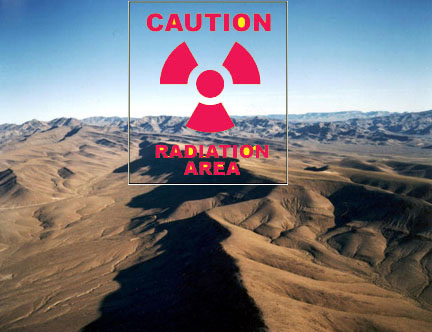 waste if professionals are convinced it would be safe. If the feds and the nuclear power market genuinely want handle of Yucca Mountain, at least they can throw some money our way — perhaps to help fund education or enhance our public infrastructure.
In other words, they’re prepared to place Nevadans in harm’s way if the income is correct. In harm’s way, mainly because no one can be sure that the web site will remain safely benign when filled with this nuclear material. Hardy and Amodei definitely have signaled to Washington and the out-of-state nuclear energy industry that they’re open to bringing lethal nuclear waste to within 90 miles of Las Vegas.
We do not even know where to commence in showing how outrageous their position is…….. Continue reading
Abbott govt’s climate paper for Paris is likely to be a disgrace
 Australia ‘at risk of failing’ biggest climate test in a decade say climate groups, as government releases Paris discussion paper, The Age March 28, 2015 Lisa Cox National political reporter The Abbott government says it will be a constructive player in global climate talks, but environment groups have warned it is laying out a path that puts Australia at risk of failing the most important climate test in a decade.
The government has published an issues paper ahead of public consultation on Australia’s post-2020 emissions reduction targets ahead of a new global climate deal in Paris at the end of this year.
Australia’s targets are under review and the government has promised it will announce new targets mid-year…….the Greens said the paper puts Australia on track for a repeat of 1997 Kyoto talks, where then environment minister Robert Hill argued Australia should be made an exception because of the economy’s high dependence on coal…….. Continue reading
Business bodies call for end to the inertia on Renewable Energy Target
Renewable energy target: Peak bodies call for end to ‘detrimental’ deadlock in open letter to politicians, ABC News 30 Mar 15 By environment and science reporter Jake Sturmer Peak bodies representing clean energy companies and electricity users have written an open letter to Australia’s politicians urging them to resolve the renewable energy target (RET) impasse.
Last week the Government emphatically rejected a proposal from the Clean Energy Council for a compromise on the RET.
A group of peak business associations including the Business Council of Australia, Clean Energy Council (CEC) and Energy Users Association of Australia warned time was running out.
“[The CEC compromise] provides a strong basis for a speedy negotiated outcome,” the letter read.
“The uncertainty of this unresolved review is having a material and detrimental impact on the renewable energy sector, energy users, the traditional energy sector and the broader business community.
“The impact will increase significantly if the issue remains unresolved.”………Both the Coalition and Labor agreed to cut the target, but are yet to settle on how big the reduction should be.
Labor want a figure in the mid-to-high 30,000s GWh and has said there will be no deal if the Government does not lift its offer.
Federal Industry Minister Ian Macfarlane told the ABC last week he was not considering anything above 32,000 GWh. http://www.abc.net.au/news/2015-03-30/ret-impasse-impact-detrimental-peak-bodies-say/6357154
Nevada said “Screw You” when asked to host nuclear waste dump
Washington, make an offer on Yucca Mountain LAS VEGAS REVIEW-JOURNAL 29 Mar 15 Hey, Washington, make us an offer we can’t refuse.If the government is serious about crafting a new national nuclear waste solution that involves asking states to accept and store dangerous military and commercial radioactive material, the least it can do is deliver a pitch to the state it tried to force the waste upon all those years ago.
Obviously, Washington has learned some lessons from the Yucca Mountain Project, the boondoggle to end all boondoggles, one of the most cynical exercises in political power the country has ever seen. About three decades ago, what was supposed to be an objective, scientific exercise in selecting a permanent storage site for the country’s high-level nuclear waste became a rigged game. Congress amended the Nuclear Waste Policy Act in 1987 to make Yucca Mountain, a ridge inside the Nevada Test Site about 100 miles northwest of Las Vegas, theonly site under study for the dump. Nevada had no political clout, so the rest of the country ganged up, scratched other potential locations from the list and said, “You’ll take our waste — and like it.” The legislation became known as the “Screw Nevada bill.”
So we did what any proud people would do. We said, “Screw you.”
Japan’s Government’s massive financial support for TEPCO
 After Fukushima: Japan’s ‘nuclear village’ is back in charge, Ecologist Jim Green28th March 2015 “…….Many have called for TEPCO to be nationalised, or broken up into separate companies, but the LDP government has protected and supported the company. The government has also greatly increased financial support for TEPCO.
For example in January 2014 the government approved an increase in the ceiling for interest-free loans the Nuclear Damage Liability Facilitation Fund is allowed to give TEPCO, from 5 trillion yen to 9 trillion yen (€39.0-70.2 billion)
The government will also cover some of the costs for dealing with the Fukushima accident which TEPCO was previously required to pay, such as an estimated 1.1 trillion yen (€8.6 billion) for interim storage facilities for waste from clean-up activities outside the Fukushima Daiichi plant.
The government has also amended the Electricity Business Act to extend the period for collecting decommissioning funds from electricity rates by up to 10 years after nuclear plants are shut down. The amendments also allow TEPCO to include in electricity rates depreciation costs for additional equipment purchased for the decommissioning of the Fukushima plant………http://www.theecologist.org/News/news_analysis/2810545/after_fukushima_japans_nuclear_village_is_back_in_charge.html
Nuclear industry is not profitable, survives only with government subsidy
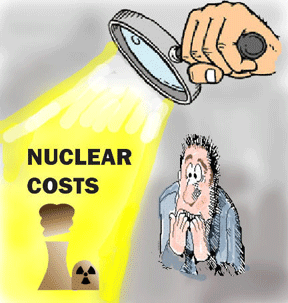 James Corbett: The nuclear industry is not profitable and could not exist without government subsidy.http://investmentwatchblog.com/james-corbett-the-nuclear-industry-is-not-profitable-and-could-not-exist-without-government-subsidy/
$6.8 billion Great Wall of Japan: Four years after the nuclear meltdown at Fukushima, TEPCO, the company that owns the plant, is still struggling to deal with the outpouring of radioactive water. Rainwater flows downhill and through the mangled nuclear plant every day and becomes contaminated on its way to the ocean. TEPCO plans to build a wall of ice by freezing soil surrounding the facility to re-direct the water.
http://finance.yahoo.com/news/6-8-billion-great-wall-235810448.html
Catholic Church backs science and efforts to address climate change
 Papal ecology: Protecting all God’s creatures, respecting God’s plan, VATICAN LETTER By Cindy WoodenCatholic News Service, 26 Mar 15
 VATICAN CITY (CNS) — The Catholic Church supports the efforts of scientists to study the causes and effects of climate change and insists governments and businesses must get serious about specific commitments for protecting the environment.
But Pope Francis, like his predecessors, does not pretend to have a technical solution to the problem. However, he does feel a responsibility to remind Christians of their religious obligation to safeguard creation, beginning with human beings who are created in the image and likeness of God.
Clearing his calendar for a week in late March, Pope Francis rolled up his sleeves to put the final touches on an encyclical letter about the environment; building on what he and his predecessors have said, the document — planned for publication early in the summer — is expected to present ecology as the ultimate pro-life, pro-poor, pro-family issue.
For Pope Francis, like Pope Benedict XVI, safeguarding creation is not simply about protecting plants and animals, or just about ensuring the air, water and land will support human life for generations to come. Those things are part of the task……….
Flying from Sri Lanka to the Philippines in January, Pope Francis told reporters accompanying him that Cardinal Peter Turkson, president of the Pontifical Council for Justice and Peace, and a team from his office had prepared drafts of the ecology document……..http://www.catholicnews.com/data/stories/cns/1501313.htm
1 This month
7 April – WEBINAR – Australia and the Doomsday Clock – Preventing nuclear war through NoFirstUse and other policies
Online | Tuesday April 7, 4:00-5:30pm, Australian Eastern Time / 8:00-9:30am Central Europe Time
– Access the registration link
15 April – Zoom –Nuclear Power is Not the Solution
Apr 15, 2026 01:00 AM in Canberra, Melbourne, Sydney

Join the International Physicians for the Prevention of Nuclear War (IPPNW) on Tuesday, April 14th for a timely webinar exploring the risks associated with nuclear power and challenging the myth that it offers a simple, safe, carbon-free solution to the climate crisis

21 April Webinar: No Nuclear Weapons in Australia
Start: 2026-04-21 18:00:00 UTC Canberra, Melbourne, Sydney (GMT+10:00)
End: 2026-04-21 19:30:00 UTC Canberra, Melbourne, Sydney (GMT+10:00)
Event Type: Virtual
A virtual link will be communicated before the event.
Host Contact Info: australia@icanw.org

of the week – Australians for War Powers Reform (AWPR)
To see nuclear-related stories in greater depth and intensity
 Antinuclear