Victoria about to get 854 wind turbines worth $5 billion
854 wind turbines worth $5 billion ready to be built in Victoria CHRIS MCLENNAN THE WEEKLY TIMES APRIL 01, 2015
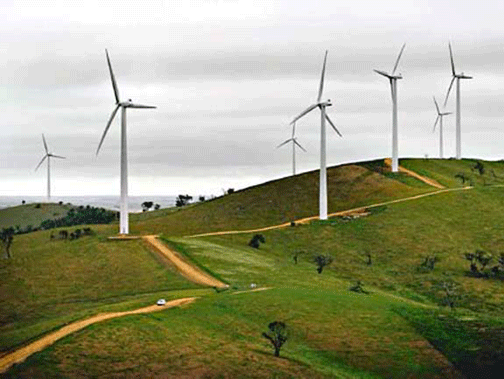 WIND farms worth almost $5 billion are poised to be built across Victoria.Thirteen projects with 854 turbines have won municipal council and State Government support and are ready to go.
Wind farms near Mortlake, Ballarat, Ararat, Warrnambool, Port Fairy, Ballan, Colac and St Arnaud can turn the soil the moment the Federal Government implements a new Renewable Energy Target scheme…….
……AGL Energy has built big wind farms at Oaklands Hill and Macarthur costing $1.18 billion. In its submission to the Senate wind farm inquiry AGL Energy estimates it has created 875 direct and indirect jobs in rural Victoria.
Northern Grampians Shire Council Mayor Murray Emerson said his council last week approved the Enerfin proposal. “It is a $460 million project, individually it would be the biggest investment in the shire’s history,” Cr Emerson said.
“Small rural shires like ours are battling all the time and the economic benefits from a project of this scale would be incredibly welcome.”Ararat Rural City Mayor Paul Hooper, who spoke at the Portland inquiry on Monday, said there were wind farm projects worth $1.68 billion ready to begin in his shire.
“This is an industry we already know very well and our residents support, we have a community which is pro-wind farm. “There are lots of jobs in construction, benefits from rates and the farms benefit which host them. “Rural shires have low populations and big areas to service, so a free kick of this magnitude is something we are very excited about.”
MAV president Cr McArthur said the dollar investment from wind farms “was astronomical”.
…….Victorian Energy and Resources Minister Lily D’Ambrosio said the Government was promoting wind farms because of job creation and regional development and impact on greenhouse gas.
Ms D’Ambrosio said the Government had recently reduced the exclusion zone from winds farms from 2km to 1km to help create even more projects. She said developments would now be approved by the state’s planning minister.
Victorian Greens leader Greg Barber said wind farms “would be a boon” to small rural councils with limited rate income.
Mr Barber said the pressure was on the State Government as well as the Federal RET negotiations “to make the wind farms happen” http://www.weeklytimesnow.com.au/news/national/wind-turbines-worth-5-billion-ready-to-be-built-in-victoria/story-fnkfnspy-1227286154627
Low-cost high-efficiency concentrated solar photovoltaic power station launched in Victoria
 The central Victorian sun powers world’s first concentrated solar power station, ABC Central Victoria By Larissa Romensky and Jonathan Ridnell, 31 March, 2015
This is the world’s first concentrated solar photovoltaic (CSPV) power station just launched by research and development company, RayGen Resources.”The end result is very low cost solar electricity and we think it’s going to really revolutionise solar energy,” said Robert Cart, CEO and co-founder of the company.
The tower acts as a receiver that collects sunlight from the mirrors that are computer controlled to move as they track the sun.”The collector field focuses the light on the receiver. The receiver directly converts that light to electricity,” said co-founder and technical director of RayGen, John Lasich.
The very small receiver is the unique part of this technology. “This is the only commercial version of this technology in the world,” said Mr Lasich.”It combines heliostats and denser photovoltaic cells, which when combined give very low cost and high efficiency.”
At this stage the $3.6 million project is a pilot testing facility. But the company are happy with the results.”It looks and feels pretty much like the real thing does,” said Mr Lasich.
High efficiency meets low costThe small plant generates enough power to run about 75 to 100 homes and the company says the technology is cheaper and more efficient than placing solar panels on roofs……….
The company recently signed a Memorandum of Understanding with their Chinese commercial partners. Juye Solar have invested $6 million which will allow RayGen to expand its manufacturing. They are currently in the process of building a larger facility at the same location.
A further $15 million will be invested by Juye Solar to develop the business in China to meet the large demand……
The ultimate aim for RayGen is to have distribution around the world. “We build the high tech components and software and sell that to the companies and they build the balance of system and put the whole plant together,” said Mr Lasich. http://www.abc.net.au/local/photos/2015/03/31/4207919.htm
THORIUM CLAIMS AND REALITIES

 Don’t Jump on The Thorium Bandwagon – It’s Not Green, Not Viable, And Not The Answer To Our Energy Problems Prevent Disease.comNov 10, 2013 by KELLEY BERGMAN
“………Numerous claims of advantages for thorium as a nuclear fuel and for LFTR (Liquid Fluoride Thorium Reactor) design have been made over conventional solid fuel reactors.
Nuclear Weapons Proliferation
Claim: thorium reactors do not produce plutonium, and so create little or no proliferation hazard.
Response: a LFTR could be adapted to produce plutonium of a high purity well above normal weapons-grade, presenting a major proliferation hazard. Beyond that, the main proliferation hazards arise from:
- the need for fissile material (plutonium or uranium) to initiate the thorium fuel cycle, which could be diverted, and
- the production of fissile uranium 233U.
Claim: the fissile uranium (233U) produced by thorium reactors is not “weaponisable” owing to the presence of highly radiotoxic 232U as a contaminant. Response: 233U was successfully used in a 1955 bomb test in the Nevada Desert under the USA’s Operation Teapot and so is clearly weaponisable notwithstanding any 232U present.
Safety
Claim: LFTRs are intrinsically safe, because the reactor operates at low pressure and is and incapable of melting down.
Response: the design of molten salt reactors does indeed mitigate against reactor meltdown and explosion. However, in an LFTR the main danger has been shifted from the reactor to the on-site continuous fuel reprocessing operation — a high temperature process involving highly hazardous, explosive and intensely radioactive materials. A further serious hazard lies in the potential failure of the materials used for reactor and fuel containment in a highly corrosive chemical environment, under intense neutron and other radiation.
State of Technology
Claim: the technology is already proven.
Response: important elements of the LFTR technology were proven during the 1970s Molten Salt Breeder Reactor (MSBR) at Oak Ridge National Laboratory. However, this was a small research reactor rated at just 7MW and there are huge technical and engineering challenges in scaling up this experimental design to make a ‘production’ reactor. Specific challenges include:
- developing materials that can both resist corrosion by liquid fluoride salts including diverse fission products, and withstand decades of intense neutron radiation;
- scaling up fuel reprocessing techniques to deal safely and reliably with large volumes of highly radioactive material at very high temperature;
- keeping radioactive releases from the reprocessing operation to an acceptably low level;
- achieving a full understanding of the thorium fuel cycle.
Nuclear Waste
Claim: LFTRs produce far less nuclear waste than conventional solid fuel reactors.
Response: LFTRs are theoretically capable of a high fuel burn-up rate, but while this may indeed reduce the volume of waste, the waste is more radioactive due to the higher volume of radioactive fission products. The continuous fuel reprocessing that is characteristic of LFTRs will also produce hazardous chemical and radioactive waste streams, and releases to the environment will be unavoidable.
Claim: Liquid fluoride thorium reactors generate no high-level waste material.
Response: This claim, although made in the report from the House of Lords, has no basis in fact. High-level waste is an unavoidable product of nuclear fission. Spent fuel from any LFTR will be intensely radioactive and constitute high level waste. The reactor itself, at the end of its lifetime, will constitute high level waste.
Claim: the waste from LFTRs contains very few long-lived isotopes, in particular transuranic actinides such as plutonium.
Response: the thorium fuel cycle does indeed produce very low volumes of plutonium and other long-lived actinides so long as only thorium and 233U are used as fuel. However, the waste contains many radioactive fission products and will remain dangerous for many hundreds of years. A particular hazard is the production of 232U, with its highly radio-toxic decay chain.
Claim: LFTRs can ‘burn up’ high level waste from conventional nuclear reactors, and stockpiles of plutonium.
Response: if LFTRs are used to ‘burn up’ waste from conventional reactors, their fuel now comprises 238U, 235U, 239Pu, 240Pu and other actinides. Operated in this way, what is now a mixed-fuel molten salt reactor will breed plutonium (from 238U) and other long lived actinides, perpetuating the plutonium cycle.
What Can You Do?
Spread the word about Sardinia. More information is available athttps://docs.google.com/open?id=0B-F67wRS5N7sR3hYMl9id0xkNWs where the original 7500-word research document is stored.
Contact your congressional representatives and demand the closure of the Sardinia NATO bases.
Do we really want another polluting energy source with high-level waste which is non-renewable and highly carcinogenic? Before jumping on the thorium bandwagon, please share this information, do your own research and think twice before spreading the hundreds of myths (not facts) about this very dangerous alternative to uranium.
Sources:
nuclearfreeplanet.org
nonukes.it
industrytap.com
envirosagainstwar.org
Kelley Bergman is a media consultant, critic and geopolitical investigator. She has worked as a journalist and writer, specializing in geostrategic issues around the globe.http://preventdisease.com/news/13/111013_Dont-Jump-on-The-Thorium-Bandwagon-Not-Green-Not-Viable-Not-The-Answer.shtml
Fukushima nuclear power station chief admits that genuine clean-up is nowhere in sight
Japan faces 200-year wait for Fukushima clean-up The chief of the Fukushima nuclear power station has admitted that the technology needed to decommission three melted-down reactors does not exist, and he has no idea how it will be developed.
Deep pools of melted nuclear cores below Fukushiam nuclear reactors
AP: Melted fuel may have “dropped even beyond” the bottom of Fukushima plant — ‘China Syndrome’ predicted by US gov’t analysis — IAEA Expert: Pools of corium beneath reactors are up to 2 stories high (VIDEO)http://enenews.com/ap-melted-fuel-could-dropped-beyond-bottom-fukushima-plant-iaea-expert-pools-corium-could-be-taller-2-story-house-video?utm_source=feedburner&utm_medium=email&utm_campaign=Feed%3A+ENENews+%28Energy+News%29
AP, Mar 27, 2015 (emphasis added): [It] was billed as a way to decipher where, exactly, the morass of nuclear fuel might sit at the bottom of reactors… But what went wrong, even in a simple demonstration for reporters… was a sobering reminder of the enormous challenges that lie ahead… a programming glitch could not be fixed in time for Friday’s demonstration… No one knows where the molten fuel debris lies, and in what shape or state. [TEPCO] has said itlikely sank to the bottom of the plant. But the fuel could have dropped even beyond. Tadashi Yotsuyanagi, an official in charge of the muon project at Toshiba… acknowledged the technology will not be able to get the complete image toward the bottom of the reactor… David Ireland, a professor who heads the Nuclear Physics Group at the University of Glasgow, said muons may be the only way to probe inside atomic reactors. “There are not really any other noninvasive options that will allow inspection,” he said in an email.
The Japan Times published the AP report above, however one sentence was altered. “Tepco has said it likely sank to the bottom of the plant. But the fuel could have dropped even beyond” vs. “But the fuel could possibly have escaped even beyond the containment facility to the outside environment.”
IAEA technical meeting Managing the Unexpected, Harri Tuomisto, Sr. Nuclear Safety Officer at Finland’s Fortum Power, 2012:
- Part 4: “If the cooling is not successful, it means the corium melts through the vessel… When this massive amount of corium enters into the containment zone, there are very, very many different energetic consequences… Interaction of molten core and concrete starts… concrete is eroding, and this eroding of concrete, for a long time it was known as China Syndrome.”
- Part 5: “The corium will be in 3 parts, there is a solid crust formation in the bottom of the pool, then there’s a pool of oxidic materials… The metals and oxides are not soluble with each other and the metals will be separated… which is bad news in the sense that theheat transfer to the vessel is much higher, and it’s much more difficult to guarantee the integrity of the [containment] vessel in that case.”
- Part 6: “Molten corium on the containment floor, it’s eroding the concrete and going partially downward. Actually it will never go to China, because it also erodes sideways… The final size of the pooling maximum case is 10 to 15 meters in diameter, and 6-7 meters [20-23 ft or 2 stories] deep — or even deeper.”
- Part 9: “There are quite many challenges… There are different energetic phenomenon… which can lead to different combustions… accelerating flames, or even detonations — which can cause a very high pressure in the containment and even break the containment… Then there’s this China Syndrome — attack of containment liner by corium — which can also bypass containment.” (See US gov’t analysis: Fukushima containment breached due to “failure of the drywell liner by melt-attack“)
- Slides 3-4: If corium melts through the vessel, there are various energetic consequences caused by ejected high-temperature molten corium… Molten corium on the containment basemat initiates core-concrete interaction that releases aerosols and non-condensible gases to containment atmosphere and erodes the concrete (‘China syndrome‘)
International Atomic Energy Agency not satisfied with India’s nuclear safety systems
 IAEA team completes review of Indian regulator, World Nuclear News 30 Mar 15 “…… the mission also provided recommendations and suggestions for improvement, many at the governmental level. The government should promulgate a national policy and strategy for safety and a strategy for radioactive waste management, it said. The team also recommended that the Indian government ensure that the AERB’s independence is embedded in law, ensuring its separation from other entities that could unduly influence the regulator’s decision making. The AERB itself should also review its policy and arrangements to ensure it maintains independence in its regulatory functions, the mission said.
The regulator should also consider increasing the frequency of on-site inspections and should develop and implement its own internal emergency arrangements, the reviewers found….The mission’s final report will be provided to the Indian government in about three months.http://www.world-nuclear-news.org/RS-IAEA-team-completes-review-of-Indian-regulator-2703158.html?utm_source=twitterfeed&utm_medium=twitter
Study shows the huge economic and health benefits of stopping global warming
 Limiting climate change could have huge economic benefits, study finds Stopping global warming at two degrees would create nearly half a million jobs in Europe and save over a million lives in China, analysis of emissions pledges says, Guardian Arthur Neslen in Brussels 31 Mar 15 Major economies would boost their prosperity, employment levels and health prospects if they took actions that limited global warming to 2c, according to the first analysis of emissions pledges made before the UN climate summit in Paris later this year.
Europe has promised a 40% emissions cut by 2030, compared to 1990 levels – and the report says this will bring real benefits, including 70,000 full-time jobs, the prevention of around 6,000 pollution-related deaths, and a €33bn cut in fossil fuel imports.
Nuclear power’s carbon emissions 25 times greater than wind’s
Amy Kalafa MBA in Sustainability Candidate Bard College
Stephanie Milbergs Assistant director Bard MBA in Sustainability Rochelle J. March
Rochelle J. March Friday, March 13, 2015 Mark Z. Jacobson is director of Stanford University’s Atmosphere and Energy Program, as well as a professor of civil and environmental engineering. He is also a senior fellow of the Woods Institute for the Environment and of the Precourt Institute for Energy.
The main goal of Jacobson’s research is to better understand physical, chemical and dynamic processes in the atmosphere in order to solve atmospheric problems, such as global warming and urban air pollution, with improved scientific insight and more accurate predictive tools. Continue reading
China’s trend to shut down coal power plants takes off in Beijing
Beijing to shut all major coal power plants to cut pollution Tulsa World 27 Mar 15 BEIJING — Beijing, where pollution averaged more than twice China’s national standard last year, will close the last of its four major coal-fired power plants next year.
The capital city will shutter China Huaneng Group Corp.’s 845-megawatt power plant in 2016, after last week closing plants owned by Guohua Electric Power Corp. and Beijing Energy Investment Holding Co., according to a statement Monday on the website of the city’s economic planning agency. A fourth major power plant, owned by China Datang Corp., was shut last year………
The closures are part of a broader trend in China, which is the world’s biggest carbon emitter. Facing pressure at home and abroad, policymakers are racing to address the environmental damage seen as a byproduct of breakneck economic growth. Beijing plans to cut annual coal consumption by 13 million metric tons by 2017 from the 2012 level in a bid to slash pollutants.
Shutting all the major coal power plants in the city, equivalent to reducing annual coal use by 9.2 million metric tons, is estimated to cut carbon emissions of about 30 million tons, said Tian Miao, a Beijing-based analyst at North Square Blue Oak Ltd., a London-based research company with a focus on China………http://www.tulsaworld.com/business/energy/beijing-to-shut-all-major-coal-power-plants-to-cut/article_155d6921-87f5-59fc-9a87-7233a6728527.html
1 This month

of the week – Australians for War Powers Reform (AWPR)
To see nuclear-related stories in greater depth and intensity
 Antinuclear