Doubts about the future of ERA’s Ranger uranium mine
Any attempt to extend the lease will be controversial.
As colleague Peter Ker reported in February, the traditional owners seem pretty wedded to the idea that mining stops in 2021 and rehab is completed by 2026.
 Ranger’s community issues stretch well beyond its sometimes fractured relationships with its local hosts, the Mirarr people. An extension will become an issue of serious contest across a sweep of the environmental movement both because of what it mines (uranium) and where it is (inside the Kakadu National Park).
Rio Tinto worried about ERA’s Ranger uranium mine http://www.afr.com/business/mining/uranium/rio-tinto-worried-about-eras-ranger-uranium-mine-20150402-1mctl1 by Matthew Stevens
The fate of Energy Resources Australia hangs in precarious balance with majority-owner Rio Tinto growing increasingly uncertain about the competitive economics and investment risk of a life-sustaining underground expansion at Australia’s most productive uranium project, the Ranger mine.
Rio owns 68 per cent of ERA and the Australian-listed uranium miner’s only operating asset is Ranger, a 30-year-old mine of occasionally extreme controversy.
Mining at Ranger’s open pit stopped more than two years ago and production is currently sustained by legacy stockpiles.
The longer future of ERA swings on an underground project called Ranger 3 Deeps, which has been the subject of $200 million in pre-feasibility investment over the past two years alone and requires up to $60 million more before a final investment decision might be secured. Continue reading
International diplomacy milestone reached in nuclear deal between Iran and the West

 World powers agree ‘historic’ nuclear deal http://www.skynews.com.au/news/top-stories/2015/04/03/eu–iran-hail-nuclear-talks-breakthrough.html Iran and world powers have agreed on the framework of a potentially historic deal aimed at curbing Tehran’s nuclear drive after marathon talks in Switzerland.
It marks a major breakthrough in a 12-year stand-off between Iran and the West, which has long feared Tehran wants to build a nuclear bomb. US President Barack Obama welcomed the ‘historic understanding’ with Iran but cautioned more work needed to be done. ‘If Iran cheats, the world will know it,’ he said in a televised address from the White House on Thursday.
After eight days of talks that sometimes went through the night, Iran agreed to curtail its nuclear program in return for the lifting of punishing sanctions, said EU foreign policy chief Federica Mogherini.
The main outlines agreed at the negotiations in the Swiss city of Lausanne now have to be finalised in a highly complex agreement by June 30.
-US Secretary of State John Kerry hailed a ‘big day’, saying on Twitter that the global powers and Iran ‘now have parameters to resolve major issues on nuclear program. Back to work soon on a final deal’.
Iranian President Hassan Rouhani said the drafting of a full agreement would begin immediately with the aim of completing it by the June 30 deadline. Iranian media said the deal will include Iran slashing by two-thirds, to 6000 from 19,000, the number of centrifuges, which can make fuel for nuclear power but also the core of a nuclear bomb.
Mogherini said the United States and the EU will lift all nuclear-related sanctions on Iran once the UN atomic agency has verified that Tehran has stuck to the ground-breaking deal. Mogherini, in a joint press statement with Iranian Foreign Minister Mohammad Javad Zarif, also said that the design of a new reactor will be changed so that no weapons-grade plutonium can be produced.
The Fordo facility, built deep into a mountain, will remain open but will not be used for enrichment but for research and development.
The so-called P5+1 group – the United States, Britain, China, France and Russia plus Germany – hope that the deal will make it virtually impossible for Iran to make nuclear weapons under the guise of its civilian program. France warned that the sanctions could be reimposed if Tehran does not fully keep its side of the bargain.The office of President Francois Hollande said in a statement that Paris would watch closely to ensure a ‘credible’ and ‘verifiable’ final agreement that prevents Iran from developing a nuclear weapon.
Tony Abbott internationally recognised as ‘world’s worst climate villain’
 Abbott the ‘world’s worst climate villain’ http://www.sbs.com.au/news/article/2015/04/01/abbott-worlds-worst-climate-villainWhile still cautious and sceptical, a US publication says Tony Abbott’s recently released climate discussion paper is a welcome sign.Australian Prime Minister Tony Abbott has been described in the US as the “world’s worst climate villain”.
That’s the bad news for the prime minister.
The good news is Mother Jones, the San Francisco-based nonprofit news organisation that gave him the label, is cautiously heartened by his government’s recently published climate issues paper.
With a new global climate deal to be hammered out in Paris later this year, Abbott’s issues paper states it is in Australia’s national interest for “a strong and effective global agreement, that addresses carbon leakage and delivers environmental benefit”.
Tuesday’s Mother Jones article, with the headline “The World’s Worst Climate Villain Just Showed Us Exactly How to Stop Global Warming”, said there’s reason to be sceptical and not get too excited about Abbott’s climate stance.
“I have no idea what ‘carbon leakage’ is,” Mother Jones climate desk associate producer Tim McDonnell wrote.
“Presumably it’s something similar to carbon dioxide emissions, which are the leading cause of global warming.
“Regardless, the announcement is a welcome sign from an administration that was recently ranked as the ‘worst industrial country in the world’ on climate action.”
Mother Jones describes itself as a nonprofit news organisation specialising in investigative, political and social justice reporting.
The Nuclear Industry’s Agenda For Killing The Competition
Nuclear Economics Nuclear Information and Resource Service….…….September 11, 2014. Killing the Competition. The Nuclear Power Agenda to block climate action, stop renewable energy, and subsidize old reactors. Major new report by NIRS’ Executive Director Tim Judson details how major utilities and nuclear power companies have begun a campaign to rig energy markets, climate regulations, and clean energy programs to prevent the advance of renewable energy.
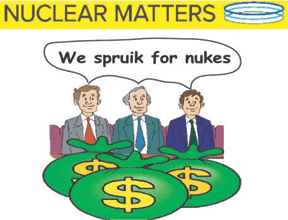
Using a deceptive public relations campaign and heavily-funded front groups like Nuclear Matters, Third Way, and C2ES, corporations including Exelon and Entergy have tried to drum up fears of a national energy crisis stemming from the closure of several aging, uncompetitive nuclear plants and the advance of renewable energy. While touting the need to “preserve” nuclear power, nuclear interests have covered up the actual reforms they are seeking and their implications for the U.S.’s energy future.
Audio recording (mp3 file) of press conference release of the report featuring Tim Judson, Dr. Mark Cooper, Vermont Law School, Institute for Energy and the Environment; Tyson Slocum, energy program director, Public Citizen; Deb Katz, executive director, Citizens Awareness Network (New England); David Kraft, executive director, Nuclear Energy Information Service (Illinois); Jessica Azulay, program director, Alliance for a Green Economy (New York).”…..http://www.nirs.org/neconomics/neconomicshome.htm
Unlike other wealthy nations, Australia fails to release post-2020 emission goals on time
 Australia not among rich nations releasing post-2020 emission goals on time, The Age April 1, 2015 Lisa Cox and Peter Hannam Australia has been left behind by most other wealthy nations in failing to disclose its post-2020 carbon reduction goals by the first quarter of 2015 as agreed at a global gathering in Peru last December.
The 28-nation European Union has announced that it would cut greenhouse gas emissions by at least 40 per cent on 1990 levels by 2030. On Tuesday, US President Barack Obama formalised in a submission to the UN the United States’ commitment to cuts that were first revealed in a landmark announcement with China last year………
Assuming the US goal was unchanged from the pledge made by President Obama during a visit to China last October, Australia would need a much deeper goal than its current bipartisan aim of slicing gas emissions by 5 per cent of 2000 levels by 2020 to keep up, said Pep Canadell, a CSIRO research scientist and executive director of the Global Carbon Project.
“If you want the effort to be proportional to what US and Australia committed for the 2005-2020 period, it would be something like [a cut of] 17 per cent by 2025 [for Australia],” Dr Canadell said.
Australia joined Canada in holding off on making any commitments for now.
The Abbott government’s issues paper, released on Saturday, appears to lay the groundwork for Australia to argue for special treatment in the talks because of the country’s heavily resource-based economy………
Emissions from power plants in the 12 months to September totalled 181.9 million tonnes, or about 1.5 million tonnes more than for the year to June.
If the emissions shift were to be maintained, it would increase emissions from electricity generators by about 4 per cent this year, Hugh Saddler, principal consultant with Pitt & Sherry, said.
John Connor, chief executive of the Climate Institute, said it was a poor showing by Australia to fall short of the March 31 goal for releasing its post-2020 target.”Australia, as a wealthy country with over 20 years’ experience in detailed climate policy analysis, should be amongst those – including Mexico – who have met that deadline,” Mr Connor said……. http://www.theage.com.au/environment/climate-change/australia-not-among-rich-nations-releasing-post2020-emission-goals-on-time-20150401-1mc2t2.html
Carbon 14 is continuously released to environment from Nuclear Power Plants
 The worldwide nuclear power operational experience gives evidence that 14C is continuously released to environment from Nuclear Power Plants (NPPs), is key radionuclide of NSRs for LILW disposal, forms significant fraction of irradiated graphite radionuclide inventory, retains in the spent nuclear fuel and consequently will be disposed of in geological repositories for long-lived high activity waste in the form of spent fuel or radioactive waste arising from spent fuel reprocessing. In this sense, we can consider 14C as one of the most powerful environmental tracers of nuclear fuel cycle.
Divest from fossil fuel companies – 17 Anglican bishops write
Anglican bishops’ letter urging fossil fuel divestment Seventeen bishops and archbishops tell Anglican church investments in fossil fuel companies incompatible with a just and sustainable future Guardian 31 Mar 15 “……..In different ways each of our own dioceses are deeply impacted by climate injustice and environmental degradation. We accept the evidence of science concerning the contribution of human activity to the climate crisis and the disproportionate role played by fossil-fuel based economies. Although climate scientists have for many years warned of the consequences of inaction there is an alarming lack of global agreement about the way forward.There is a compelling need to listen to the voices of our youth who will inherit the challenges and catastrophes we fail to address and pre-empt. We believe we must be reconciled to Creation and to one another and that there is an urgency to this call. We believe the issue of climate change is a moral issue at its heart……….
We will develop and distribute educational resources for everyone (adults, youth and children) on climate change, climate justice, and the ethical and practical principles of sustainable living in global and local contexts……..
We encourage Anglicans everywhere to:……….
Implement energy conservation measures in church buildings and moving to renewable energy sources as quickly as possible…….
We call upon political, economic, social and religious leaders in our various constituencies to address the climate change crisis as the most urgent moral issue of our day. We urge them to:
· Work with all possible commitment and speed toward fair, ambitious, accountable and binding climate change agreements at national and international levels.
· Develop policies that genuinely assist environmental and climate refugees and promote mechanisms of intergovernmental co-operation that ensure their human rights, safety and resettlement………
UK’s Hinkley Point nuclear plans grind to a halt, with financial problems
 Hinkley Point C nuclear project workers face layoff , Guardian 2 Apr 15 Up to 400 constructors at site of new nuclear power station could be laid off as preparation work comes to end before final investment decision by owner EDF. As many as 400 workers at the site of a new nuclear power station at Hinkley Point face being laid off while the French owners of the project decide whether to make an investment in the £16bn project.
EDF has almost completed the project’s preparatory earthworks, drainage, welfare facilities and roadworks, but is yet to decide on the investment to mark the beginning of the construction the plant in Somerset.
The company said a decision would be reached in the coming months, and it has already launched a 45-day redundancies consultation, said the unions…….
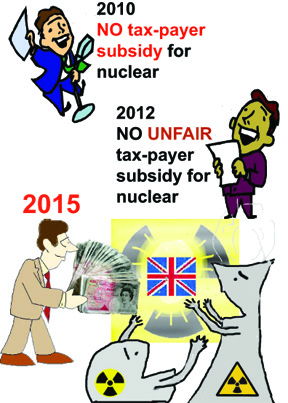
It is the first new new nuclear plant in the UK in decades and is scheduled to start producing electricity in 2023. EDF, however, is still negotiating with UK authorities about government debt guarantees for the project, along with decommissioning costs and other details.
It is also negotiating with two Chinese utilities about their role in Hinkley Point and possible future UK nuclear projects with EDF……http://www.theguardian.com/environment/2015/apr/02/hinkley-point-c-nuclear-project-workers-face-layoff-power-station-investment-edf
Cancellation of new coal plants at twice the rate of ones being built
 For Every New Coal Plant Being Built, Two Are Being Cancelled, Clean Technica, March 21st, 2015 Originally published on The Carbon Brief. By Sophie Yeo
The global coal boom has started to slow, a new report says, as more plans for new power plants are now being shelved than completed.
The number of cancelled coal projects across the world has outstripped those completed at a rate of two to one since 2010, according to Sierra Club and CoalSwarm – two campaign groups that have tracked the progress of 3,900 intended plants since 1 January 2010.
The findings update a 2012 report by the World Resources Institute, which estimated that 1,199 new coal-fired power plants, with a total capacity of 1,401 gigawatts, were in the pipeline for construction.
New figures suggest that, by 2014, this had shrunk by 23% to a proposed 1,083 gigawatts of new coal-fired capacity. The report puts this down to citizen opposition, competition from renewables, new policy initiatives and political scandals putting a freeze on the highly polluting projects………
Stranded assets
1 This month
7 April – WEBINAR – Australia and the Doomsday Clock – Preventing nuclear war through NoFirstUse and other policies
Online | Tuesday April 7, 4:00-5:30pm, Australian Eastern Time / 8:00-9:30am Central Europe Time
– Access the registration link
15 April – Zoom –Nuclear Power is Not the Solution
Apr 15, 2026 01:00 AM in Canberra, Melbourne, Sydney

Join the International Physicians for the Prevention of Nuclear War (IPPNW) on Tuesday, April 14th for a timely webinar exploring the risks associated with nuclear power and challenging the myth that it offers a simple, safe, carbon-free solution to the climate crisis

21 April Webinar: No Nuclear Weapons in Australia
Start: 2026-04-21 18:00:00 UTC Canberra, Melbourne, Sydney (GMT+10:00)
End: 2026-04-21 19:30:00 UTC Canberra, Melbourne, Sydney (GMT+10:00)
Event Type: Virtual
A virtual link will be communicated before the event.
Host Contact Info: australia@icanw.org

of the week – Australians for War Powers Reform (AWPR)
To see nuclear-related stories in greater depth and intensity
 Antinuclear