Mercifully short – Australian nuclear news this week
 South Australia’s Nuclear Royal Commission. It’s gone pretty quiet, but South Australian Treasurer Tom Koutsantonis has been spruiking nuclear expansion at a resources conference. Publicity promotes Australia as becoming the Saudi Arabia of Nuclear Power
Nuclear promoters quietly lobbying Labor politicians, claim that they have the backing of Labor leader Bill Shorten.They are planning to follow the tactics of USA anti-climate lobbyists – taking their attack to the States. Although the nuclear industry is a Federal issue, and they need to overturn National laws – the idea is to get the States onside first. Keep up with developments at https://antinuclear.net/nuclear-royal-commission/
Social media. I’m hoping that some people will join me in monitoring Twitter. (I’m quite chuffed at the attacks on me – I tweet as @ChristinaMac1 – shows that my tweets are having an impact. ) The Australian pro nuclear lobby tweets with the hashtag #SANuclearRC. So far that’s just a few shills retweeting old propaganda to each other – nothing new or really relevant.
Former estate agent Senator Sean Edwards has gone out on a political limb, spruiking for the Australian nuclear lobby. He got national media coverage, but Dr Helen Caldicott got the brushoff, from Murdoch media (surprise surprise)
Abbott govt’s Energy White Paper is highly political, as is its stand on Renewable Energy Target, and ‘wilfully deluded’ on climate change. Loves coal, hates solar, friendly to nuclear.
Coal. Big investment banks walk away from Queensland’s Galilee Basin coal projects. New South Wales Premier Mike Baird firmly on the side of the coal lobby
Queensland Senator Matthew Canavan wants no tax deductability for environment groups
Thousands of Australians rally against closure of remote indigenous communities
In China, wind power is beating nuclear
 Wind Power Beats Nuclear Again in China. Earth Policy Institute
J. Matthew Roney. 5 Mar 15 China, the country that is building more nuclear reactors than any other, continued to get more electricity from the wind than from nuclear power plants in 2014. This came despite below-average wind speeds for the year. The electricity generated by China’s wind farms in 2014—16 percent more than the year before—could power more than 110 million Chinese homes.
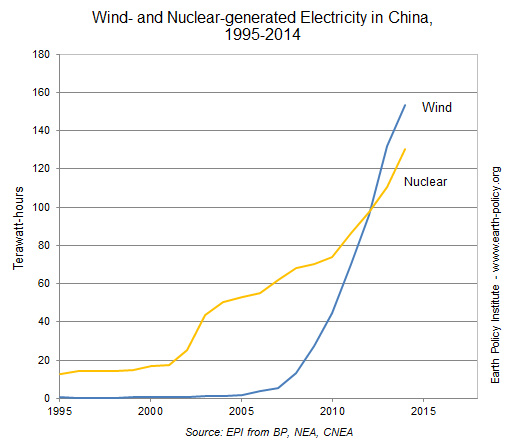
China added a world record 23 gigawatts of new wind power capacity in 2014, for a cumulative installed capacity of nearly 115 gigawatts (1 gigawatt = 1,000 megawatts). Some 84 percent of this total—or 96 gigawatts—is connected to the grid, sending carbon-free electricity to consumers.
As China’s wind power installations took off in the mid-2000s, electric grid and transmission infrastructure expansion could not keep pace. But the situation is improving: China is building the world’s largest ultra-high-voltage transmission system, which is connecting remote, wind-rich northern and western provinces to the more populous central and eastern ones. At the same time, the government is providing incentives for wind farm development in less-windy areas nearer to population centers. Advances in wind power technology can allow greater capture of energy in spots without the strongest wind resources.wind resources.
China’s wind power goal is to have 200 gigawatts connected to the grid by 2020. According to China’s National Energy Administration, the country has some 77 gigawatts of wind capacity now under construction, bringing this goal that much closer to being realized. Efforts to bolster the grid and connect more turbines are reducing the amount of potential wind generation lost each year due to curtailment, when turbines must stop producing because the grid cannot take on any more electricity. Since 2012, the rate of this curtailment at China’s wind farms has dropped by more than half; however, further improvements are still needed……..ttp://www.earth-policy.org/data_highlights/2015/highlights50
Nuclear reprocessing not likely to be viable for China (nor for Australia?)
the experiences of nations that have launched large reprocessing programs and built demonstration breeder reactors in the expectation that the commercialization of these reactors would follow. Commercialization did not follow in those countries—but huge expenses were incurred for cleaning up reprocessing sites and disposing of separated plutonium.
 Reprocessing in China: A long, risky journey, Bulletin of the Atomic Scientists, April 15 Hui Zhang Since 1983, a closed fuel cycle has been an official element of China’s nuclear energy policy. According to proponents, plutonium reprocessing and breeder reactors will allow full utilization of China’s uranium resources, drastically reduce the volume of radioactive waste that must be stored in an underground repository, and establish a way to dispense with the spent fuel accumulating in China’s reactor pools.
But Beijing’s attempts to develop commercially viable reprocessing facilities and breeder reactors have been afflicted with technological difficulties, serious delays, and cost overruns. At this point—especially taking into account China’s ample uranium resources and its easy access to additional resources abroad—it appears very doubtful that reprocessing and fast reactors are the proper way forward for China’s nuclear energy sector.
Not according to plan………. Continue reading
Abbott govt’s Energy White Paper is highly political, as is its stand on Renewable Energy Target
Energy white paper has some huge black holes, SMH 12 Apr 15 Was it an accident or wilful blindness? The federal government’s 74-page energy white paper, released last week, contained just a single reference to climate change. Given the Abbott government’s self-imposed blindness on this issue, we have to suspect it was the latter. The omission renders the document deeply flawed.
The white paper’s approach is that of the classic free-marketeer: governments should not intervene to modify energy consumers’ behaviour (by, say, subsidising renewables or reserving gas supplies for domestic use at a lower cost to consumers). Applied to other industries that analysis may still sketch the outlines of a workable policy, but it is no longer adequate in a supposedly comprehensive review of energy production and use. The burning of fossil fuels is the world’s single most important contributor to greenhouse gases and therefore to climate change. Yet the white paper virtually ignores this link which is central to its subject…….
 Despite its dispassionate pretence, Australia’s white paper is a highly political document. Economics rules Australia’s politics, and hence our political response to climate change has also been achingly slow. Cocooned by the country’s income from hydrocarbons in a world of comfortable fantasy, many in this country deeply still resent any disturbance from scientists or others who try to point out the stark evidence of record average temperatures, changed farming environments, warmer oceans, longer and harsher bushfire seasons……..
There is no risk now that Australia will lead the world in acting against climate change, since most developed nations are already ahead of us, and our recent steps have all been retrograde. But Australia should not be cutting off any options to act when at last it makes up its mind to do so. Unfortunately the white paper, and the row over the RET, look to have precisely that effect. http://www.smh.com.au/comment/smh-editorial/energy-white-paper-has-some-huge-black-holes-20150412-1mjflr.html
For China, it’s becoming clear that renewables offer a faster, better, energy path than nuclear does
 As China looks to energy solutions to reduce the air pollution choking its cities, to conserve water, and to rein in its carbon emissions, it is becoming clear that renewables offer a more expeditious path than nuclear power does.
Wind Power Beats Nuclear Again in China. Earth Policy Institute, J. Matthew Roney. 5 Mar 15 “…………Even as it pursues the world’s most ambitious wind power goal, China also undeniably has the world’s most aggressive nuclear construction program, currently accounting for 25 of the 68 reactors being built worldwide. Six reactors totaling 6 gigawatts of capacity went online in China in 2013 and 2014. Another reactor connected to the grid in January 2015, bringing national nuclear capacity to 20 gigawatts at 24 reactors. But to meet the government’s nuclear target of 58 gigawatts by 2020, China will not only need to complete the reactors now under construction—most of which are behind schedule—it will need to start and finish another dozen or so by then.
Several factors stack the odds against China meeting its nuclear power goal. After a massive earthquake and tsunami induced the 2011 nuclear meltdown in Fukushima, Japan, the Chinese government suspended approvals for new reactors as it conducted safety reviews of those operating and under construction at the time. The moratorium was lifted in late 2012, yet for more than two years no new reactors received permission to build. In February 2015, a nuclear plant in northeastern Liaoning province reportedly got the go-ahead for a two-reactor expansion. Once construction begins, it typically takes six years to complete a reactor in China (compared with one year or less for the average wind farm).
Further complicating China’s nuclear picture is that suitable real estate for new reactors along the coast—with ready access to cooling water—is in increasingly short supply. Following the Fukushima disaster, public opposition to reactors in China’s earthquake-prone inland provinces grew, prompting officials to put off consideration of proposed reactors in non-coastal provinces until 2015 at the earliest. Regardless of when the government decides to begin approving inland reactors, nuclear developers will face dwindling freshwater resources.
Perhaps the biggest question facing the future of nuclear power in China is the fate of the 1-gigawatt Sanmen reactor under construction in Zhejiang province. Designed by Westinghouse, this is a “Generation III” reactor billed as much safer than previous nuclear technologies, due to its earthquake and flood resistance features and its ability to continue cooling in the event of a prolonged loss of power. Sanmen is both the basis for Chinese-designed third generation reactors and a test case for the technology closely watched worldwide.
When construction got under way at Sanmen in 2009, completion was projected by the end of 2013. Blaming increased safety concerns and design changes post-Fukushima, the developer pushed this date back to 2015. Then in January 2015, the chief engineer of China’s State Nuclear Power Technology Corp., Wang Zhongtang, announced that Sanmen would not generate electricity until 2016, if that soon. As the project runs further behind schedule and goes further over-budget, more doubt is cast on the design’s ability to catalyze faster nuclear power growth in China.
China’s energy landscape is changing rapidly. Consumption of coal, which supplies about 75 percent of Chinese electricity, dropped nearly 3 percent in 2014, according to official datafrom China’s National Bureau of Statistics. Meanwhile, in addition to the impressive growth in wind power, China is quickly expanding its solar generating capacity. With 28 gigawatts by the end of 2014 and plans for another 15 gigawatts in 2015, China may overtake Germany for the top solar spot in a matter of months. As China looks to energy solutions to reduce the air pollution choking its cities, to conserve water, and to rein in its carbon emissions, it is becoming clear that renewables offer a more expeditious path than nuclear power does.
J. Matthew Roney is a Research Associate with Earth Policy Institute and co-author of The Great Transition: Shifting from Fossil Fuels to Solar and Wind Energy . (W.W. Norton, 2015). Visit the Table of Contents to download Chapter Changing Direction, or pre-order your copy from the EPI Bookstore. More resources are available at www.earth-policy.org.
Divesting from fossil fuels has paid off for investors
Fossil fuel-free funds outperformed conventional ones, analysis shows, Guardian, Patrick Collinson 11 Apr 15 Investors who dumped holdings in coal, oil and gas earned an average return of 1.2% more a year over last five years, data from the world’s leading stock market index reveals Investors who have dumped holdings in fossil fuel companies have outperformed those that remain invested in coal, oil and gas over the past five years according to analysis by the world’s leading stock market index company,
MSCI, which runs global indices used by more than 6,000 pension and hedge funds, found that investors who divested from fossil fuel companies would have earned an average return of 13% a year since 2010, compared to the 11.8%-a-year return earned by conventional investors.
The figures indicate that if a major charitable institution or foundation with £100m in funds had divested from fossil fuels in November 2010 they would be around £7m better off today than if they had maintained their holdings in coal, oil and gas companies.
In total, a portfolio of shares with fossil fuel companies included has grown in value by 62.2% since 2010, but this compares to the 69.9% growth of a fund without fossil fuel investments.
The data will challenge the widespread belief among asset managers that divestment hurts the financial performance of investment funds……….http://www.theguardian.com/environment/2015/apr/10/fossil-fuel-free-funds-out-performed-conventional-ones-analysis-shows
New South Wales Premier Mike Baird firmly on the side of the coal lobby
 Thom Mitchell: Backing Big Coal – Mike Baird Promises To Up The Ante For Acting On Your Conscience
Miners get rewarded for destroying our environment, while protestors cop massive fines. And it’s about to get worse. Welcome to Mike Baird’s new New South Wales……..
“So-called plans to phase out mining in NSW have no place in this parliament,” Baird announced, “and I’ll be very clear on this, no place”.
In fact, Baird said, he would halve the time it takes to get big mines approved………
New Matilda understands Baird’s Liberal government will seek to change Workplace Health and Safety laws and other relevant legislation in the new parliament to reverse the liability, but protestors are unlikely to be deterred by his promise of harsher penalties……https://newmatilda.com/2015/04/12/backing-big-coal-mike-baird-promises-ante-acting-your-conscience
Vancouver joins other great cities in committing to 100% renewable energy
More than 50 cities have announced they are on their way to 100% renewable energy including San Diego and San Francisco in California, Sydney Australia, and Copenhagen. Some are aiming for 2020, others by 2030 or 2035.
Vancouver commits to run on 100% renewable energy http://www.theguardian.com/environment/2015/apr/10/vancouver-commits-to-run-on-100-renewable-energy
Canadian city of 600,000 people is the latest to announce it will use only green energy for electricity, transportation, heating and air conditioning within 20 years Vancouver has become the latest city to commit to running on 100% renewable energy. The city of 600,000 on Canada’s west coast aims to use only green energy sources for electricity, and also for heating and cooling and transportation. Continue reading
1 This month

of the week – Australians for War Powers Reform (AWPR)
To see nuclear-related stories in greater depth and intensity
 Antinuclear