Economic chickens coming home to roost, for AREVA, France’s State-owned nuclear business
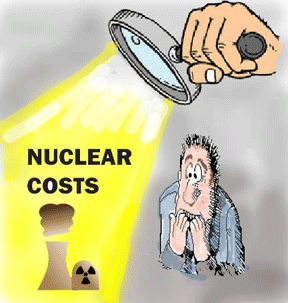 French authorities reported on April 7 that flaws were found in some of the steel used in the reactor vessel of an EPR being built in Normandy. That reactor is five years behind schedule, and its price tag has ballooned from $3.5 billion to $9.3 billion.
 Areva Is Costing France Plenty The company thought it had a winning nuclear reactor technology http://www.bloomberg.com/news/articles/2015-04-16/france-s-areva-falters-in-reactor-business-leaks-cash Nuclear plants supply almost three-fourths of France’s electricity, and they boast a near-spotless safety record and some of the cheapest electric rates in Europe. In 2001 the government created a state-owned company, Areva, to export French reactors and nuclear know-how to the rest of the world. Those ambitions are now in tatters, offering an object lesson in the dangers of French dirigiste industrial policy.
Areva, along with competing reactor builders Westinghouse Electric and General Electric, was hit hard when orders dried up after the 2011 Fukushima accident in Japan. Cheap shale gas and development of renewable energy have compounded those woes. But “you can’t really blame Areva’s plight on Fukushima,” says Steve Kidd, a British nuclear consultant and former executive of the World Nuclear Association, a London-based trade group.
$5.1b
Areva’s loss in 2014, on sales of $8.9 billionFrench authorities reported on April 7 that flaws were found in some of the steel used in the reactor vessel of an EPR being built in Normandy. That reactor is five years behind schedule, and its price tag has ballooned from $3.5 billion to $9.3 billion. Areva also is facing an investigation of its 2007 acquisition of Uramin, a Canadian uranium mining company. In 2011, Areva wrote off almost all of the $2.5 billion purchase price after concluding that the ore deposits were of negligible value. The government’s chief auditor, who faulted management for inadequate oversight and possible “dissimulation,” asked prosecutors to look into the Uramin purchase.
The next step for Areva may be a tieup with EDF, its top customer—an idea that horrified the utility’s investors, who dumped the stock after Energy Minister Ségolène Royal suggested it in March. Other government officials have suggested that Areva might work with EDF on engineering and maintenance, stopping short of a full merger.
The company still makes money supplying fuel and reprocessing waste for nuclear plant owners. It’s already clear, though, that Areva won’t be selling many new reactors. North American and European utilities stopped ordering them after the Fukushima accident, and the EPR’s problems have cast a pall over the company’s prospects in China, which now accounts for more than half of the new reactors expected to come online by 2030. Thanks to past collaboration with Areva and other Western suppliers, the Chinese have developed the technology they need to build their own reactors, says Steve Thomas, a professor at the University of Greenwich in England who studies the industry. The reactors built by Areva and Westinghouse “are just too expensive for the Chinese,” he says.
The French government’s 80 percent ownership of Areva helped mask its problems, consultant Kidd says. “Everyone was laughing” at the company’s projections for reactor sales, he says. “Everyone in the know could tell the chickens were going to come home to roost. I don’t think that would have happened in a private business.”
—With Francois de Beaupuy and Tara Patel
The bottom line: Areva’s bid to be the globally dominant maker of reactors was undone by cost overruns and strategic blunders.
No comments yet.
1 This month

of the week – Australians for War Powers Reform (AWPR)
To see nuclear-related stories in greater depth and intensity
 Antinuclear
Leave a comment