Kevin Scarce kicks off the SA Nuclear Royal Commission with a warning about people being “emotional”
 Kevin Scarce expects debate around the future of the nuclear fuel cycle in SA to be ‘emotional’ CAMERON ENGLAND THE ADVERTISER APRIL 17, 2015 “……. Commissioner Scarce said he expected there to be a lot of “emotion” associated with the debate, and he was committed to running a transparent process.
“Today really is the start of business,’’ Commissioner Scarce said. “We are issuing our first issues paper which covers the opportunity to expand mining and exploration, and also the risks and costs of doing that……..
“I think there’s going to be a lot of emotion about the nuclear industry. We can’t walk away from the fact that when there are accidents they are catastrophic and I would expected there will be a lot of emotion about the risks, the impact on the environment, and I want to encourage people, again in an evidence-based way, to give us their views on that, but at the end of the day, the purpose of a Royal Commission is to inquire and to get evidence-based information back…….
The issues paper addresses issues around exploration, mining and milling uranium, and poses 13 questions for discussion around what could be done to foster more activity, whether that is economically viable, and what the environmental and social costs might be.
Three further issues papers will be released over the next two to three weeks, looking at fuel management and storage, fuel enrichment and power generation.
Commissioner Scarce said once all of the issues papers were released there would be 90 days for companies, organisations and individuals to make submissions.
“The we’ll take all of that evidence, bring it together in a report, and then we will engage the community in the outcomes of all of the reports that come to us through the issues papers.’’
Commissioner Scarce will spend the next month travelling to areas such as Aboriginal communities including the APY Lands, and Maralinga and regional areas including Port Pirie and Whyalla……http://www.theaustralian.com.au/news/kevin-scarce-expects-debate-around-the-future-of-the-nuclear-fuel-cycle-in-sa-to-be-emotional/story-e6frg6n6-1227307853022
Mayors call on Florida residents to fight nuclear expansion project

 Florida mayors call on residents to fight nuclear expansion project MIAMI | BY DAVID ADAMS (Reuters), 15 Apr 15 – A group of South Florida mayors are escalating their campaign against plans to expand a nuclear power plant near Miami that involves constructing 100-foot (30-meter) tall transmissions lines through some of the area’s toniest neighborhoods.
Florida Power & Light Co [NEEPWR.UL] is seeking federal approval from the Nuclear Regulatory Commission (NRC) to add nuclear reactors to its Turkey Point plant in south Florida. Public hearings are scheduled for next week.
Miami Mayor Tomás Regalado urged residents to speak against the project, which was approved by the Florida legislature last year.
“This plan should not be approved,” he said, arguing that the need for extra water for cooling ponds would shrink the area’s supply of fresh water.
Also rising sea levels due to climate change put the plant at risk of being flooded by salt water…..http://www.reuters.com/article/2015/04/15/us-usa-florida-nuclear-idUSKBN0N62JH20150415
Florida mayors detail the case against nuclear industry expansion
Mayors make case against FPL nuclear expansion BY JENNY STALETOVICH JSTALETOVICH@MIAMIHERALD.COM 17 Apr 15
The mayors — Tomas Regalado of Miami,, Philip Stoddard of South Miami and Cindy Lerner of Pinecrest — held a joint conference with one clear goal: Boost opposition to a controversial expansion that will be the subject of two public hearings federal regulators have scheduled next week in Miami-Dade.
“We are looking at a population base within 50 miles of 2.5 million people,’’ said Lerner. “Who in their right mind would put two new nuclear plants at sea level with storm surge?” Continue reading
Jetsetting for South Australia’s Pro Nuclear Royal Commissioner, and who else?
International nuclear-site visit on cards for royal commissioner MEREDITH BOOTH THE AUSTRALIAN APRIL 18, 2015
http://www.theaustralian.com.au/business/mining-energy/international-nuclear-site-visit-on-cards-for-royal-commissioner/story-e6frg9df-1227308901763
Deep burial of nuclear waste is safer and cheaper than reprocessing
NuClear News, April 15 Alternatives to MOX A new report by Frank von Hippel and Gordon MacKerron reviews programs in France, Japan, the UK and the US to dispose of large stocks of separated plutonium in nuclear power reactor mixed-oxide (MOX) fuel. Most of these efforts have suffered long delays and large cost increases and all have failed to reduce plutonium stockpiles. This has led some of these countries to consider alternatives.
A less costly and more effective approach may be to treat plutonium as a waste to be processed into a 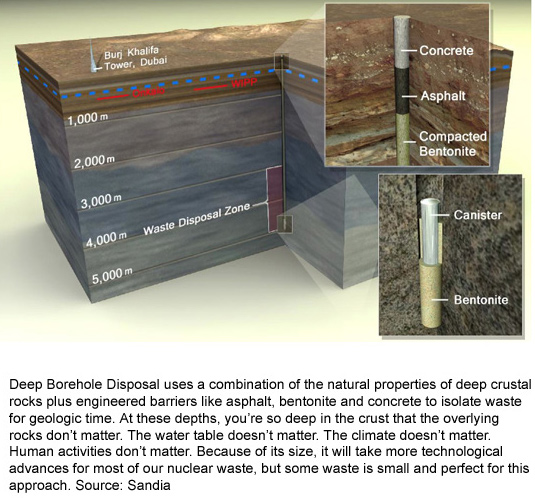 stable form and deeply buried. These alternative approaches include disposal with radioactive waste or spent fuel or disposal down a 3-mile (5-kilometer) deep borehole. The report recommends that more than one direct-disposal approach be pursued. It also recommends that the countries that share the problem of plutonium disposal collaborate on exploring direct-disposal options.
Finally, it recommends that the quantities of plutonium disposed by the weapon states be verified by the IAEA. The huge cost overruns in the under-construction MOX plant at the DOE’s Savannah River Site in South Carolina led the Obama Administration to conclude in 2013 that plutonium disposal via MOX “may be unaffordable.”
This has revived policy interest in the U.S. in the possibilities of direct disposal of plutonium as a waste. Continue reading
Britain’s nuclear power programme in jeopardy as faults found in EPR reactors
Sources in the French nuclear industry told the newspaper Le Parisien yesterday that dismantling the faulty pressure vessel and ordering and manufacturing a new one could take several years. “If the weakness of the steel is proved, I don’t hold out much hope for the survival of the EPR project,” a former senior nuclear safety official told Le Parisien
 UK nuclear strategy faces meltdown as faults are found in identical French project, The
  Independent UK, The faults could also scare off the Chinese state investors who are supposed to cover part of the cost of the £14bn Hinkley project JOHN LICHFIELD
  PARIS Friday 17 April 2015 A “very serious” fault has been discovered in a French nuclear power station which is at the heart of David Cameron’s strategy to “keep the lights on” in Britain in the next decade.
The future of two nuclear reactors planned for Hinkley Point in Somerset has been thrown into doubt by
the discovery of a potentially catastrophic mistake in the construction of an identical EPR power plant in Normandy.
“It is a serious fault, even a very serious fault, because it involves a crucial part of the nuclear reactor,”
said Pierre-Franck Chevet, head of France’s nuclear safety inspectorate.
A second investigation has been ordered into the quality of the steel used to make a 50ft-high safety casing, or “pressure vessel”, which encloses the groundbreaking new reactor at Flamanville, near Cherbourg. If the steel proves to be defective, the completion of the prototype EPR plant – already behind schedule and nearly three times over budget – could be delayed for several years. Continue reading
Indians aware on delays in uranium sales as the Abbott government might not last long
Domestic wall between Aussie-India nuclear hug New Delhi, Telegraph, Calcutta April 14: India’s diplomatic establishment is preparing for delays in importing Australian uranium despite a commitment today to implement their nuclear deal this year – not because it doubts Canberra’s intent but because of the vagaries of that country’s domestic politics. Continue reading
Canada, like Australia, increases weapons proliferation risks by selling uranium to India
Findlay and other experts warn that the special treatment for India shows other governments a country can ignore the rules, build the bomb, tough it out for a few decades and emerge on the other side as an accepted nuclear weapons power.Canada-India uranium deal will spur proliferation, experts warn Arms control experts say Canada sends the wrong signal to countries that play by the rules By Evan Dyer, CBC News 17 Apr 15 India test-fired a nuclear-capable ballistic missile Thursday, just hours after signing a deal to buy 3,000 tons of Canadian uranium.The Agni-III missile, which has a range of over 3,000 kilometres, was fired from the Indian army’s test range on Wheeler Island in the Bay of Bengal. India declared the test a success…….While the terms of this week’s deal are not public, the nuclear cooperation agreement, first announced in 2010 and finalized in 2013, includes assurances that India use Canadian material for civilian purposes only……..
some nuclear proliferation experts say India has been able to make such a deal without abiding by the rules set out for most other countries that abide by the international non-proliferation regime. And they warn that countries the West has been attempting to bring into the rules-based system — such as Iran — will be less inclined to submit when they see the rules don’t apply to India. Continue reading
Prolonged exposure to low radiation impacts birds and animals
 “There are so few barn swallows left,” Mousseau added. “We know that there were hundreds in a given area before the disaster, and just a couple of years later we’re only able to find a few dozen left.”
“Both the biodiversity and the abundance are showing dramatic impacts in these areas with higher radiation levels, even as the levels are declining.”
For Fukushima Birds, Things are Getting Worse Even as Radiation Abates, Nature World News, By Brian Stallard follow Brian on Twitter @BS_ButNoBS Apr 17, 2015 The destructive earthquake and tsunami that triggered a catastrophe at Japan’s Fukushima-Daiichi nuclear power plant are now four years behind us, but the effects of that disaster are still being felt today. Now a new study has revealed that even as ecosystems slowly recover, Fukushima’s native bird population is actually dwindling more than ever – and researchers think they know why………
“A growing body of empirical results from studies of birds, monkeys, butterflies, and other insects suggests that some species have been significantly impacted by the radioactive releases related to the Fukushima disaster,” Timothy Mousseau, a lead researcher behind one of many ongoing investigations, announced last August.
He explained that a common theme researchers have noticed is that prolonged exposure to low doses of radiation has a very different effect on organisms compared to sudden high-level exposure, as seen at Chernobyl. This came to be called Fukushima’s “insidious effect” and was expected to abate, with lingering radiation levels, by 2016.
Unfortunately, new research detailed in the Journal of Ornithology shows that birds may be facing trouble for even longer. “The declines have been really dramatic,” study author and biologist Tim Mousseau, of the University of South Carolina, said in a recent statement. Continue reading
Nuclear power so uneconomic in USA that dozens of reactors risk closure
 As many as three dozen reactors are considered at risk of closure for economic reasons.Nuclear Power Goes Begging, Likely at Consumers’ Expense Operators of nuclear power plants are seeking rate increases to avoid closures in deregulated market, WSJ, By
Electricity producers in several states are asking for hundreds of millions of dollars in financial support to keep costly nuclear power plants in business—a move that is likely to boost customers’ power bills. Continue reading
As Abbott govt delays decision on RET, South Africa races ahead with renewable energy
 The contrast with South Africa, another coal dependent country, could not be greater. It has so far contracted for more than 5,000MW of large scale wind and solar and announced overnight it would look to install another 6,300MW – much of this solar PV and solar thermal, where it has become a leader in the global market.
developers in WA are confident their projects can go ahead, because of the unique nature of that market, and there are numerous smaller projects that could also get the tick of approval, and finance, if a resolution is found
 First 100MW solar plant points to missed opportunity in Australia, REneweconomy By Giles Parkinson on 17 April 2015 In a ceremony attended by the heads of AGL Energy and First Solar, and ministers from the NSW government – but not the federal government – the last and 1,366,380th solar panel was installed on the 102MW Nyngan solar farm in western NSW on Friday.
And while it is a welcome thought that Australia has finally made it onto the big solar map, it also highlights just what could have been for big solar in Australia. Continue reading
Uranium market gloom, as Japan’s regulator blocks nuclear restart
Japanese Court Blocks Reactor Restarts on Safety Concerns, Uranium Investing News
April 16, 2015, By Staff Writer The U3O8 spot price has floundered a little since the start of April. Though it was sitting at $39.50 at the beginning of the month, it’s since dropped down to $39 per pound.
 Compounding that stagnancy, the uranium market was dealt a heavy hit this week when a Japanese court issued an injunction to block the restart of two reactors at Kansai Electric Power Company’s (TSE:9503) Takahama nuclear power plant. Reactor restarts are a key psychological catalyst for the uranium market, and the news is expected to have a negative impact on the space.
Safety concerns
Nuclear power is not looked upon favorably in all areas of Japan, and the Fukui Prefecture, where the Takahama plant is located, is one such place. It’s thus perhaps not too surprising that the Fukui District Court shelved plans to restart the two reactors.
The court’s decision was reportedly made on the basis of safety concerns and is the first injunction against any nuclear power plant in Japan in 50 years. Specifically, the court ruled that regulations implemented after the 2011 Fukushima disaster are no guarantee against another accident.
“The new regulations are not reasonable, therefore there is no need to study whether the Takahama plant satisfies them,” the court said, adding that the regulations are “so loose that compliance with these regulations wouldn’t secure the safety of this plant.”
According to NHK, residents of the Fukui Prefecture are in favor of blocking the reactors, and have “argu[ed] that the government’s plans ignored or underestimated risks and failed to meet tougher safety standards that were imposed after the Fukushima crisis.”
Kansai Electric is working on getting the injunction lifted. Originally, the reactors were scheduled to restart later this year, but that is now unlikely given the setback……..
It it is unclear if Japan’s pro-nuclear central government will be able overturn district courts like the one in Fukui Prefecture. In addition, the court’s decision could still have a negative impact on equities, and could slow down the process of bringing nuclear power back to Japan. Sadowski also believes that if more utilities are blocked, the uranium price could bear the burden, sinking lower as the market factors in the implications…….
investors would do well to watch not only what’s going on in Fukui Prefecture, but also what’s happening in Kagoshima Prefecture. According to NDTV, activists there are seeking an injunction to stop the restart of reactors at Kyushu Electric Power Company’s (TSE:9508) Sendai nuclear power plant. A court ruling is expected there on April 22. http://uraniuminvestingnews.com/21492/japan-kansai-electric-power-takahama-nuclear-power-plant.html
AGL Energy to shut all coal power stations by 2050
Australian energy firm AGL to shut all coal power stations by 2050 About-face after buying coal power stations in 2014
*Will add to pressure on Australia’s coal industry
* Environmental lobby sceptical (Adds reaction from environmentalists, background)
By Byron Kaye SYDNEY, April 17 (Reuters) – AGL Energy Ltd, Australia’s No.2 power retailer and its biggest carbon polluter, said on Friday it would not buy any more coal-fired power stations and would close all its existing coal-fired power plants by 2050.
The company, which became Australia’s biggest owner of coal-fired power stations when it bought two plants from New South Wales state for A$1.5 billion ($1.17 billion) in 2014, announced the apparent about-face in a new “greenhouse gas policy”.
Although the shutdowns may be far in the future, the AGL policy introduces a domestic element to a slowdown already confronting the Australian coal industry as exports to Chinadrop and that country shifts towards cleaner energy options………
However, the move won only grudging praise from environmentalists.
“It’s good that they’re finally listening to the nine out of 10 Australians who want more renewable energy but it’s a shame that they’re going to keep pumping carbon into the atmosphere until 2050, when most of their dirty power plants would have been shut anyway,” said James Grugeon, director of market impacts at GetUp!, an activist group. “It’s a step forward after several steps backwards.”……..http://www.reuters.com/article/2015/04/17/agl-energy-coal-idUSL4N0XE1Q320150417
New South Wales goes for big solar energy
 Baird and Nyngan bask in big solar energy switch http://www.governmentnews.com.au/2015/04/baird-and-nyngan-bask-in-big-solar-energy-switch/ by Julian Bajkowski on April 17, 2015 The Federal government’s Renewable Energy Target (RET) may still be in political limbo, but states are voting with their sustainable dollars after New South Wales’ Minister for Industry, Resources and Energy Anthony Roberts and Minister for the Environment Mark Speakman cut the ribbon on what has been hailed as the installation of the final solar panel at Australia’s largest solar project. Continue reading
Go 100% Renewable
 The adoption of targets for 100% renewables by 2050 could deliver combined energy savings of more than $500 billion a year to the major economies of the EU, the US and China, and create millions of new jobs, a new study has found. The study, released this week by New Climate Institute and commissioned by Climate Action Network, also found that if all countries took action on renewables at this scale, global warming would not cross the 2°C threshold beyond which scientists predict would result in dangerous and irreversible changes to the earth’s climate.
1 This month

of the week – Australians for War Powers Reform (AWPR)
To see nuclear-related stories in greater depth and intensity
 Antinuclear