France’s involvement in South Australia’s Nuclear Royal Commission
 This Nuclear Royal Commission is becoming a bigger farce with each passing day!
We already knew that the Royal Commission was seeking help from Canada- notorious for the corruption in its nuclear industry
The Advertiser (South Australia’s voice for the nuclear industry) has informed us , apparently with joy and delight, that:
“The French want to sell the state their world-leading uranium enrichment and electricity-generating nuclear technology.”
“Suggestions proposed by the French have already been incorporated into its terms of reference”
“the French Ambassador, Christophe Lecourtier, also briefed Mr Weatherill on the transformation of the regional economy of Normandy, as host to significant sectors of French’s nuclear industry.
The ambassador argued parallels could be found with the South Australian economy if it were to become the home of a fledgling Australian uranium enrichment and nuclear energy industry.
Normandy has the French government’s most modern and main export reactor design, the so-called European pressurised reactor (EPR), which is currently under construction.”
It all sounds so very fine and dandy.
EXCEPT for:
1 France’s Nuclear Financial Crisis France’s State owned nuclear company AREVA now a costly burden France’s nuclear corporation AREVA in deep financial trouble – needs tax-payer bailout.
2. France’s Nuclear Safety Crisis UK nuclear strategy faces meltdown as faults are found in identical French project. Future of the entire Flamanville-3 project in doubt, with more problems at EPR nuclear reactor
Rio Tinto and ERA passing the buck to each other on who pays for Ranger uranium clean-up
As Ranger approaches its end of mine life the stark question of which company bears responsibility for the costly, complex and technically challenging rehabilitation effort is increasingly being asked. ERA says it doesn’t have the funding capacity and Rio Tinto claim it hasn’t the legal responsibility.
Rio Tinto and ERA are playing a game of corporate convenience and the stakes are very high as the miners are required by law to bring the former mineral lease to a standard whereby it can be incorporated into the surrounding Kakadu National Park.
 Rio Tinto and Energy Resources of Australia: Uranium Uncertainty and Radioactive Responsibility, Environment Centre NT 22 Apr 15 “The fate of Energy Resources Australia hangs in precarious balance with majority-owner Rio Tinto growing increasingly uncertain about the competitive economics and investment risk of a life-sustaining underground expansion” Financial Review, April 2015
Rio Tinto owns 68 per cent and is the parent company of Energy Resources of Australia, an Australian-listed uranium miner who’s only operating asset is the troubled Ranger mine in Kakadu – a 30-year-old mine with a long history of accidents, spills and security breaches.
Mining at Ranger’s open pit ceased over two years ago and production is currently sustained by processing stockpiles. All mining and mineral processing at the site must end in January 2021, to be followed by a mandated five year rehabilitation period.
But as the window on mining at Ranger closes there is growing concern that Rio Tinto may seek to avoid its near $700 million rehabilitation responsibilities and leave a lasting radioactive hole in the heart of Kakadu National Park.
RIO HOLDING THE REINS AT RANGER Continue reading
Warning to Australian and Canadian governments on the dangers in selling uranium to India
International call not to sell uranium to India http://www.acfonline.org.au/news-media/media-release/international-call-not-sell-uranium-india April 15, 2015
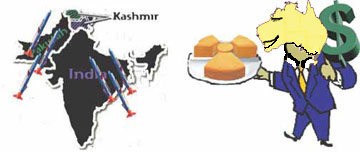 Canadian and Australian governments not to further advance controversial plans for uranium sales to India.
The call comes as Australian nuclear free campaigners join Indigenous landowners affected by uranium projects to present at the World Uranium Symposium in Québec.
The conference takes place against the backdrop of Indian Prime Minister Narendra Modi’s visit to Canada and Australian Foreign Minister Julie Bishop’s trip New Delhi to advance planned uranium sales.
“Canada and Australia should show responsibility restraint and prudence, as India has been criticised widely over the safety, security and transparency of its nuclear industry,” ACF’s Dave Sweeney said. “Australia and Canada should not rush into uranium sales agreements with India while serious concerns about safety and security remain unresolved.”
Australia’s controversial uranium deal with India has been widely criticised, including by former safeguards director John Carlson, who was for two decades head of Australia’s safeguards regime and was a keen nuclear promoter. Mr Carlson has raised concernsthat the new treaty’s administrative arrangements could substantially depart from Australia’s usual safeguards conditions, meaning Australia may be unable to keep track of what happens to uranium supplied to India.
Speaking from Québec ACF’s Dave Sweeney called on the Canadian and Australian governments not to further fuel instability in South Asia by selling uranium into the already volatile region.
“Uranium is not like other minerals. It is the fuel for nuclear weapons and creates carcinogenic waste that lasts for thousands of years,” he said. “Fuelling danger and instability in India is not in the interests of Canada or Australia.”
New research: 50% chance of another nuclear catastrophe before 2050
Wheatley and co’s work suggests that a Chernobyl-scale accident is worryingly likely to occur within the working lifetime of the reactors now being built. And when that happens, a once obscure place will enter the lexicon as a synonym for catastrophe, just like Chernobyl, Windscale and Fukushima.
These risks will have to be carefully weighed against the advantages. The question for engineers, policy makers and the general public alike is whether that risk is worth taking, given what’s at stake.
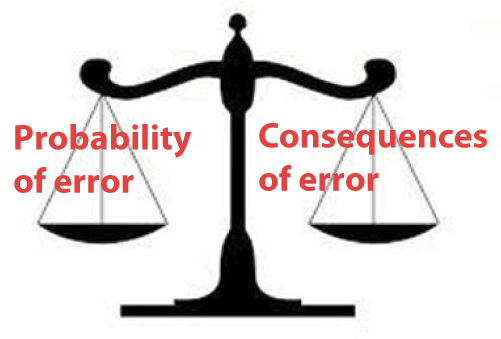 The Chances of Another Chernobyl Before 2050?
  50%, Say Safety Specialists, MIT Technology Review April 17, 2015 “…..And there’s a 50:50 chance of a Three Mile Island-scale disaster in the next 10 years, according to the largest statistical analysis of nuclear accidents ever undertaken……..
Today, we get an answer thanks to the work of Spencer Wheatley and Didier Sornette at ETH Zurich in Switzerland and Benjamin Sovacool at Aarhus University in Denmark. These guys have compiled the most comprehensive list of nuclear accidents ever created and used it to calculate the likelihood of other accidents in future.
Their worrying conclusion is that the chances are 50:50 that a major nuclear disaster will occur somewhere in the world before 2050. “There is a 50 per cent chance that a Chernobyl event (or larger) occurs in the next 27 years,” they conclude.
The nuclear industry has long been criticised for its over-confident attitude to risk. But truly independent analyses are few and far between, partly because much of the data on accidents is compiled by the nuclear industry itself, which is reluctant to share it. Continue reading
South Australia faces job losses if Renewable Energy Target is cut
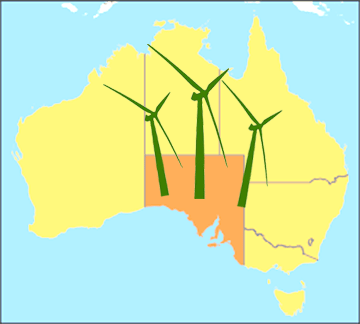
 Renewable Energy Target: Conservation Foundation warns cut would threaten potential SA jobs http://www.abc.net.au/news/2015-04-20/acf-warns-against-renewable-energy-target-cut/6405544 The Australian Conservation Foundation (ACF) says South Australia could lose up to $6 billion worth of investment, if the Renewable Energy Target (RET) is reduced.
The Federal Government wants to cut the target from 41,000 gigawatt hours to less than 32,000 gigawatt hours by 2020.
The foundation’s energy analyst, Tristan Knowles, said leaving the target as is would have huge benefits for South Australia.
“The bigger picture here if the RET isn’t weakened is that there’s 10 wind projects across South Australia that have been approved and the investment potential for those is about $6 billion and if they went ahead there’d be over 6,000 construction jobs and 31 ongoing jobs,” he said.
“So there’s a lot of potential.”
“South Australia was the only state that saw a drop between 2009 and 2014, so if these projects go ahead, they will generate jobs in construction and in ongoing maintenance and operations.”
Australia’s crumbling international reputation – questions on climate policy
 UN Countries Question Australia Over Climate And Energy Policy http://cleantechnica.com/2015/04/20/un-countrys-issue-australia-questions-climate-energy-policy/ by Joshua S Hill
Australia’s clean energy and climate policy (or lack thereof) has been brought back back into international focus again these last few weeks, as the country’s politicians continue to bicker over the Renewable Energy Target. Such political uncertainty has also led several major UN nations to present Australia with questions to explain their lack of political support for a cleaner future, with Brazil even going so far as to highlight Australia’s “low level of ambition.”
Over the past week, two reports have shown that the current political bickering has cost Australia’s renewable energy industry dearly, not to mention worldwide coverage concerningAustralia’s poor performance and unwillingness to commit to agreed upon climate facts and goals.
On Monday of last week, the Australian Bureau of Statistics (ABS) released a report which showed that the country’s renewable energy sector lost almost 2,500 jobs over 2013-14. According to the figures published by the ABS, renewable energy industry jobs dropped 15%, or 2,300, from the peak of 14,890 recorded in 2011-12.
Two days later, a new analysis from Bloomberg New Energy Finance showed that investment in the Australian renewable energy industry plummeted 90% over the 12 months since 31 March, 2014, “stifled by more than 13 months of policy uncertainty.”
We’re going backward if you compare us to quite a wide range of countries,” Andrew Thomson, managing director of Acciona Energy in Australia, said by phone to Bloomberg. “For companies operating in Australia, many would be saying, it’s getting extremely difficult here, why don’t we take a look at the broader region, Southeast Asia for example.”
These two reports followed a white paper published by the Australian Government on its energy policy, which was subsequently pulled apart by news agencies and industry representatives the country over.
So it comes as no real surprise, then, that United Nations’ countries are also going to be asking questions of Australia. The UN has compiled a list of questions presented to Australia (PDF) from a number of countries, including from big emitters like the United States and China. Even countries like Saudi Arabia and Brazil got in on the action, calling in to question Australia’s “initiative to support sustainable development” and Australia’s “level of ambition.”
Of the over 35 questions presented to Australia in the March session of the UN, not a single one has an answer from Australia — and that, ladies and gentlemen, is the most telling point of it all.
Uranium company Cameco embroiled in tax scandal, and indigenous opposition

 Multi-million dollar tax battle casts shadow over Canada-India uranium deal, Vancouver Observer The Canadian mining company selected to provide uranium to India is still fighting Canada Revenue Agency over millions in unpaid back taxes. Danny Kresnyak
Apr 19th, 2015 “……….. Cameco, the Saskatchewan-based company hired to supply India with 3,220 metric tonnes of uranium over five years, is wrapped up in legal a fight with Canada Revenue Agency over millions in owed taxes. In 2013, the Globe and Mail reported the company owes $800 million in back taxes………
in addition to the tax battle with Canada Revenue Agency, the company’s drilling operations in Saskatchewan are facing significant opposition from the Clearwater Dene First Nation…….
In a road north of La Loche, Saskatchewan, a group called “Holding the Line Northern Trappers Alliance” (HLNNTA) has been camping in the area to block companies from further exploratory drilling in their territory. The group first set up camp last November, and promises to remain until mining companies leave.
The HLNNTA argued they are unable to pursue the traditional, ecologically sound way of life of their ancestors, due to incursion by companies like Cameco looking for mineral deposits on their land.
HLNNTA spokesperson Candyce Paul told the Vancouver Observer she was opposed to the Cameco uranium deal with India. She said “scientific evidence is building towards proving that the uranium mining industry is killing the Indigenous people of northern Saskatchewan.”………
USA State passes law protecting Journalists’ Electronic Privacy
Montana Becomes First State To Pass Law Protecting Journalists’ Electronic Privacy
By: Rachel Blevins Apr 17, 2015, Benswann1
Montana recently passed a bill, sponsored by Liberty Republican Rep. Daniel Zolnikov, which closed a loophole in the state’s media shield law, making Montana the first state to include a provision protecting journalists’ electronic communications from government entities.
Last week, Montana became the first state to include a provision in its Media Confidentiality Act that protected journalists’ electronic communications from the government when Governor Steve Bullock signed a bill “prohibiting disclosure of media info from electronic communications services.”…………..
The text of the bill states that it both prohibits “governmental bodies from questing or requiring the disclosure of privileged news media information from services that transmit electronic communications,” and prohibits “an electronic communication service from being adjudged in contempt” if that service “refuses to disclose certain information.”
Zolnikov tells Benswann.com that he created the bill to help Montana set the precedent at the state level for the rest of the nation.
“Freedom of the press is one of the most crucial rights contained in the First Amendment,” Zolnikov said. “The federal government has cracked down on whistleblowers and journalists in the past few years, and many have said this has a ‘chilling effect’ on news reporting.”……….http://benswann.com/montana-becomes-first-state-to-pass-law-protecting-journalists-electronic-privacy/
Senate Inquiry warns of energy “death spiral”
An energy ’death spiral’ could result in electricity prices skyrocketing as more consumers go ‘off-grid’ http://www.couriermail.com.au/news/queensland/an-energy-death-spiral-could-result-in-electricity-prices-skyrocketing-as-more-consumers-go-off-grid/story-fnihsrf2-1227312552139 JESSICA MARSZALEK APRIL 21, 2015
AN ENERGY “death spiral” could result in electricity prices skyrocketing further as some customers tear up large bills in favour of using their own solar and battery power.
A Senate committee examining the management of electricity networks has found bill shock will become even more shocking for some unlucky customers as improving technology allows other customers to go “off-grid”.
A report prepared by the Environment and Communications References Committee said it was increasingly likely more and more customers would generate their own electricity in the future as technology improves solar and battery power, leaving fewer customers to foot the bill for the growing and expensive electricity network.
“Electricity prices, largely driven by network costs, have risen significantly while the demand for electricity has declined,” the report says.
“This had led to concern about a death spiral; that is, high prices are causing demand to decline while also encouraging consumers and businesses to engage in their own generation activities. Remaining customers would be required to pay an increasing share of the network costs.”
With more than one million solar power systems already on roofs and emerging battery storage technology allowing homes to store their own solar power, we could see an even more dramatic behaviour shift.
The report recommended an urgent investigation into electricity production, asking state governments to “prioritise efforts” to focus on whether networks are properly anticipating more and more customers going “off-grid”. Meanwhile, the committee is still considering allegations of price rorting by electricity company Energex.
The inquiry was sparked by an Energex whistleblower’s revelations published in The Courier-Mail last year that it looked into manipulating data to target a higher rate of return. The issues will be discussed in the inquiry’s final report, due by May 5.
University offering free online course to demolish climate denial

 Climate change is real, so why the controversy and debate? Learn to make sense of the science and to respond to climate change denial……https://www.edx.org/course/making-sense-climate-science-denial-uqx-denial101x#%21
Starting 28 April, 2015, the University of Queensland is offering a free Massive Open Online Course (MOOC) aimed at “Making Sense of Climate Science Denial”. ..
Report shows Australia could have 100% renewable energy by 2050
 100% Renewable Energy Powered Australia Possible By 2050 http://www.energymatters.com.au/renewable-news/renewables-anu-wwf-em4784/ April 22, 2015
Australia has the potential to reach 100% renewables and zero net emissions by 2050 according to a report from Australian National University’s Centre for Climate Economics and Policy.
Commissioned by WWF-Australia, the report’s primary focus is on how deep cuts to Australia’s emissions can be achieved, and at a low cost. An important strategy is boosting uptake of renewables.
The report notes 100% renewable energy can be supplied through utilising existing technologies such as wind turbines, solar panels and concentrating solar thermal.
Surplus or deficits in supply could be addressed by molten salt storage associated with solar thermal plants, biomass-fired generators and existing hydropower.
However, a rapid shift to 100% renewables could be problematic in that it would mean early retirement of significant existing power generation assets – and while that may be attractive to many; it’s not going to happen without a massive fight.
“A more gradual transition to a near-zero carbon system, by around 2040, would take advantage of natural asset turnover and be more cost effective, and would be combined with early targeted retirement of Australia’s most emissions intensive power stations. Almost all of Australia’s existing electricity generation assets will be retired before 2050 in any case.”
Going green in such a big way doesn’t mean ‘we’ll all be rooned’.
“Most economic modelling indicates that ambitious mitigation action does not dramatically change the structure of the Australian economy, and that all industries that are growing in the base case,” says the report.
The devil in the detail is policy stability – a devil we’ve become all too familiar with already. The current argy-bargy over Australia’s Renewable Energy Target has seen new investment in large scale renewables practically stall. Local investment in new large-scale renewable energy projects collapsed in 2014 to levels almost 90 per cent lower than the year before.
“The solution is clear: set an ambitious long-term goal for reducing carbon pollution, and take decisive action to make it happen,” said Kellie Caught, WWF-Australia’s National Manager – Climate Change. “That’s the kind of leadership hardworking taxpayers deserve – let’s commit to leaving things better than we found them.”
The report, “Australia Can Cut Emissions Deeply And The Cost Is Low” can be viewed in full here (PDF).
Clean energy has spread to every corner of the globe
In developing countries, where renewables are best positioned to address the chronic lack of energy access, clean energy investment rose 36% to $131bn. It’s well on track to surpass investment in developed countries, which amounted to $139bn last year.
 The world is finally producing renewable energy at an industrial scale’, Guardian Achim Steiner, 21 Apr 15 Clean energy has spread to every corner of the globe, with more than 100,000 megawatts of capacity installed last year Renewables are finally becoming a globally significant source of power, according to a United Nations Environment Programme report released in March by Frankfurt School UNEP Centre and Bloomberg New Energy Finance.
Driven by rapid expansion in developing countries, new installations of carbon-free renewable power plants in 2014 surpassed 100,000 megawatts of capacity for the first time, according to the Global Trends in Renewable Energy Investment report. It appears that renewable energy is now entering the market at a scale that is relevant in energy industry terms – and at a price that is competitive with fossil fuels.
The numbers are compelling. Renewables such as wind, solar and biomass generated an estimated 9.1% of the world’s electricity in 2014, up from 8.5% in 2013, according to the report. These sources made up the majority of new power capacity in Europe, and also brought electricity to new markets.
They also caught the eyes of investors: in 2014, energy investment in rose 17% over the previous year, surging to $270bn, according to the report.
Conventional wisdom meets unconventional growth Continue reading
1 This month

of the week – Australians for War Powers Reform (AWPR)
To see nuclear-related stories in greater depth and intensity
 Antinuclear