“Australia now holds the fate of the world’s climate in its hands”.
The government has indicated it will take a ‘technology neutral’ approach, which explains why Australia is the only nation in the world to axe the (carbon) tax, and efforts to slash the Renewable Energy Target by more than half.
Last year, the federal government approved the world’s largest coal fields in Queensland’s Galilee Basin – resources which the Climate Council reports “can not be developed” because they are “inconsistent with tackling climate change”.
Collectively, the proposed mines would create more emissions than nations like Australia, the UK, Italy and South Africa.
Why The Fate Of The World’s Climate Is Largely In Australia’s Hands, New Matilda, By  Thom Mitchell, 23 Apr We’re told Australia’s contribution to global warning is minimal. A report out today proves that’s a dangerous lie. Thom Mitchell explains.
As American academic Bob Massey put it, “Australia now holds the fate of the world’s climate in its hands”.
In its pursuit of a solution to the ‘budget emergency’ Australia is using up the ‘carbon budget’ at a rate incompatible with the global goal of limiting temperature rises to below two degrees, a Climate Council report out today has demonstrated.
While Australia is under increasing pressure to announce an ambitious target to limit emissions at home, the report makes clear that it is our reliance on fossil fuel exports that is doing the real damage.
By actively seeking to prolong the dying revenue stream, which has buoyed the economy through the past decade, the Australian government is doing massive damage to the remaining ‘carbon budget’.
At a recent talk in Sydney, Massey was blunt. “If your government and mining companies decide to develop all of the coal and gas currently planned, already on the books, our children will be forced to endure a world very different from what we know,” he said.
To avoid such a world, scientists have developed the ‘carbon budget’ which, put simply, is the amount of carbon dioxide humans can emit into the atmosphere before temperature rises reach two degrees above pre-industrial levels.
On that basis, if all of Australia’s coal were burnt, it would use up two thirds of the ‘carbon budget’. Effectively, 90 per cent of the continent’s coal must stay in the ground.
Not all of that coal is technologically and economically viable now, but even if we burnt only the nation’s ‘reserves’, a 19 per cent bite would be taken out of the carbon budget.
If we burnt the total ‘resources’ – coal known to exist but not necessarily recoverable at this point – it would constitute a whopping 67.7 per cent of the carbon budget.
Yet despite the increasingly gloomy outlook for the commodity – the price of which has collapsed by around 60 per cent in the last five years – mining companies continue to explore for it and develop new mines. Australian governments are not only approving them, they’re promoting them.
Last month, it was revealed that Tony Abbott is standing in the way of attempts from the US, UK, and France to shut down OECD subsidies for new coal-fired power stations in developing Asian economies which are seen as a promising market.
The central purpose of the document, which maps out the foreseeable future for energy policy, is to ‘keep us competitive’, and keep us exporting.
The government has indicated it will take a ‘technology neutral’ approach, which explains why Australia is the only nation in the world to axe the (carbon) tax, and efforts to slash the Renewable Energy Target by more than half.
Last year, the federal government approved the world’s largest coal fields in Queensland’s Galilee Basin – resources which the Climate Council reports “can not be developed” because they are “inconsistent with tackling climate change”.
Collectively, the proposed mines would create more emissions than nations like Australia, the UK, Italy and South Africa.
According to the former President of BP Australasia and Councillor at the Climate Commission, Gerry Heuston, the fact that “there’s not a very strong link between energy policy and climate policy” is a key problem.
“My view is that it’s nothing to do with the environmental concerns or moral concerns, it just defies economic logic.
“When you see the economic analysis being done, [it’s] investing money in a future that’s not going to exist.
“Basically what the report shows is the demand is not going to exist if the world is going to keep within the two degree guard rails.” Huston argues that big business is not against climate action, and recognises there’s a risk, but is waiting on secure, bi-partisan policy settings.
“In fact for years companies like Shell and BP, and other extractives player, were advocating ‘lets have the right policy settings and business will do the heavy lifting’,” he said………
https://newmatilda.com/2015/04/23/why-fate-worlds-climate-largely-australias-hands#sthash.QM3FSxBK.dpuf
No comments yet.
1 This month
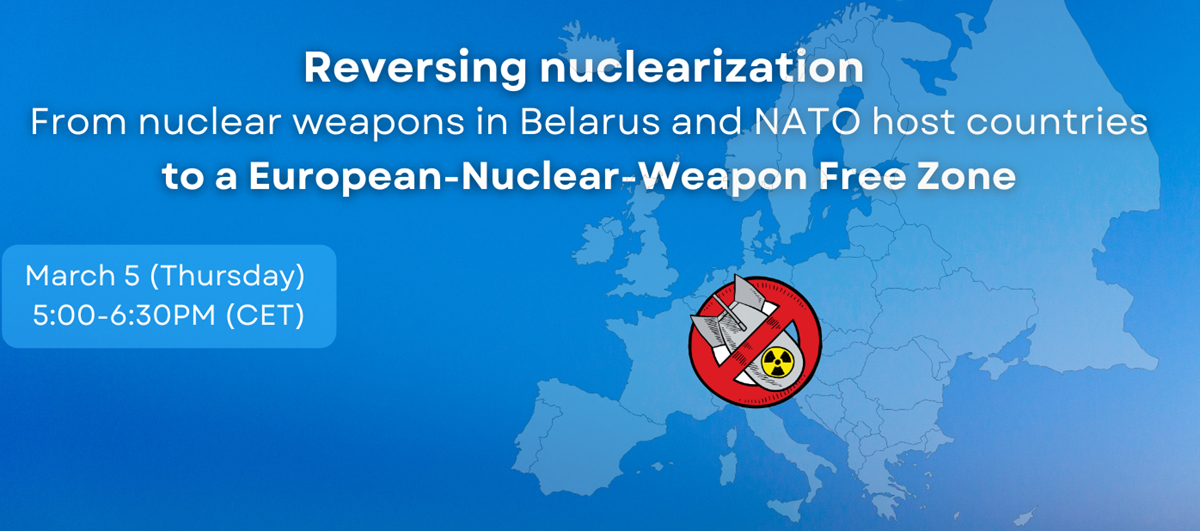
6 March -Online – Reversing nuclearization:
From nuclear weapons in Belarus and NATO host countries to a European-Nuclear-Weapon Free Zone
Mar 6, 2026 03:00 AM in Canberra, Melbourne, Sydney

of the week – Australians for War Powers Reform (AWPR)
To see nuclear-related stories in greater depth and intensity
 Antinuclear
Leave a comment