AUDIO: Wind power subsidising New South Wales farmers
 AUDIO: Farmers use wind farm rent to pay on-farm costs ABC NSW Country Hour 24 Apr 15
Joshua Becker Farmers in south-east New South Wales are using wind farm rent to subsidise on-farm costs. AUDIO: Farmer uses rent from wind farm to pay for on weed management (ABC Rural)

Howard Charles is one of 17 farmers who have wind turbines from the Boco Rock Wind Farm on their properties west of Nimmitabel in south-east NSW.
He said money from hosting wind farms on his property had helped him tackle noxious weeds on his property.
“With the two towers on our farm the extra income from the rent certainly helps with controlling the weeds, which is a never ending problem, serrated tussock in particular,” he said.
“I don’t see any downside, we are the closest house to the wind farm, some of the towers are less than a kilometre from here, even with prevailing winds we don’t hear it, I don’t see it. I do wonder what all the fuss is about sometimes.
“They’re certainly not interfering with our agriculture at all and I think we’re going to wake up down the track to the fact that renewable energy is pretty important.
“The most telling comment I’ve had about this [wind farm] is – ‘thank God we’re not the Hunter Valley’…….http://www.abc.net.au/news/2015-04-23/farmers-use-wind-farm-rent-to-pay-on-farm-costs/6415126
Nuclear power a low carbon energy source? that’s a myth
When it comes to nuclear power, the industry wants you to think of electricity generation in isolation
Every aspect of the nuclear fuel cycle—mining, milling, shipping, processing, power generation, waste disposal and storage—releases greenhouse gases,
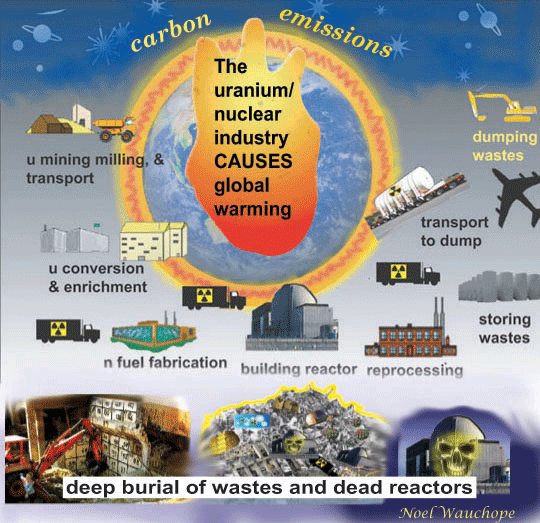
Why Do People Claim that Nuclear Power is a Low-Carbon Source of Energy?, Washington’s Blog
Even well-known, well-intentioned scientists sometimes push bad ideas. ……..
some scientists are under the mistaken impression that nuclear power is virtually carbon-free, and thus must be pushed to prevent runaway global warming. (If you don’t believe in global warming, then this essay is not aimed at you … although you might wish to forward it to those who do.)
But this is a myth. Amory Lovins is perhaps America’s top expert on energy, and a dedicated environmentalist for close to 50 years. His credentials as an energy expert and environmentalist are sterling…….
Lovins says nuclear is not the answer:
Nuclear plants are so slow and costly to build that they reduce and retard climate protection.
Here’s how. Each dollar spent on a new reactor buys about 2-10 times less carbon savings, 20-40 times slower, than spending that dollar on the cheaper, faster, safer solutions that make nuclear power unnecessary and uneconomic: Continue reading
Australian tax-payers funding shonky climate economics with $4m Bjørn Lomborg centre
So is this “methodology” the Abbott Government has spent $4million on any good?……
while cost-benefit analysis can be useful, it doesn’t work when you apply it to climate change policy.
How do you price, for example, the loss of a Pacific island nation and what that would mean for the cultures that have thrived there? What’s the price losing multiple species of flora and fauna or the Great Barrier Reef Jotzo adds:
Climate change is exceptional because it has all of these dimensions that go beyond the practical capability of cost benefit analysis.
 Australian taxpayers funding climate contrarian’s methods with $4m Bjørn Lomborg centre Graham Readfearn, Guardian 23 Apr 15 Lomborg’s think tank methods underplay the impact of climate change and have ‘no academic credibility’ says leading climate economist. Danish political scientist and climate change contrarian Bjørn Lomborg says the poorest countries in the world need coal and climate change just isn’t as big a problem as some people make out.
Australia’s Prime Minister Tony Abbott says “coal is good for humanity” and there are more pressing problems in the world than climate change, which he once described as “crap” but now says he accepts.
So it’s not surprising then that the latter should furnish the former with $4 million of taxpayer funds to start an Australian arm of Lomborg’s Copenhagen Consensus Centre (CCC) at the University of Western Australia’s business school.
The CCC has consistently said that targets to cut greenhouse gas emissions are too expensive and money should be spent elsewhere
After a couple of weeks of doubt and confusion over the origins and the funding of the centre, latest reports suggest that the idea came from the Prime Minister’s office.
A spokesperson for the Prime Minister told Fairfax media it was “the government’s decision to bring the Lomborg consensus methodology to Australia”.
More on this “methodology” and some pretty fundamental problems with it in a bit.
Students at UWA are gathering names on a petition and campaigning in protest, saying Lomborg’s appointment as an adjunct (unpaid) professor there damages the university’s reputation and is an embarrassment. The University’s Student Guild claimed that “students, staff and alumni” were outraged. Continue reading
“Australia now holds the fate of the world’s climate in its hands”.
The government has indicated it will take a ‘technology neutral’ approach, which explains why Australia is the only nation in the world to axe the (carbon) tax, and efforts to slash the Renewable Energy Target by more than half.
Last year, the federal government approved the world’s largest coal fields in Queensland’s Galilee Basin – resources which the Climate Council reports “can not be developed” because they are “inconsistent with tackling climate change”.
Collectively, the proposed mines would create more emissions than nations like Australia, the UK, Italy and South Africa.
Why The Fate Of The World’s Climate Is Largely In Australia’s Hands, New Matilda, By  Thom Mitchell, 23 Apr We’re told Australia’s contribution to global warning is minimal. A report out today proves that’s a dangerous lie. Thom Mitchell explains.
As American academic Bob Massey put it, “Australia now holds the fate of the world’s climate in its hands”.
In its pursuit of a solution to the ‘budget emergency’ Australia is using up the ‘carbon budget’ at a rate incompatible with the global goal of limiting temperature rises to below two degrees, a Climate Council report out today has demonstrated.
While Australia is under increasing pressure to announce an ambitious target to limit emissions at home, the report makes clear that it is our reliance on fossil fuel exports that is doing the real damage.
By actively seeking to prolong the dying revenue stream, which has buoyed the economy through the past decade, the Australian government is doing massive damage to the remaining ‘carbon budget’.
At a recent talk in Sydney, Massey was blunt. “If your government and mining companies decide to develop all of the coal and gas currently planned, already on the books, our children will be forced to endure a world very different from what we know,” he said.
To avoid such a world, scientists have developed the ‘carbon budget’ which, put simply, is the amount of carbon dioxide humans can emit into the atmosphere before temperature rises reach two degrees above pre-industrial levels.
On that basis, if all of Australia’s coal were burnt, it would use up two thirds of the ‘carbon budget’. Effectively, 90 per cent of the continent’s coal must stay in the ground. Continue reading
Climate change damage makes compelling economic argument for renewable Energy
 even without any damage from climate change itself, the argument of moving to renewables (given the position of the rest of the world) makes good economic sense. When you add the risk of damage from climate change the case is unassailable.
Why would a nation like India waste money on taking poles and wires to every remote village and spending billions on coal power stations and metering when solar panels make more sense? They do not provide power continuously, but they are so much cheaper.
We should invest in renewable energy SMH, April 24, 2015 Crispin Hull “……..storms like the ones this week – which scientists say will become more frequent with global warming – should give cause for reflection. The extent and cost of the potential damage is so high that prudence demands action.
But there is another more significant point. Governments can fix most things, but they will not be able to fix climate change. They will not be able to refreeze the Greenland and Antarctic ice sheets and make the rising seas fall – a bit like King Canute. The damage will be irreversible for thousands or even millions of years.
But governments can force changes to stop the melt in the first place.
There are several reasons why people see no need for any action at all or no need for urgency. We have always had bad weather events.
Change is imperceptible. The science is not conclusive so we can wait before taking action. Damage is a long time off.
If we see real evidence of climate change we can act then to fix it. Australia is just one nation and can do little on its own.
Because so many people think like this, governments have been able to get away with doing so little. Continue reading
Bjorn Lomborg’s climate contrarianism: where his money comes from

many of the earlier donors to Lomborg’s US think tank have been linked to the conservative side of politics, some with links to the billionaire Koch brothers.
There’s nothing “smart” about spending $4 million of taxpayer cash on a highly questionable methodology that by design downgrades climate change.
Australian taxpayers funding climate contrarian’s methods with $4m Bjørn Lomborg centre Graham Readfearn, Guardian 23 Apr 15 Lomborg’s funding“………Exactly how and where Bjorn Lomborg’s think tank has gathered its cash over the years has been a tough story to get the bottom of.
When the Danish Government’s funding of the CCC ran out in 2012, Lomborg had already registered the US arm of the think tank four years earlier.
Since 2008, the US tax records of the Copenhagen Consensus Center show it has gathered about $5million in income, more than half of which had come in 2012 and 2013 (the most recent years for which records are available).
Lomborg himself was paid $975,000 via the think tank in those two years.
Yet much of the think tank’s income is not disclosed Continue reading
1 This month

of the week – Australians for War Powers Reform (AWPR)
To see nuclear-related stories in greater depth and intensity
 Antinuclear