Choosing Wisely campaign warns on unnecessary radiation medical procedures
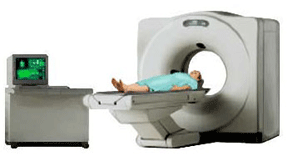 Unnecessary tests: Choosing Wisely campaign targets brain scans, food allergy tests SMH, April 29, 2015 Harriet Alexander Common medical procedures including brain scans, food allergy tests and long-term reflux medication are unnecessary and possibly harmful for many patients and should be radically reduced, doctors have warned.
Five of the peak specialty medical groups has identified 24 tests and treatments that physicians and patients should question in a national campaign that aims to influence treatment standards in hospitals and medical practices across Australia.
Each college or association has listed five examples, including tests that lead to false positives or expose patients to radiation without generating a useful diagnosis and treatments that new research has proved ineffective…….
The Australian College of Emergency Medicine’s immediate past president Sally McCarthy said 40 to 60 per cent of diagnostic tests were of little or no benefit to patients.
“It’s phenomenal, so it’s in everyone’s interests to not waste resources by diverting them to stuff that doesn’t need to be done,” Dr McCarthy said.
Most of the tests and treatments identified by the colleges were known to be ineffective, but junior doctors and nurses could be more prone to ordering unnecessary tests because they did not want to miss anything, she said……..
The Choosing Wisely campaign, co-ordinated by the not-for-profit organisation NPS MedicineWise, has been modelled on an initiative of the same name launched in the United States in 2012 and has since been adopted in Canada, Italy, the Netherlands and Germany.
NPS MedicineWise chief executive Lynn Weekes said few items on the list would be controversial among clinicians, but many recommended them anyway.
The aim of the campaign was to start a conversation.
“But doctors are careful, they’re worried that they’re going to be sued, they do practise a bit of defence medicine,” Dr Weekes said.
“It may be the system is putting pressures on them in terms of the way the hospital works that just makes this the easier route. So it’s a combination of factors.”………http://www.smh.com.au/nsw/unnecessary-tests-choosing-wisely-campaign-targets-brain-scans-food-allergy-tests-20150429-1mv8n3.html
Aborigines bear the brunt of Australians’ unspoken racism
Aboriginal action groups are prepared for yet another arduous battle for political and physical space in a place that was once theirs.
Don’t mention the R word, The Guardian, 29 Apr 15 Sisonke Msimang
Is there a place where white people are more committed to faux race blindness than South Africa?
The first thing that strikes you when you arrive in Australia is how racist this place is, and yet how committed many Australians are to not talking about race. As a South African I recognise this purposeful, focussed commitment to faux race blindness. Even as someone slags off Aboriginal people and immigrants, and rants about the need to “reclaim Australia,” many here will insist that they are not racist………..
The levels of racism amongst many white Australians seem to match the levels of denial about their being racist. And there is no doubt that the deepest and most abiding forms of racism are directed against Aboriginal people. It is as though on some psychic level, white Australians are angry with Aboriginal people for still being here, for reminding them of their sins, for refusing to conform to their own ideas about what Australia is or should be……
white Australia’s history of dealings with the Indigenous people of this continent are as ugly as you’ll find anywhere in the world. Continue reading
1 This month

of the week – Australians for War Powers Reform (AWPR)
To see nuclear-related stories in greater depth and intensity
 Antinuclear