A business perspective on the economics of nuclear power
Before rushing to endorse nuclear expansion, regulatory agencies and individual researchers should critically examine past performance and demand experimental proof for claims that the next generation of nuclear plants (should any ever be considered for construction) will be economically viable, climate-friendly, and accident-proof.
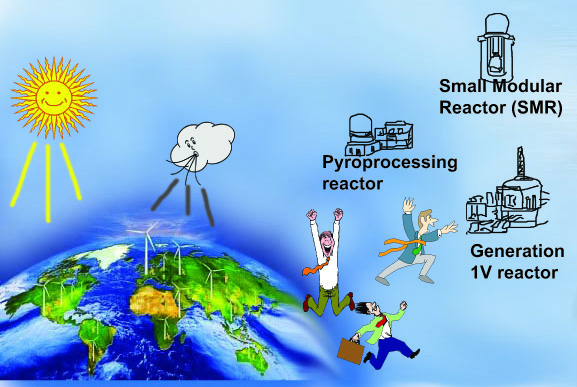
It is believed that next generation reactors will differ dramatically from current reactors in that they will replace active water cooling and multiple backup safety systems with “passive safety” designs. In fact, many nuclear advocates and news reports inaccurately describe the proposed new reactor designs, such as the pebble bed modular reactors, as “accident-proof” or “fail-safe.”
 Nuclear Power: Totally Unqualified to Combat Climate Change BY RINALDO S. BRUTOCO , WORDL BUSINESS ACADEMY SEPTEMBER 14, 2014 “………From a business perspective, private investors should be seen as the ultimate ”referees” on competing energy choices, using informed diligence and prudent criteria to determine which energy technologies can compete in the market with the best chance of generating revenues and profits. As Amory Lovins points out, the capital markets have already spoken. Private investors and project finance lenders have flatly rejected large base-load nuclear power plants and have enthusiastically embraced supply-side competitors, decentralized cogeneration, and renewables……… We believe the reason all sophisticated investors avoid nuclear investments isbecause no one has figured out how to build a reactor that doesn’t routinely emit toxic levels of radioactivity while still producing power economically, and because there is no safe disposal system known to humanity.
The commercial nuclear industry has been around for over half a century, so the prudent approach would be to look at the industry’s track record. Under close examination, we find a string of broken promises, product failures, massive subterranean leaks of liquid nuclear waste (e.g., the Hanford facility), cost overruns, overly optimistic projections, stranded debts, bankruptcies, bond defaults, premature plant closings resulting from bad plant siting and/or accidental radioactive emissions from core reactor equipment failures (e.g., San Onofre), and vast quantities of toxic waste that grows daily primarily in spent fuel pools as inviting targets for terrorism. The above account does not include a series of catastrophic accidents and near-accidents, the most memorable of which are the 1979 near-meltdown at Three Mile Island, the 1986 Chernobyl disaster and the ongoing leakage from three failed reactors in Fukushima.
After decades of subsidies, nuclear power still remains the most expensive and non-competitive form of base power generation that takes decades of lead-time before a single electron is produced.[15] Nevertheless, in attempting to promote nuclear power, industry advocates focus only on certain limited costs for heavily subsidized fuel, labor, materials, and services that are characterized as “production costs.” But these limited costs are only part of the economic picture. The real challenge facing nuclear power becomes clear when “life cycle” production costs are compared, including construction, operations, maintenance, fuel, decommissioning, and millennial waste storage.[16]
The serious challenges described above make nuclear technology a very bad deal. Nuclear advocates claim that safety concerns will be addressed by the next generation of new advanced reactor designs that are supposedly “inherently safe.” This appears to be a backhand admission that the first-generation reactors were not that safe in the first place. And, as noted elsewhere herein, after hearing promises of a “next generation” reactor designs for many decades, no such design has appeared that is remotely ready for commercial construction. How long can all the acknowledged ills of nuclear power be cavalierly wiped away by invoking a mythical “next generation” reactor that has never appeared nor is likely to appear?
Before rushing to endorse nuclear expansion, regulatory agencies and individual researchers should critically examine past performance and demand experimental proof for claims that the next generation of nuclear plants (should any ever be considered for construction) will be economically viable, climate-friendly, and accident-proof. It is believed that next generation reactors will differ dramatically from current reactors in that they will replace active water cooling and multiple backup safety systems with “passive safety” designs. In fact, many nuclear advocates and news reports inaccurately describe the proposed new reactor designs, such as the pebble bed modular reactors, as “accident-proof” or “fail-safe.” However, experiments conducted at the THTR-300 modular reactor in Germany led to accidental releases of radiation after one of the supposedly “accident-proof” fuel pebbles became lodged in a feeder pipe, damaging the fuel cladding. After the operators tried to conceal the malfunction and blamed the radiation release on the Chernobyl accident, the government closed the reactor.[17]……….
[refuting this Claim]“Innovation and economies of scale can make new power plants even cheaper than existing plants.” The historically consistent record of nuclear reactors for over 50 years is exactly the opposite – they have gone up each year in cost and have never achieved economies of scale or brought prices down. To our knowledge, there is no evidence supporting the proposition that either innovation or “economies of scale” will result in cheaper nuclear power in the future and, as noted earlier, no functional design exists (or is on the drawing board) that will lead to reduced costs for nuclear energy in the foreseeable future. The economic challenge facing nuclear power becomes clear when one faces the fact that its “life cycle” production costs, computed on a per kilowatt-hour basis, are several times that of coal, natural gas, and wind — not including the ultimate waste disposal costs which remain unknown because no approved disposal system exists in the U.S………https://worldbusiness.org/nuclear-power-totally-unqualified-to-combat-climate-change/
No comments yet.
1 This month
7 April – WEBINAR – Australia and the Doomsday Clock – Preventing nuclear war through NoFirstUse and other policies
Online | Tuesday April 7, 4:00-5:30pm, Australian Eastern Time / 8:00-9:30am Central Europe Time
– Access the registration link
15 April – Zoom –Nuclear Power is Not the Solution
Apr 15, 2026 01:00 AM in Canberra, Melbourne, Sydney

Join the International Physicians for the Prevention of Nuclear War (IPPNW) on Tuesday, April 14th for a timely webinar exploring the risks associated with nuclear power and challenging the myth that it offers a simple, safe, carbon-free solution to the climate crisis

21 April Webinar: No Nuclear Weapons in Australia
Start: 2026-04-21 18:00:00 UTC Canberra, Melbourne, Sydney (GMT+10:00)
End: 2026-04-21 19:30:00 UTC Canberra, Melbourne, Sydney (GMT+10:00)
Event Type: Virtual
A virtual link will be communicated before the event.
Host Contact Info: australia@icanw.org

of the week – Australians for War Powers Reform (AWPR)
To see nuclear-related stories in greater depth and intensity
 Antinuclear
Leave a comment