Medical warning on radiation risks in unnecessary CT scans
 Less is the new more: choosing medical tests and treatments wisely The Conversation,Tammy Hoffmann A/Prof Clinical Epidemiology, Bond University; NHMRC Research Fellow at The University of Queensland Chris Del Mar Professor of Public Health at Bond University
29 April 2015 “……Not so long ago, getting an x-ray for acute back pain was the norm. Although it’s now known that they don’t help most cases, they are still used far more frequently than is necessary.
Acute non-specific low back pain is a very common problem that, most of the time, gets better without any treatment. We are not sure anything, except staying active, helps it resolve faster.
X-rays are only helpful to diagnose the rare causes of acute back pain such as cancer (spread from some other origin), infection (very rare nowadays), osteoporotic fractures in elderly folk, or exceptional narrowing of the spinal canal. Most of these have some clinical indications that doctors look out for.
X-rays not only have little to contribute, they have downsides too.
First, they detect problems that may not be relevant (such as disc-space narrowing) and can lead to more investigations, such as computed tomography (CT) scans. Rarely does anything detected from the x-rays or the further investigations contribute to the better management of the condition and resolve a person’s back pain faster.
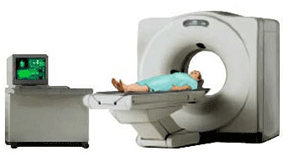
Second, x-rays themselves are directly harmful: accumulated doses of radiation increase the risk of cancer. While the doses are very small for plain x-rays, they are much higher for CT scans…….
One move comes from government. Last week federal Health Minister Sussan Ley ordered a review of Medicare item numbers to prune away activities funded from the public purse that are useless.
Another initiative, launching in Australia this week, comes from the clinical professions themselves: the Choosing Wisely campaign. It aims to encourage a conversation between clinicians and patients about tests, treatments and procedures that may provide little or no value, and which may cause harm.
The Choosing Wisely campaign first launched in America in 2012 as collaboration between the American Board of Internal Medicine Foundation, Consumer Reports and nine medical speciality societies. Each society developed a list of five treatments, tests or services that were commonly provided but whose necessity should be questioned and discussed.
The campaign has expanded, with 70 societies now participating. Thirteen countries have adapted and implemented Choosing Wisely…….
These lists are not just for clinicians. As we recently wrote on The Conversation, our research showed most people overestimate the benefits and underestimate the harms of tests, screens and treatments.
These unrealistic and overly optimistic expectations often result in patients asking clinicians for tests and treatments. Some of these are unnecessary and will provide little, if any, benefit and may cause harm………http://theconversation.com/less-is-the-new-more-choosing-medical-tests-and-treatments-wisely-40756
No comments yet.
1 This month

of the week – Australians for War Powers Reform (AWPR)
To see nuclear-related stories in greater depth and intensity
 Antinuclear
Leave a comment