Short-lived medical nuclear wastes not the same problem as long-lived reprocessed wastes
 This excellent article does not, however, explore the difference between the (generally short-lived) radioactive wastes from nuclear medicine, and the highly toxic and long-lived radioactive wastes that must be accepted from UK, France and Argentina. Australia is bound to take back those wastes, which originated from Lucas Heights, and then went overseas for processing.
As the medical radioactive wastes have relatively short half-lives, it makes sense to dispose of them close to the point of origin. (It also makes sense to (a) reduce the overuse of nuclear medicine, and (b) obtain the necessary radionuclides from other sources, rather than from a nuclear reactor, and (c) shut down the Lucas Heights nuclear reactor.)
What the government is rightly concerned about, is the disposal of the high level wastes due to return very soon from overseas. And there’s an argument for storing these near the point of origin – Lucas Heights, along with shutting down Lucas Heights.
Adding to the confusion is the greedy and irrational push of some people in Australia to set our country up as the world’s nuclear waste dump – and import wastes from other countries – not just the wastes that we are already contracted to have returned from the processing of Lucas Heights’ wastes.
May 5 closing date for Nominations from landowners to host nuclear waste
South Australia, Western Australia, Victoria and the Northern Territory have legislation in place prohibiting the storage of radioactive waste from outside the state or territory. This means that the legality of nominations coming from these states or territories is compromised. The Federal Government, however, calls onto all Australian landowners fulfilling the criteria to submit applications, as the National Radioactive Waste Management Act 2012 allows the Minister to override state legislation if conflict arises. The question is just how voluntary the siting would be in that case, given that it undermines democratically made decisions?event of an accident) or indirectly affected
 Let’s hope the opportunity to deal with radioactive waste won’t be wasted, SBS, Over the coming weeks and months we will find out whether the Federal Government’s new approach to finding a radioactive waste storage and disposal site will be more successful than past efforts. By Anica Niepraschk 1 MAY 2015 -Australia does not produce any high-level radioactive waste. It does however produce moderate amounts of low-level waste that could be disposed of in a shallow repository to be monitored for several hundred years, and long-lived intermediate-level waste that will need to be carefully managed for some thousands of years.
After more than 20 years of flawed and failed attempts to impose a dump on communities in South Australia and the Northern Territory, the Government has finally realised that a matter of such importance and extraordinary risks can’t be imposed on communities but has to be the result of a voluntary process.
In March, Industry Minister Ian McFarlane called on landowners across Australia to nominate their land to host a radioactive waste management facility. The two-month nomination period ends this Tuesday, May 5, which could give a first indication on where the Government is heading with its new approach.
It is worth having a look at how the process is set out and if it is really as voluntary as the Government claims. Continue reading
Kintyre uranium project
Kintyre Uranium Project. WA (EPBC 2010/5637)
Minister’s approval decision and conditions
http://www.environment.gov.au/epbc/notices/assessments/2010/5637/2010-5637-approval-decision.pdf
(Even though the decision has been made by Environment Minister Greg Hunt, concerned readers can still send him messages here: http://ccwa.org.au/takeaction/kintyre and here: https://www.action.org.au/kintyre )
Unusual occurrence and rate of development of thyroid cancer in Fukushima children
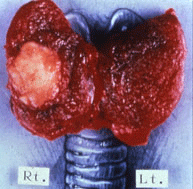
| 74% chance of lymph node metastasis Not only is the number of thyroid cancers large, but also the symptoms are serious. Last year Fukushima Medical University published 55 cases of thyroid cancer in Fukushima: 2 of them were anaplastic carcinoma, and 74% of them lymph node metastasis. Normally, the prognosis of thyroid cancer among adults is good: little metastasis and slow progression. But this is not true of thyroid cancer found in Fukushima.
The Government Must Expand Medical Examinations for Victims of the Fukushima Nuclear Disaster http://www.foejapan.org/en/energy/doc/150310.html 10 March 2015
|
Environment Minister Greg Hunt’s hype about “Direct Action” doesn’t ring true
 Greg Hunt hasn’t a lot to show for $660m spent on reducing greenhouse emissions, Guardian, Lenore Taylor, 1 May 15
While the environment minister is proclaiming a ‘stunning’ result, the money mostly went on projects begun under the previous government
Last week the government spent $660m to reduce Australia’s expected greenhouse emissions by 47m tonnes – a result the environment minister, Greg Hunt, described as “stunning” and one starry-eyed commentator suggested was so completely amazing it may have won the next election for the coalition.
So what stunning things did we get for our money? Did we start to transform our economy so we use less fossil fuel in the future? Did we buy lasting change? Not a lot. Mostly we spent it on making sure that projects begun under the former government kept going…….http://www.theguardian.com/environment/2015/may/01/greg-hunt-660m-spent-reducing-greenhouse-emissions
Recycling of rare earths – an industry already under way
Recycling gives old electronics new life JAMIE DUNCAN AAP MAY 01, 2015 Herald Sun
IMAGINE a world in which billions of dollars of gold, silver, platinum and other precious metals are thrown into a pit like rubbish.
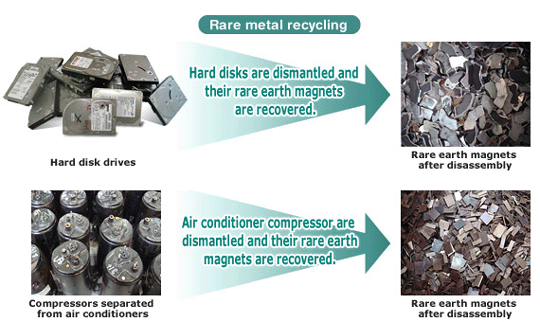
IT seems unlikely, but it’s happening now at landfills around the globe.
- A recent United Nations University report found consumers threw out 41.8 million tonnes of unwanted electronics, or e-waste, in 2014 but recycled only 6.5 million tonnes.That discarded e-waste included an estimated $US52 billion ($A65.78 billion) of precious and other metals.Rose Read, recycling manager with MobileMuster (MobileMuster), says recycling components from e-waste is good for the economy and the environment.”The benefits are massive, and not just in terms of dollar value, but also the environmental benefits of slowing the rate of mining,” Ms Read told AAP.”The amount of energy it takes to recover product materials from a mobile phone is a tenth of digging them up.”MobileMuster is a federal government-accredited product stewardship scheme funded voluntarily by a range of mobile phone manufacturers and retailers that collects unwanted mobiles to recycle components.A similar scheme operates for end-of-life televisions.Consumer thirst for the latest technology is forcing the need to recycle e-waste, Ms Read said…….
- Recycling e-waste entails significant costs, hence the need for industry-funded stewardship schemes, but Ms Read says Australia could build a new, self-sustaining e-waste industry.
- Already, a lead smelter in South Australia is considering expanding to recycle circuit boards locally rather than send them overseas, she said.”There is a whole range of opportunities to create a new industry and employment,” she said.”A lot of new jobs could come out of this. There is some innovative new technology that we can use.”
Fkushima nuclear plant shaken by Strong Mag 5 Quake
Breaking* Strong Mag 5 Quake Strikes Fukushima Nuclear Plant- 5/3/15 http://investmentwatchblog.com/breaking-strong-mag-5-quake-strikes-fukushima-nuclear-plant-5315/
M5.0 – 45km E of Namie, Japan
IV
DYFI?
Location
Data Source US1
Map showing extent (w,s,e,n) = (136.5151, 32.4929, 146.5151, 42.4929)
37.493°N 141.515°E depth=42.4 km (26.4 mi)
http://earthquake.usgs.gov/earthquake…
Occurred at (JST) Latitude
(degree) Longitude
(degree) Depth Magnitude Region Name
13:03 JST 03 May 2015 37.5N 141.6E 40 km 4.8 Fukushima-ken Oki
http://www.jma.go.jp/en/quake/2015050…
It would appear Youtube is further censoring me by not allowing thumbnails for my videos.
Japan’s Nuclear Watchdog ignoring earthquake risks
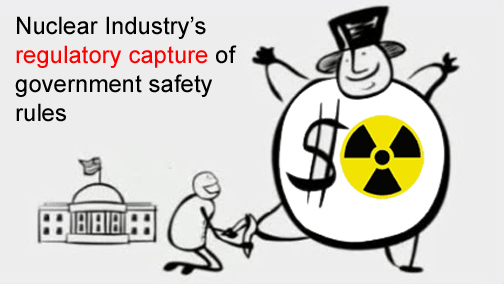 The government’s billing of the NRA, formed in the aftermath of the Fukushima disaster, as the world’s most stringent nuclear regulator is simply not true, Ishibashi said. The regulator feels beholden to government policy, which is pro-nuclear and supports restarts,
Japan Earthquake Expert Says Nuclear Watchdog Ignoring Risk, Bloomberg, by Yuriy Humber 3 May 15 Japan’s nuclear regulator ignored earthquake risk and its own rules in approving the safety of a nuclear power plant on the western island of Kyushu, said Kobe University professor and seismologist Katsuhiko Ishibashi.
Ishibashi, well-known in Japan for books and papers on earthquake threats that later became reality, said he has filed a formal complaint to the Nuclear Regulation Authority challenging the legality of its decision………
Ishibashi has seen his warnings of earthquake dangers come true in devastating fashion at least twice in a country that accounts for about 10 percent of the world’s quakes. Continue reading
A warning about paid trolls on social media
Already, trolls on Twitter have been running a scurrilous campaign against Dr Helen Caldicott. I believe that these Twitter trolls are Australia, and not connected with NASA or similar organisations. Their abusive tweets are so sill and insulting that I doubt that a serious agency would use them. Internet Trolls May be Trained Government Agents According to Leaked Document Health Impact News Editor, 3 May 15 Glenn Greenwald, a journalist, constitutional lawyer, commentator, and author of three New York Times best-selling books on politics and law, has been working with NBC News in publishing a series of articles on how covert government agents infiltrate the Internet to “manipulate, deceive, and destroy reputations.”
The information is based on documents leaked by National Security Agency (NSA) whistleblower Edward Snowden. Greenwald’s article, How Covert Agents Infiltrate the Internet to Manipulate, Deceive, and Destroy Reputations, is based on four classified documents produced by the British spy agency GCHQ, and presented to the NSA and three other English speaking agencies reportedly part of “The Five Eyes Alliance.”
In this shocking piece, Greenwald publishes a copy of a spy training manual used entitled: “The Art of Deception: Training for Online Covert Operations.” Greenwald writes that agencies like the NSA are “attempting to control, infiltrate, manipulate, and warp online discourse, and in doing so, are compromising the integrity of the internet itself.” Greenwald writes: Continue reading
1 This month
7 April – WEBINAR – Australia and the Doomsday Clock – Preventing nuclear war through NoFirstUse and other policies
Online | Tuesday April 7, 4:00-5:30pm, Australian Eastern Time / 8:00-9:30am Central Europe Time
– Access the registration link
15 April – Zoom –Nuclear Power is Not the Solution
Apr 15, 2026 01:00 AM in Canberra, Melbourne, Sydney

Join the International Physicians for the Prevention of Nuclear War (IPPNW) on Tuesday, April 14th for a timely webinar exploring the risks associated with nuclear power and challenging the myth that it offers a simple, safe, carbon-free solution to the climate crisis

21 April Webinar: No Nuclear Weapons in Australia
Start: 2026-04-21 18:00:00 UTC Canberra, Melbourne, Sydney (GMT+10:00)
End: 2026-04-21 19:30:00 UTC Canberra, Melbourne, Sydney (GMT+10:00)
Event Type: Virtual
A virtual link will be communicated before the event.
Host Contact Info: australia@icanw.org

of the week – Australians for War Powers Reform (AWPR)
To see nuclear-related stories in greater depth and intensity
 Antinuclear