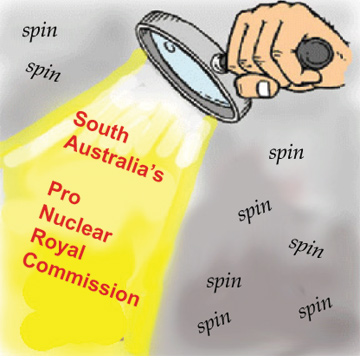
Dennis Matthews exposes South Australia Royal Commission “Issues Paper 2” spin
In relation to the dangers of ionising radiation the issues paper refers simply to “radiation” thereby lumping it together with electromagnetic radiation including such innocuous things as visible light and radio waves.

Dennis Matthews, 8 May 15 NUCLEAR FUEL CYCLE (sic) ROYAL COMMISSION
 ISSUES PAPER TWO
FURTHER PROCESSING OF (uranium and thorium) MINERALS AND MANUFACTURE OF MATERIALS CONTAINING RADIOACTIVE AND NUCLEAR SUBSTANCES
Two things stand out in this the second Issues Paper for the Scarce Nuclear Industry Commission.
One is the consistent use of pro-nuclear jargon/spin, the other is the frequency with which statements are accompanied by provisos.
The pro-nuclear jargon/spin started right from the beginning of this whole process with the name of the Commission. Instead of using the neutral, straight forward term “nuclear industry”, the value –laden, scientifically incorrect, misleading phrase “nuclear fuel cycle” was chosen. This was accompanied by similarly misleading, nuclear industry, feel-good phrases such as “value adding” and “enrichment”.
The most obvious nuclear industry ploy used in this discussion paper is to refer to “radiation” rather than “ionising radiation”. This is unscientific, misleading and potentially confusing to many readers who are familiar with the fact that “radiation” includes microwaves, radiowaves, visible light, and infrared radiation, none of which is ionising.
This issues paper makes frequent use of vague terms such as “may allow”, “ongoing”, “possible”, “currently being developed”, “may be”, “could be influenced”, “being developed”, and “emerging technologies”. These are hardly encouraging or appropriate terms for producing serious policy, especially on such a contentious issue as expanding the nuclear industry in SA.
This issues paper is in four sections: Further Processing, Manufacture, Viability, and Risks and Opportunities. Continue reading
Beyond Nuclear Initiative (BNI) calls forAustralian government transparency on nuclear waste site nominations
 Window closes for waste dump sites nomination 6 May 15 A national environment group has called on the federal government to release details of possible sites for a national radioactive waste facility at the end of a public nomination period provided for landholders to nominate a potential site for Australia’s first purpose built national radioactive waste dump and store.
The revised national nomination process was launched after a dedicated community campaign stopped a national dump being built at Muckaty in the Northern Territory. In early March Industry Minister Ian Macfarlane announced a two -month public nomination period with a closing date of May 5.
The Beyond Nuclear Initiative (BNI) has urged the federal government to consider the full range of available management options, adopt transparent and inclusive processes and ensure any potential sites meet key social as well as environmental criteria.
“There are many people, particularly in regional and remote Australia, with a keen interest in and a close eye on this issue,” said BNI convenor Natalie Wasley.
“Muckaty was rightly labeled a disaster by Federal Resources Minister Ian Macfarlane. To move beyond a discredited Decide-Announce-Defend approach the government needs to show a commitment to genuine volunteerism- including ruling out any sites where land ownership or support for the dump is contested or unclear”.
“Previous failed proposals in both South Australia and the Northern Territory saw a pattern of government secrecy and community distrust.
“We urge the Minister to rebuild community trust and confidence by releasing the full list of nominations received through this process so nearby communities and affected people can have the greatest opportunity to consider and comment and Australia can have the best chance of advancing a responsible and effective radioactive waste management”. Further context and comment: Natalie Wasley 0429 900 774
Australia’s disarmament double-speak at the nuclear Non-Proliferation Treaty Review Conference 2015
Australia’s claimed reliance on the US’ nuclear arsenal hijacks any meaningful contribution to disarmament. Most endorsers of the Australian-led humanitarian statement are similarly thwarted by their commitment to the nuclear weapons of their allies. Meanwhile, many other countries are refusing to accept and enable indefinite inaction.
While Australia remains tolerant of nuclear weapons, thankfully Austria and the majority of states are seeking new methods and action, now. This process is bound to go ahead with or without the nuclear weapons states.
The Australian Government should respond to the 84% of the Australian public who want their government to support a nuclear weapons ban (2014 Nielsen poll) and stop encouraging the reckless behaviour of the nuclear minority.
 Gem Romuld, 6 May 15 Despite being close in name, the gap between Australia and Austria on the issue of nuclear disarmament is stark. Austria is at the forefront of a global push to stigmatize, ban and eliminate nuclear weapons, whereas Australia is leading efforts to undermine this push.
During the first week of the nuclear Non-Proliferation Treaty Review Conference, currently underway in New York, the Australian Ambassador to the United Nations, Ms Gillian Bird, delivered a statement expressing concern that 45 years since the NPT entered into force, “some 16,000 nuclear warheads still exist”. But she dismissed the “call for a treaty banning nuclear weapons”, and stated Australia’s support for “practical, realistic measures to achieve actual nuclear disarmament”. Elaboration on these unambitious measures was saved for the 26-nation Statement on the Humanitarian Consequences of Nuclear Weapons, not to be confused with the much stronger Austrian-led 159-nation Joint Statement on the Humanitarian Consequences ofNuclear Weapons.
Both ‘humanitarian statements’ acknowledged the renewed focus on the humanitarian impacts of nuclear weapons, catalysed by the three conferences that have been held on the subject since February 2013 by the Norwegian, Mexican and Austrian Governments. The Austrian-led statement said that the “humanitarian focus is now well established on the global agenda” and affirmed that “the only way to guarantee that nuclear weapons will never be used again is through their total elimination”. The Australian-led statement claims there are “no short cuts”, implying that the slow, and thus far ineffective, steps to disarmament are the only way to reach a world without nuclear weapons. Continue reading
Podcast – Impacts of uranium mining in Australia and abroad
 Radioactive Responsibility – Impacts of uranium mining in Australia and abroad 18 April 2015 Download MP3
Safeguarding radioactive materials from impacting public and environmental health and from military use is essential for a safe and healthy future. But as the risks increase, big business and government seeking short-term profit are seen to be distancing themselves further from their responsibility to keep these materials from endangering life on earth.
Lauren Mellor (Environment Centre of the Northern Territory) brings us an update on the Ranger uranium mine and Kumar Sundaram (Coalition for Nuclear Disarmament and Peace in India) talks about the latest developments in the negotiation for a nuclear deal between Australia and India.
America’s burden of funding shortage for closing down many aging nuclear reactors
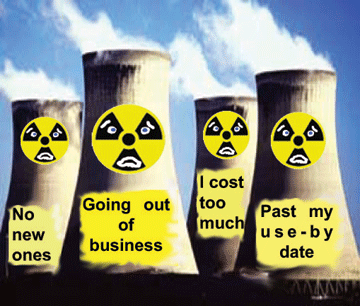
The question is who will pay — for Humboldt Bay, and for dozens of other reactors that are in the process of closing or might soon.
Nuclear operators like PG&E are supposed to lay up enough money to cover the costs, similar to how corporations fund pensions. Turns out, most haven’t. Continue reading
In USA. like Australia, indigenous people bear the toxic nuclear legacy
 fragile communities continue to live amid the poisoned wells and contaminated earth, and the uranium riddled sagebrush flats are home for the next generation of Navajo children.
Abandoned Uranium Mines Plague Navajo Nation, Earth Island Journal BY SONIA LUOKKALA – MAY 5, 2015 Mining companies left behind a legacy of poisoned wells and contaminated earth
We are in Diné Bikéyah, land of the Navajo. “………The incidence of Navajo neuropathy is five times  higher on the western side of the Navajo reservation than on the eastern side. Some researchers believe this discrepancy is linked to the land: On the western side, the mines were mostly tunnels, whereas in the west they were primarily open pits. After the uranium companies left, the unfilled pits started to fill with water. Some, as deep as 130 feet, eventually formed into small lakes. Unsuspecting Navajos and their livestock use the contaminated water for drinking.
A 1990 study of Navajo neuropathy ruled out water contamination as a possible cause of the disease………As the Los Angeles Times also reported, in 1986, Thomas Payne an environmental health officer for Indian Health Services, along with a National Park Service ranger, took water samples at 48 sites surrounding Cameron, AZ, a town in Navajo Nation. These samples revealed uranium levels in wells as high as 139 picocuries per liter. In abandoned pits, the levels were as high as 4,024 pinocuries. The EPA limit for safe drinking water is 20 picocuries per liter. ….. Continue reading
Prosperity for Victorian farmers hosting wind farms
There are jobs and prosperity blowin’ in the wind http://www.weeklytimesnow.com.au/news/opinion/there-are-jobs-and-prosperity-blowin-in-the-wind/story-fnkerdb0-1227337252668 MAY 06, 2015
“THE single biggest investment in rural Victoria.” That’s how Municipal Association of Victoria president Bill McArthur described the $5 billion worth of new wind farms waiting to be built in Victoria.
This recognition of the sheer scale of the opportunity the wind farms present to regional Victoria is a welcome turn in the debate. In much of the discussion around wind farms, the interests of regional Victoria are too often overlooked. How to keep farming businesses viable. How to keep tenants in the shops along the main street. How to provide the jobs that will draw the next generation of families back to small towns and farms.
These are questions country Australia has constantly had to address.
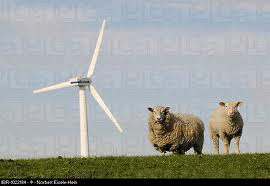 Wind farms fit with farming. Wind towers use only a fraction of a farmer’s land and add valuable access tracks, improving farm viability.
Wind farm lease payments bring a 25-year income stream on to farms and that money returns to the local economy through things such as farm upgrades, the hire of local labour and purchases from local businesses.
A full-time work force can make a huge difference to a small town and guaranteed rates income has already become vital for shires like Moyne, Pyrenees and Southern Grampians.
Crucially, wind farms don’t use a drop of water. As southeast Australia becomes drier, a large-scale energy source that makes no call on our precious water supplies will become all the more important.
But there’s no such thing as a free lunch. As The Weekly Times editorial recognised last month, more wind farms will bring a “long-term change to our beloved landscape”. Visually, wind farms are a big deal, but whether people like the look of them or not can’t be the main driver.
An end to the Federal Government’s attack on the renewable energy target will bring a once-in-a-generation investment boom to regional Victoria. Our choice is to embrace this and make it work, or just hope that another opportunity like it might one day turn up.
Andrew Bray is Australian Wind Alliance national co-ordinator
South Australia gets world class floating solar system – by an Australian company
Australian company creates world-first floating solar system NEWS.COM.AU MAY 02, 2015 AN AUSTRALIAN company is leading the way for renewable energy after creating a world-first floating solar system.
Infratech Industries selected the Northern Areas Council Waste Water Treatment Plant in South Australia as the first location to implement the new system.
Director Felicia Whiting said it is expected the innovative technology will generate an estimated 57 per cent more power than fixed land-based systems.
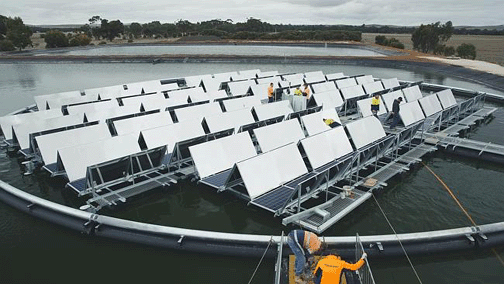
“The proprietary tracking, cooling and concentrating technology uses water to counteract the gradual loss of output caused by overheating solar panels to create a better performing and more efficient system,” she said.
“The Northern Areas Council will reap additional economic benefits with a cost saving of approximately 15 per cent on their current energy expenditure, plus an additional one per cent margin on the excess energy provided to the local community.”
- Ms Whiting said the biggest challenge in implementing the technology was changing the mindset of government officials and bureaucrats who questioned the need for renewable energy.
“Just how strong Australia’s post-2020 emissions reduction targets remain unknown, however we do know solar innovation is a milestone towards Australian councils, communities and businesses making a difference,” she said.
“As Australians evangelise this type of technology, it is our hope that renewable energy becomes the mainstream rather than niche solution.
“Change is not beyond us and this is definitely a strong step forward.”………http://www.news.com.au/technology/innovation/australian-company-creates-world-first-floating-solar-system/story-fnjwucti-1227331868879
Climate change making Australia’s hot spells even more costly
 Severe heat costs the Australian economy US$6.2 billion a year, New Scientist, May 2015 by Michael Slezak Heat stress costs the Australian economy a whopping US$6.2 billion a year – a finding that shows what other countries might be facing in areas where global warming will make extremely hot days more common. Continue reading
Next Australian stock exchange winner could be renewable energy
 Could Renewable Energy be the Next Big ASX Winner? Money Morning 5 May 15 On Wednesday, Infratech Industries announced their intention to list on the ASX. It’s a bold move for the fledgling renewables company, which was established in April 2012.
The company is behind the $17.5 million floating solar panels project currently being expanded in South Australia. They say their tracking and cooling technology produces 57% more power than land-based solar panels. It’s a big deal for the entire solar industry.
Chief executive Raj Nellore says that soon, more capital will be required to keep up with demand. Of listing on the ASX, he said ‘once we get to a certain size, [it] makes sense’.
Infratech has partnered up with the Centre for NanoScale Science and Technology at Flinders University (CNST) for research. CNST has backing from the South Australian state government. So their funding — and the partnership with Infratech — is subject to budget changes.
There are other forces that might pressure Infratech to go public sooner rather than later. For example, they may need to raise money to expand their US operations too. Their US entity was opened in June 2014. They signed their first US customer — the City of Holtville, California — in November. That’s pretty much all they’ve done there.
Whenever they do float, they won’t be alone. A small group of renewable energy companies are already listed on the ASX.
Which renewable energy companies are currently on the ASX?
Wave power Carnegie Wave Energy [ASX:CWE] ………
Solar Dyesol [ASX:DYE] ……Enviromission [ASX:EVM]……..
Geothermal The Raya Group [ASX:RYG]……http://www.moneymorning.com.au/20150505/could-renewable-energy-be-the-next-big-asx-winner-cw.html
Greens leader Christine Milne steps down
 Christine Milne resigns as Greens leader, will not contest 2016 election, SMH May 6, 2015 – Lisa Cox National political reporter The Greens will elect a new leader on Wednesday morning after Christine Milne revealed she would not contest the 2016 election and resigned as party leader……………
New Zealand shows the way in the fight to get rid of nuclear weapons
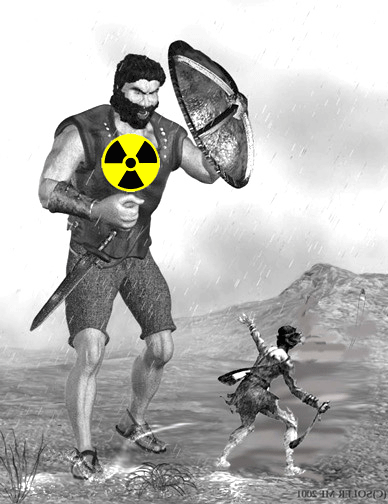 NZ leader in ‘nuclear thinking’ http://www.nzherald.co.nz/northern-advocate/news/article.cfm?c_id=1503450&objectid=11444033 By Lindy Laird May 6, 2015 New Zealand still punches above its weight in the fight for nuclear weapon disarmament, says Whangarei MP Shane Reti who has just returned from an international conference on the subject.
Mr Reti, the executive secretary of the New Zealand Parliamentarians for Nuclear Non-Proliferation and Disarmament, said the Kiwi delegation had no qualms about telling giants like the US to hurry up and decrease its nuclear arsenal.
He was in New York at the five-yearly United Nations review of the Nuclear Non-Proliferation Treaty (NPT) last week with Labour MP Phil Goff, who is the Parliamentary anti-nuclear weapons group’s chairman, and NZ Disarmament Ambassador Dell Higie.
“New Zealand is well recognised as leading the world in nuclear thinking.
“We have substantive countries coming to us and saying ‘we’re under the nuclear umbrella, could you speak for us?’,” Mr Reti said.
“We do tell our story, that gives us some leverage,” he said of New Zealand’s anti-nuclear history which includes banning US nuclear weapons-carrying or powered naval ships. But 45 years after the “P5” nuclear nations – US, United Kingdom, France, China and Russia – agreed to the NPT, dubbed the “grand bargain”, their massive weapons stocks still exist. That grand bargain was essentially if those countries were allowed to keep their nuclear capability in the meantime, they would begin to disarm,” Mr Reti said.
“It’s turning out to be no bargain and nothing grand. It isn’t happening fast enough. The issue for New Zealand at the conference was ‘you need to keep your word’.”
“The ‘Nuclear 5’ are recalcitrant, and the rest of the world is restless,” he said.
Those five nations are also the permanent members on the UN security council. New Zealand and other delegates want the disarmament issue raised in the general assembly forum instead of that security council.
The international focus is shifting to the humanitarian perspective “that moves beyond balancing weapons and talks about body counts”, Mr Reti said. “It also supports, and embedding in legislation de-alerting, or ‘take the finger off the trigger’ – where hours or days instead of minutes are taken to consider launching any retaliatory missiles. In 1983 an electrical storm appeared on Russian screens as a US nuclear missile attack and a counter attack was only avoided because a Russian expert on duty that day demanded visual confirmation,” Mr Reti said.
“Geese flying in large formations have appeared on military screens as a nuclear missile launch.”
Largest Nordic fund company blacklists Boeing over nuclear arms
Nordea blacklists Boeing over nuclear arms Madison Marriage , Ft.com , 5 May 15
Boeing has been blacklisted by the largest Nordic fund company over concerns that the civil and defence aerospace group is producing nuclear weapons.
Nordea Asset Management, which oversees €174bn of assets, told FTfm it added Boeing to its exclusion list in May due to the group’s involvement in producing components for replacement nuclear-armed Trident ballistic missile submarines in 2014.
The exclusion creates further problems for Boeing, which has already been blacklisted by the world’s largest sovereign wealth fund and a number Europe’s largest pension funds.
Sasja Beslik, head of corporate governance at Nordea, said: “Boeing is in the process of developing a new nuclear programme, [which means] we cannot engage with them. These companies will not change their business models, because [nuclear] is too lucrative.”…….
Nordea already excludes a handful of companies involved in manufacturing or supplying nuclear weapons, including UK groups BAE Systems andBabcock International and Areva of France………
The Norwegian Government Pension Fund, the world’s largest sovereign wealth fund, has blacklisted 10 companies involved in the production of nuclear weapons, including Boeing, since 2005.
PGGM, the second-largest Dutch pension fund manager, with €189bn of assets, has similarly excluded more than a dozen companies, including Boeing, over their involvement in nuclear arms since 2008………http://www.ft.com/intl/cms/s/0/ab38fee8-eff9-11e4-ab73-00144feab7de.html#axzz3ZJPY7ucS
1 This month

of the week – Australians for War Powers Reform (AWPR)
To see nuclear-related stories in greater depth and intensity
 Antinuclear