Weapons Over Food: India’s Nuclear Poverty
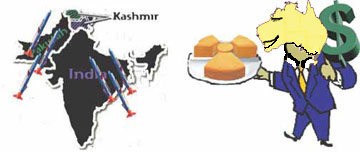 On the same day as Julie Bishop jubilantly announces progress in then deal to sell Australia’s uranium to India – for “peaceful purposes” (as if that can be assured!) – comes this report on Prime Minister Modi’s nuclear priorities.
First was the announcement on April 10 that India would buy 36 Rafale fighter aircraft from France at a cost of some 4 billion dollars. The second was six days later when India test fired its nuclear-capable Agni-III ballistic missile with a range of 3,000 km and capable of carrying warheads weighing over a ton..
Nuclear missiles don’t come cheap, and of course we don’t know and will never be told the real cost of any country’s nuclear weapons’ program, but an expert estimate for India in 2011 was five billion dollars a year which is a substantial chunk of the national budget.
Third was the report that “US Defence Secretary Ashton Carter is likely to visit India next month when the two sides are expected to ink the nearly $2.5 billion deal for 22 Apache [attack] and 15 Chinook heavy-lift helicopters.” India’s financial commitment to the purchase of foreign military hardware is increasing day by day and there seems no end to the list of expensive weaponry being acquired. The billions of dollars are mounting up. There is no apparent ceiling to military expenditure, and neither is there a limit to acquisition of wealth by India’s growing number of mega-rich, as evidenced by the proudly broadcast news that India now has 90 billionaires (total worth $295 billion) and wasreported on May 7 as being “home to 56 of the world’s 2,000 largest and most powerful public companies.”
But then there is an interesting description of the other side of the Indian coin by Jean-Pierre Lehman, a visiting professor at a university in Rajasthan, about 70 miles from Delhi, who has no axe to grind butrecords and evaluates the Indian scene as he sees it at first hand:
Upon reaching the outskirts of Jaipur, the scene switches to hundreds and hundreds of dilapidated makeshift tents beneath which people live – or perhaps more accurately manage more or less to survive. This is far worse than poverty. It is destitution. It is people living in what can only be described as bestial conditions. There is of course no access to sanitation; people cook their meagre repasts on coal furnaces inside the tents — one of the major causes of death in India. The contrast with the swankiness of some of the residential and business districts of Jaipur is of chasm proportions — a vividly desperate illustration of the growing inequality in India. That people, our fellow humans, should live in such conditions in the early 21st century is a terrible indictment of Jaipur, of Rajasthan, of India, and indeed of humanity in general.
It is doubtful that anybody could convince them of a need for jet fighters, nuclear missiles or attack helicopters.
Like all the poor around the world — most notably in India’s neighbors Pakistan and Bangladesh, but also in America and Britain and almost everywhere else — those at the bottom of the economic pile in India have no voice, no dignity, no hope. Some politicians do try hard to help them. Prime Minister Modi is their leader and is certainly not hypocritical in that regard, unlike his enormously rich counterpart in Pakistan, but he won’t be able to alleviate poverty in his country for so long as he permits such massive military expenditure. India was the world’s largest importer of military material in 2014 and the government authorized over 40 billion dollars in this year’s budget, excluding dozens of new commitments — so the nuclear missiles, fighter jets, and helicopters are only a start.
India’s military equipment order books include 7 frigates, at about ten billion dollars; another 400 helicopters for two billion or so; hundreds of medium artillery guns for at least 3 billion; 6 submarines costing 9 billion; and payment for a galaxy of other equipment whose manufacture will also provide massive employment — but mainly in other countries, and even in India only for the tiny number of those who are trained craftsmen (no women, of course). India’s poor will benefit from neither profits nor work, because the money will go nowhere near them and they are unqualified for all but the most simple and meanest of jobs………….
And it’s not just in India that this applies. If the leaders of India could manage to sit down with those of Pakistan and China — the nations against whom India’s military policy and posture are directed — and come to agreement about longstanding territorial disputes, then the roads to true prosperity would begin to open in all three countries.
There are faults in the stances of China and Pakistan concerning their disagreements with India on border matters, but India has not helped in any way by being aggressively inflexible concerning mediation and it is time for false pride to be replaced by pragmatism and common sense. Disputes and confrontation over territory are futile and counter-productive and in this case have contributed enormously to these countries’ perceived requirement for masses of vastly expensive nuclear weapons and other military hardware.
Emphasizing national pride is an important political tool, and nuclear weapons are very impressive in an macabre sort of way. Unfortunately in pursuit of both it is always the poor who suffer most. Mr Modi is one of the few world leaders who could move to change this appalling state of affairs, and it must be hoped that he will place the interests of his half-billion poverty stricken citizens to the forefront of national policy. His “ambitious vision to reduce extreme poverty” must not be allowed to dim.
Brian Cloughley writes about foreign policy and military affairs. He lives in Voutenay sur Cure, France. http://www.counterpunch.org/2015/05/08/indias-nuclear-poverty/
No comments yet.
1 This month

of the week – Australians for War Powers Reform (AWPR)
To see nuclear-related stories in greater depth and intensity
 Antinuclear
Leave a comment