Australian breakthrough solar technology built in Cyprus in five weeks
Australian scientists have designed and installed solar energy technology in Cyprus to help the island nation shift away from fossil fuels and also to tackle its chronic water shortages.
A team from the CSIRO, Australia’s national science agency, took five weeks to construct a ‘solar thermal field’ containing 50 heliostats – large mirrors that reflect the power of the sun. The solar thermal field lies in Pentakomo, on the southern coast of Cyprus and places the country at the frontier of solar energy research in Europe.
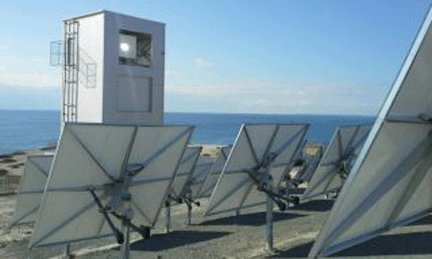
The CSIRO won an international tender to provide its technology to Cyprus for a trial that could lead to broad solar take-up in the country and elsewhere. It is understood that several other countries in Europe and the Middle East are interested in adopting CSIRO solar technology.
Cyprus hopes to take on the technology so it can reform its oil-dependent economy and meet a European Union target of 13 per cent of energy coming from renewable sources by 2020. The Mediterranean country is also plagued by water shortages and may use solar energy to power desalination plants.
The CSIRO technology uses mirrors to track the sun and reflect it towards a single receiving point on top of a tower. This heat then warms a fluid, in this case molten salt.
The molten salt, heated to 250°C, is stored in a hot tank and the steam produced powers a turbine for electricity. Crucially, this storage method allows for energy to be produced long after the sun has disappeared.
“The question about solar is always about storage at night-time,” said Wes Stein, solar research leader at CSIRO.
“This liquid is cheaper and more efficient than batteries, such as those made by Elon Musk. We can generate steam for electricity on a cloudy day. Continue reading
Australia leads the world in percentage of homes with solar power
 Australian households chase sun to lead world on solar adoption http://www.canberratimes.com.au/act-news/australian-households-chase-sun-to-lead-world-on-solar-adoption-20150516-gh2uh9.html May 16, 2015 Mark Sawa Northside Chronicle reporter Australian households are world leaders in solar power installation, according to new figures from Australia’s peak industry body representing the fossil fuel and renewable energy sector.
The Energy Supply Association of Australia, representing the fossil fuel and renewable energy sector, has sourced data from around the world revealing household solar photovoltaic (PV) penetration in Australia is way out in front of any other nation.
The report shows almost 15 per cent of Australian households have adopted the technology to power their homes.
This is more than triple that of Germans, who are second on the world stage and typically thought of as the most prolific solar adopters. Continue reading
Solar trams for Melbourne
Renewable energy group bids to turn Melbourne’s trams solar May 18, 2015 Tom Arup Environment editor, The Age

Melbourne’s entire tram network could be powered by solar if the state government gave a bold renewable energy proposal the green light.
While the pitch may conjure up images of trams with rooftop panels on them like the family home, the power would instead be generated at two new solar farms the project proponents plan to build near Swan Hill and Mildura.
The company behind the bid, the Australian Solar Group, have held quiet talks over four years with different arms of the government to try get the project off the ground, but has so far not got final backing.
The two solar farms would generate 80 gigawatt-hours of electricity a year, about the same amount used by Melbourne’s tram network, which is the world’s largest.
Under the proposal the government would back the project by signing Public Transport Victoria (PTV) up to a power purchase agreement with the solar farms, creating a reliable revenue source alongside the renewable energy target.
The proponents say the project has been designed to ensure the cost of tram tickets would not rise, nor would it add to PTV’s power bill. It would cut 100,000 tonnes of greenhouse gas emissions a year from running trams and give the city an obvious global selling point (see the mock-up tram design above), according to the pitch…….http://www.theage.com.au/victoria/renewable-energy-group-bids-to-turn-melbournes-trams-solar-20150518-gh3ime.html
Tasmania keen to fast track electric vehicles – and become 100% renewable energy powered
 Tasmania looks to EVs as next step to 100% renewable energy, REneweconomy, By Giles Parkinson on 19 May 2015 Tasmania looks to fast-track take-up of electric vehicles to boost its credentials as a green manufacturing hub to replace old industries, and export clean energy to the mainland. Tasmania could end up totally renewable – a Green Apple Isle – in both electricity and transport. Tasmania is looking closely at electric vehicles to take the next step towards 100 per cent renewable energy – both electricity and transport – and boost the state’s strategic advantage as a clean energy manufacturing hub. Continue reading
AREVA’s EPR (Evolutionary Power Reactor) may be finished – an unsafe nuclear design?

the International Energy Agency’s World Economic Outlook 2014 report:
- that nuclear growth will be “concentrated in markets where electricity is supplied at regulated prices, utilities have state backing or governments act to facilitate private investment”;
- and that “nuclear power faces major challenges in competitive markets where there are significant market and regulatory risks.”.
Finland cancels Olkiluoto 4 nuclear reactor – is the EPR finished?, The Ecologist, Dr Jim Green & Oliver Tickell 15 May 15 A negative learning curve on steroids
“……What to make of the EPR saga? First, Areva is backing the wrong horse – the outcome of current political debates will result in a declining role for nuclear power in France, coupled to the growth of renewables.
A new report by ADEME, a French government agency under the Ministries of Ecology and Research, concludes that a 100% renewable electricity supply scenario is feasible in France. Continue reading
Areva nuclear company: Losses on all fronts
Despite the guaranteed increased purchase price for Hinkley Point C’s power, however, investors are not in a hurry to jump on board with a project where Areva will not just build the reactors but is also to bring in funding in the amount of 10% of the project’s total cost. The problem is that last fall, the company admitted it was having serious economic difficulties, which may cause it to fail to deliver on the financial commitments in the Hinkley Point C project.
Areva’s economic troubles have to do with another project the company is pursuing: the highly problematic reactor construction at a new site in Olkiluoto, Finland.
Survival of the fittest? World’s major nuclear builders are in for a long stretch in the red, Bellona, May 18, 2015 by Vladimir Slivyak, Translated by Maria Kaminskaya MOSCOW Continue reading
Some GOOD news: The Ozone hole is shrinking
New NASA satellite data confirms what other research has shown, namely that the hole in the ozone layer appears to be getting smaller. Steve Williams, Care2, May 18, 2015 07:14 AM
The Ozone hole is shrinking http://www.enn.com/pollution/article/48570 The ozone is crucial for us here on Earth because it shields us from some of the Sun’s most damaging radiation. In the 1980s it was confirmed that a host of chemicals like CFCs that we had been using in manufacturing and, in particular in aerosols, had been breaking down that ozone layer, creating several holes including a worryingly large hole over the Arctic. In the long term our CFC use threatened to destroy this vital shield completely if we did not act.
Fortunately, and in a move that might seem rather rare today, politicians did listen to scientists and in 1989 the Montreal Protocol was brought into force as an international agreement to dramatically cut down on CFCs and begin phasing them out entirely. The Montreal Protocol wasn’t and isn’t a perfect solution, as we’ve detailed previously here, but it was at least a step in the right direction. Unfortunately, we haven’t been able to gauge the impact of our ozone saving efforts–that is, until now.
A new report based on data gained via NASA’s AURA satellite shows a long term trend that, barring unforeseen hiccups, should see the hole over the Arctic shrink to less than 8 million square miles within the next thirty years. At the moment the hole is about 12 million square smiles, so that represents a rapid rate of repair. What’s more, the rate of repair suggests that the hole could be entirely gone by the end of the 21st century.
1 This month
Chernobyl: The Lost Tapes – A good documentary on Chernobyl on SBS available On Demand for the next 3 weeks– https://www.sbs.com.au/ondemand/tv-program/chernobyl-the-lost-tapes/2352741955560
15 April – Zoom –Nuclear Power is Not the Solution
Apr 15, 2026 01:00 AM in Canberra, Melbourne, Sydney

Join the International Physicians for the Prevention of Nuclear War (IPPNW) on Tuesday, April 14th for a timely webinar exploring the risks associated with nuclear power and challenging the myth that it offers a simple, safe, carbon-free solution to the climate crisis

21 April Webinar: No Nuclear Weapons in Australia
Start: 2026-04-21 18:00:00 UTC Canberra, Melbourne, Sydney (GMT+10:00)
End: 2026-04-21 19:30:00 UTC Canberra, Melbourne, Sydney (GMT+10:00)
Event Type: Virtual
A virtual link will be communicated before the event.
Host Contact Info: australia@icanw.org

of the week – Australians for War Powers Reform (AWPR)
To see nuclear-related stories in greater depth and intensity
 Antinuclear