Examining the nuclear lobby’s hype about “planned construction of reactors
If we had a list of renewable projects that were planned and under construction, it would look like the renewable sector was 1000 per cent of what it actually is. That’s because there are a lot of planned wind farms and even more solar farms.
In fact in interviews of Australian households beyond the 10 per cent who already have solar on their roof (25 per cent in South Australia), more than 75 per cent have a plan to get solar on their roof at some point in time. A similar number believe or are “planning” to get batteries to deliver their solar power as a cheaper alternative to the grid at night.
 So if we put all the planned nuclear reactors that never get built against all the planned solar installs and wind installs around Australia and the rest of the world, the nuclear proposals would be so dwarfed to be completely irrelevant.
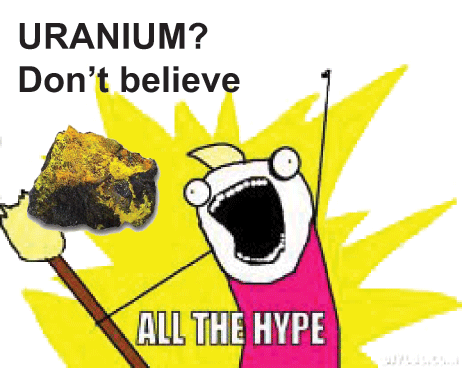 If you’re hearing another one of these countless stories such as those being hawked at the pro-nuclear “Nuclear Fuel Cycle Royal Commission” being held in South Australia, just remember there are people who want their uranium penny stocks to take them from rags to riches or riches to even more riches that are creating most of the hype.
In the west, a second generation nuclear reactor is unacceptable and no third generation reactors have ever successfully been built.
 What if we all adopted the nuclear industry’s interpretation of a ‘planned’ project?MATTHEW WRIGHT , HTTP://WWW.BUSINESSSPECTATOR.COM.AU/ARTICLE/2015/5/27/RENEWABLE-ENERGY/WHAT-IF-WE-ALL-ADOPTED-NUCLEAR-INDUSTRYS-INTERPRETATION-PLANNED
If you search the definitive list of reactors on Wikipedia, you’ll find that reactors are being decommissioned globally at a rate of knots, and many more are set to be decommissioned in the not too distant future. This includes the entire fleet in Germany and a significant portion but unspecified number of reactors in Japan.
If you looked further, you’d find that you could count the total number of reactors built in 2014 and 2015 on just one hand. In that period there was activity predominately in China — with its centralised state control avoiding the scrutiny the technology gets everywhere, outside a lone reactor in Argentina being the exception — but you could hardly get excited as that project was started when first of the Generation Ys were still in nappies in 1981.
So you’ve got a few plants getting built at a much slower pace than planned in China, and a bunch of plants ‘planned’ all over the place. But as is the case with almost all nuclear plans in the last 25 years, they’ve gone nowhere. They are plans (if a dream is a plan), but are not likely to be plants.
So why do we hear about these so called plans over and over?
The answer is the stockmarket: the uranium juniors and the speculative stocks. Get rich quick by backing a speculative exploration license holder, or someone who’s got as far as doing a desktop of some geology somewhere on earth.
It’s these guys who really need the uranium story to continue. Without it they don’t exist; all those pieces of paper that were going to create multi-millionaires are worth nothing. The trick here for them is to keep everyone believing that nuclear and hence the appetite for uranium is rocketing on.
That’s why there are so may projects being ‘planned’ or ‘under construction’ but nothing substantial ever getting built and delivered.
Let’s compare that to renewables.
If we had a list of renewable projects that were planned and under construction, it would look like the renewable sector was 1000 per cent of what it actually is. That’s because there are a lot of planned wind farms and even more solar farms.
In fact in interviews of Australian households beyond the 10 per cent who already have solar on their roof (25 per cent in South Australia), more than 75 per cent have a plan to get solar on their roof at some point in time. A similar number believe or are “planning” to get batteries to deliver their solar power as a cheaper alternative to the grid at night.
So if we put all the planned nuclear reactors that never get built against all the planned solar installs and wind installs around Australia and the rest of the world, the nuclear proposals would be so dwarfed to be completely irrelevant.
The difference between the two is that if the cost of solar drops from say US50c to US60c/W today to US30c/W, then all those ‘planned’ solar projects on private rooftops will happen. From the time the decision is made to install, they’ll be up and operating, delivering electricity in 30 days.
With nuclear, if a project does get up it’s going to take 30 years, like what we’ve seen with the recent belated completion of the Atucha II plant in Argentina that started construction in 1981. At best it’s going to take 10 to15 years in the west to ever get a plant built but Areva, the world’s biggest nuclear plant builder, is proving that 15 years is highly optimistic.
All the time that a nuclear plant is getting built someone is footing the bill on the materials that are not generating revenue, it’s usually the state that is building the project. It also inevitably becomes an open cheque book, whereas in solar the project is totally underwritten by the supplier (in the terms of small domestic and medium to large commercial rooftop) and the technology is generating, earning a return (as a feed-in tariff and/or self consumption) before it is even paid for.
If you’re hearing another one of these countless stories such as those being hawked at the pro-nuclear “Nuclear Fuel Cycle Royal Commission” being held in South Australia, just remember there are people who want their uranium penny stocks to take them from rags to riches or riches to even more riches that are creating most of the hype.
In the west, a second generation nuclear reactor is unacceptable and no third generation reactors have ever successfully been built. The French project at Flamanville has turned out to be a monumental cock-up and the sister project in Finland is an embarrassment. It took Siemens, Europe’s biggest energy technology supplier, out of the game and has all but destroyed Areva, the French state-owned nuclear tech giant.
While all this speculation continues, the cost of renewable energy gets cheaper. With every wind turbine installed, the next one is cheaper. With every single rooftop solar panel installed, the next one is cheaper. That’s renewable economics, as opposed to nuclear economics where every plant is more expensive than the last due to the need for ever more safety.
Solar and wind have a positive learning curve whereas nuclear has a negative learning curve as the technology is lumbered with the latest safety fix and associated cost. More nuclear research and development leads to more costly attempts at being safer; that’s a reality because the technology is inherently unsafe. No one cares if a solar panels fails — just get it replaced under warranty or buy another one in 10 years for 20 per cent of the cost.
If you’re thinking about uranium minors, then don’t go there. If you want to do good and gamble on a better future, then get in on a ground floor clean-tech opportunity. Better still, just use that money to put some solar panels on your roof, upgrade your house with efficient electric appliances and get yourself a guaranteed return that is better than what mutual funds, stockmarket investments, property and the like will ever give you.
Matthew Wright holds a graduate diploma in engineering and is executive director of Zero Emissions Australia, technical director at Efficiency Matrix and resident columnist at Climate Spectator.
No comments yet.
1 This month
7 April – WEBINAR – Australia and the Doomsday Clock – Preventing nuclear war through NoFirstUse and other policies
Online | Tuesday April 7, 4:00-5:30pm, Australian Eastern Time / 8:00-9:30am Central Europe Time
– Access the registration link
15 April – Zoom –Nuclear Power is Not the Solution
Apr 15, 2026 01:00 AM in Canberra, Melbourne, Sydney

Join the International Physicians for the Prevention of Nuclear War (IPPNW) on Tuesday, April 14th for a timely webinar exploring the risks associated with nuclear power and challenging the myth that it offers a simple, safe, carbon-free solution to the climate crisis

21 April Webinar: No Nuclear Weapons in Australia
Start: 2026-04-21 18:00:00 UTC Canberra, Melbourne, Sydney (GMT+10:00)
End: 2026-04-21 19:30:00 UTC Canberra, Melbourne, Sydney (GMT+10:00)
Event Type: Virtual
A virtual link will be communicated before the event.
Host Contact Info: australia@icanw.org

of the week – Australians for War Powers Reform (AWPR)
To see nuclear-related stories in greater depth and intensity
 Antinuclear
Leave a comment