THe latest in nuclear and climate news – Australia
 AUSTRALIA
South Australia’s Nuclear Royal Commission has gone very quiet. They are now in Japan, then to Taiwan, Finland, Austria, France and the United Kingdom. It’s all quite secretive – no idea what their global junket is costing the South Australian tax-payer. Why is no media covering this?
South Australia’s agriculture in danger from nuclear developments
Meanwhile the pretense continues that it’s just a State matter – ignored by the media in all other States. Except for The Saturday Paper in which Dr Helen Caldicott dissected the propaganda for South Australia’s Nuclear Chain Royal Commission.
Australia’s nuclear lobby never lets up. Their social media propaganda has lately stepped up its vilification of Dr Caldicott. I guess that could be seen as a tribute to her expertise, and to the impact of her splendid article – which I urge you all to read.
Some people who care are quietly organising their Submissions to the Royal Commission, due by 24 July, and 3 August. The Conservation Council of South Australia gives helpful advice . They put out a long IssuesPaper and a summary one.
Senators David Leyonhjelm and Bob Day salivate over thought of free nuclear-powered electricity and want nuclear powered submarines.
Nuclear waste. ANSTO’s problem of mounting radioactive wastes at Lucas Heights.
Uranium Paladin – the ugly Australian in Malawi faces opposition, as its uranium pollution takes its toll. Paladin (apparently not Australian owned) signs Western Australian uranium deal.
Rare earths AND URANIUM company allying with Clean Energy Council!
Big mining companies are losing the public opinion battle.
Climate Change. Universities can get tax-payer funding for a Bjorn Lomborg climate centre.
Renewable Energy:
- 2014 Clean Energy Australia Report released.
- Australian Renewable Energy Agency sets out conditions for large scale solar.
- Solar testing laboratory: CSIRO helps investor confidence in large-scale solar.
- Clean Energy Finance Corporation helping irrigators to buy renewable energy.
- Western Australian gas company planning to sell solar panels and batteries.
- Home energy storage is bringing solar power to the people.
- The ANZ Bank’s first green bond issuance a resounding success.
- Offgrid solar power with storage is an economic winner for Western Australian farming family
Paladin – the ugly Australian in Malawi faces opposition, as its uranium pollution takes its toll
“It’s shocking that Paladin has disposed of millions of tons of radioactive and chemically hazardous waste on a plateau with very negative geological and hydrogeological characteristics,”
On the shores of Malawi’s lake of stars, activists raise uranium fears, Guardian, Santorri Chamley, 3 June 15
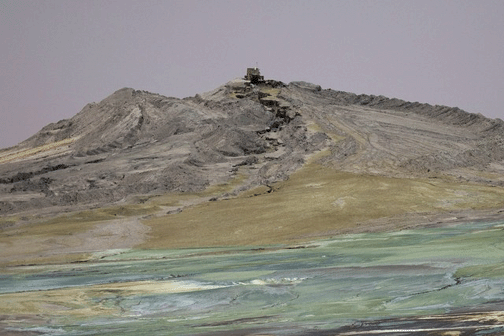
When dead fish were washed ashore in northern Malawi, activists and residents looked to a nearby uranium mine for answers – the latest battle in a protracted conflict with Paladin, the mine’s Australian owners “……For many of the tens of thousands of people living in Karonga, a lakeside district in northern Malawi, life revolves around fishing. So when dead fish began to wash ashore, they were worried. Some blamed pollution from the nearby Kayelekera uranium mine, the country’s biggest foreign investment.
“People are fearful because there are a lot of fish dying in the lake, so people are suggesting that they are dying because of the discharge from the Kayelekera mine,” said Harry Hudson Mwanyembe, the chairman for health and environment on Karonga’s district council.
The Australian company that owns the mine, Paladin Energy Ltd, says it has complied with all its environmental obligations and routinely monitors aquatic life in the Sere River and elsewhere. It denies any responsibility for the dead fish but its operation in Kayelekera has been beset by controversy since it was openedby the late president Bingu wa Mutharika in 2009.
The disputes, legal battles and public concern over the mine go to the heart of what many call Africa’s resource curse. As one of the continent’s poorest countries – ranking 174 of 187 countries in the UN human development index – Malawi desperately needs foreign exchange, as well as employment and infrastructure. But its pursuit of extractive wealth has been stymied by a lack of adequate regulation and transparency as well as by corruption, activists say.
In Kayelekera, the pitfalls associated with launching a multi-million dollar enterprise, with government backing, in an area where people lack access to both information and power, are evident in the many rumours, claims and counter-claims surrounding the mine’s operations……
resident of Kayelekera, Philip Simbowe, said the government had sold the lives of Malawians for cash. Continue reading
Paladin (apparently not Australian owned) signs Western Australian uranium deal
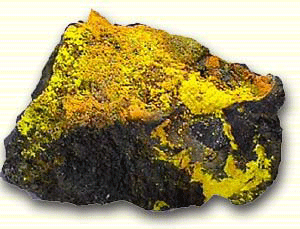 Paladin signs uranium land deal MICHAEL RODDAN BUSINESS SPECTATOR JUNE 01, 2015 Uranium miner Paladin Energy will pay $16 million for land containing a uranium deposit as the group looks to enhance the value of its neighbouring project.
Paladin (PDN) will take over Energia Minerals’ Carley Bore uranium project in north west Western Australia for $15.8 million in cash and shares.
The Carley Bore project in the Carnarvon Basin consists of three connected exploration licenses, located 100km south of Paladin’s Manyingee uranium project, and will increase the miner’s mineral resources in the area by more than 30 per cent……….But the miner has said it will not develop any new projects before it is confident of a sustainable uranium price of at least $US70 a pound. The material has traded between $US34 and $US40 a pound this year.
“The current low uranium price and sustained sector weakness have created an opportunity to consolidate our portfolio in strategically important regions,” Paladin chief executive John Borshoff said.
The takeover is subject to regulatory approval by the Foreign Investment review Board, as Paladin is deemed to be a foreign corporation under Australian law. http://www.theaustralian.com.au/business/mining-energy/paladin-signs-uranium-land-deal/story-e6frg9df-1227377778419
The Nuclear Fuel Chain Cost Calculator
 John Mecklin: Introducing the Nuclear Fuel Cycle Cost Calculator http://thebulletin.org/introducing-nuclear-fuel-cycle-cost-calculator8361
… Over the last two years, the Bulletin of the Atomic Scientists and the University of Chicago have created an online tool that will help countries understand the true cost of choosing the reprocessing route—and perhaps also help limit the spread of nuclear reprocessing.

The Nuclear Fuel Cycle Cost Calculator estimates the full cost of electricity produced by three configurations of the nuclear fuel cycle. This calculator is the first generally accessible model to provide a nuanced look at the economic costs of nuclear power, particularly in regard to the reprocessing of spent nuclear fuel. Among many other things, the calculator clearly demonstrates that in most cases, reprocessing results in electricity that is considerably more expensive than other nuclear power, when all costs are added in.
June 16 In Conversation with Dr Mark Diesendorf. 100% renewable electricity for South Australia
 June 16 – Adelaide – In Conversation with Dr Mark Diesendorf. 100% renewable electricity for South Australia Facebook event
Conservation Council SA invites you to join us as leading expert in renewable energy Dr Mark Diesendorf presents his newest report showing that South Australia could produce 100% of its electricity from renewable sources. This will be a critical conversation to inform submissions to the SA’s Nuclear Fuel Cycle Royal Commission.
Where: The Joinery, 111 Franklin Street, Adelaide
When: Tuesday 16 June
Time: 7pm – 9pm
This is a free event, please RSVP.
Check out the Facebook event
Come along, get inspired, and learn what we need to do to make 100% renewable electricity in SA happen!
Senators David Leyonhjelm and Bob Day salivate over thought of free nuclear-powered electricity
The Conservation Council of SA this week said it did not support an expansion of SA’s role.
“Uranium mining in SA has a history of very significant environmental impacts that show no signs of abating,” spokesman Jim Green said.
“All forms of energy generation have some environmental impact … nuclear power brings with it a range of unavoidable risks to public health and safety that other energy options simply do not.”
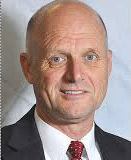 Senators David Leyonhjelm and Bob Day want atomic industry advanced
  to make nuclear submarines viable TORY SHEPHERD POLITICAL EDITOR THE ADVERTISER JUNE 03, 2015 CHEAP or free power for South Australia is an “excellent” idea, crucial crossbench Senator David Leyonhjelm says, arguing it could come through a nuclear or a coal deal.
The Liberal Democrat also joined South Australian Senator Bob Day in calling for Australia to get nuclear-powered submarines.
The Advertiser revealed earlier this year that Liberal Senator Sean Edwards was working on a plan to earn billions of dollars by storing nuclear waste and generating nuclear power, and using that money to deliver free electricity and abolish state taxes.
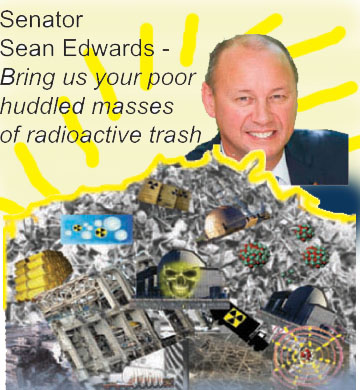
That would make SA a magnet for investment, he said. Continue reading
Offgrid solar power an economic winner for Western Australian farming family
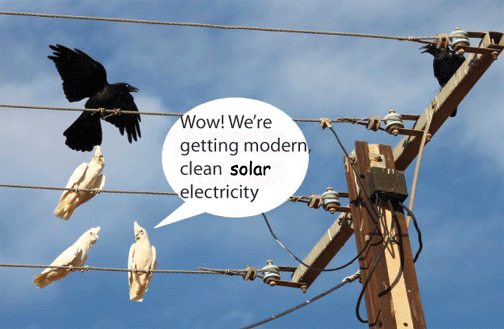 WA farming family opts for solar power battery system over costly grid connection, ABC News By Kathryn Diss 3 June 15 When Katherine Naughton’s family moved to a farm in Northam, north-east of Perth, it was going to cost them up to $60,000 to connect their house to the power grid.
But for just two thirds of that cost they have been able to install a solar power storage system, harnessing all of their electrical needs from the sun.”Not having that $400 bill every three months is just fantastic,” Ms Naughton said.
Perth-based company Solar Balance designed the system with Chinese battery manufacturer BYD.The batteries charge from rooftop solar panels during the day and store the energy for use when the sun goes down.
And unlike connecting to the grid, it is an investment that pays for itself. “With the cost of power going up, it’s quite scary how much it keeps going up by every single year, and you don’t know how much it’s going to be in the next five years,” Ms Naughton said. “So if we can go solar then we don’t have to worry about that bill.”
Battery storage an affordable option
With the entry of new players it will put downward pressure on battery costs which is going to be good for everyone over time because it will become more and more affordable. – Rod Hayes
The power revolution may be taking place slowly, just one household at a time, but the industry believes that is set to change………..
Curtin University’s Sustainability Policy Institute’s Jemma Green said the power grid will become less relevant.
“The grid will have a place but it will become more of a back up system as electricity prices go up even further and the price of solar and batteries decline further, the economics of grid defection are going to stack up sooner.
“This is going to have an impact on the utilisation of the grid and therefore the revenue that the government currently derives from using it.
“I think the grid and the business models of the utilities, that is the generators and the poles and wires will need to evolve to deal with this changing energy system which is effectively a centralised and decentralised energy model,” Ms Green said.
Bosche, LG and Samsung have also indicated they plan to enter the market. http://www.abc.net.au/news/2015-06-03/farming-family-opts-for-solar-power-battery-system/6519960
Is South Australia’s Nuclear Commission considering the UN warning on cyber attacks?

I wonder if South Australia’s Nuclear Fuel Chain Commission is considering this safety threat?
 UN watchdog group warns of cyberattacks on nuclear facilities, SC Magazine http://www.scmagazine.com/international-conference-on-computer-security-hosted-for-first-time/article/418241/ Ashley Carman, Editorial Assistant 3 Jun 15 Nuclear facilities around the world are facing daily cyberattacks on their systems, a United Nations nuclear watchdog group said during a Monday conference.
“Reports of actual or attempted cyberattacks are now virtually a daily occurrence,” said Yukiya Amano, director general of the International Atomic Energy Agency (IAEA). “Last year alone, there were cases of random malware-based attacks at nuclear power plants and of such facilities being specifically targeted.”
The conference at which Amano spoke, the International Conference on Computer Security in a Nuclear World, is in its inaugural year and goes until June 5, the UN reported.
“Staff responsible for nuclear security should know how to repel cyber-attacks and to limit the damage if systems are actually penetrated,” Amano said. “The IAEA is doing what it can to help governments, organizations, and individuals adapt to evolving technology-driven threats from skilled cyber adversaries.”
Rather like South Australia’s govt , South Africa’s nuclear plans are very secretive
Key details of South Africa’s nuclear procurement plan kept under wraps, BD Live, BY CAROL PATON, 02 JUNE 2015 KEY DETAILS OF SA’S NUCLEAR PROCUREMENT PROGRAMME REMAINED SECRET IN A PRESENTATION BY TOP DEPARTMENT OF ENERGY OFFICIALS, AS WELL ENERGY MINISTER TINA JOEMAT-PETTERSSON TO PARLIAMENT’S PORTFOLIO COMMITTEE ON ENERGY.
However, officials said the procurement would be completed by the end of the financial year when “a strategic partner or partners” would be chosen.
While the officials gave a lengthy motivation on the need for nuclear power and SA’s preparedness for the new nuclear energy build, details about the cost, the financing and the procurement process were not provided. Inter-governmental agreements that SA has signed with various countries on nuclear co-operation, as well as a damning report by the Integrated Nuclear Infrastructure Review on SA’s readiness also remained under wraps.
Ms Joemat-Pettersson is backed by President Jacob Zuma in her quest to build 9.6GW of nuclear generation capacity. However, there are several detractors of the plan, including the former National Planning Commission, opposition political parties and a wide array of civil society and human rights lobby groups……
DA MP Gordon MacKay said that with regard to the financing the government had got the cart before the horse.”It is strange that we are wanting to buy something that we don’t know the cost of and we don’t know how we will pay for,” he said.
Mr MacKay also criticised the secrecy of the report compiled in the Integrated Nuclear Infrastructure Review process.
While reports for other countries are available on the website of the International Atomic Energy Agency, the report compiled on SA remains “classified” despite being completed two years ago.
Mr MacKay said it was believed that the report showed SA to be unprepared for the nuclear procurement in 14 of 19 benchmark areas.http://www.bdlive.co.za/business/energy/2015/06/02/key-details-of-sas-nuclear-procurement-plan-kept-under-wraps
US govt secretly to test West Coast residents for Fukushima radiation

 Censored US gov’t emails reveal proposed plan to test West Coast residents for Fukushima fallout — “Many cases of cancer may end up being attributed to exposures” — Doses could exceed EPA’s emergency levels — UC Berkeley Nuclear Dept.: “Prompt action should be taken” http://enenews.com/govt-emails-reveal-proposed-plan-test-west-coast-residents-fukushima-radiation-many-cases-cancer-being-attributed-exposures-doses-could-exceed-epas-emergency-levels?utm_source=feedburner&utm_medium=email&utm_campaign=Feed%3A+ENENews+%28Energy+News%29
FOIA Document — Excerpts from email by Per Peterson, Chair of Dept. of Nuclear Engineering at Univ.of California Berkeley & scientific adviser to Energy Secretary Steven Chu , Mar 23, 2011 at 1:35p (emphasis added): Continue reading
Australian govt pushing for international financial deregulation in Trade Agreement – Wikileaks reveals
 WikiLeaks reveals new trade secrets, SMH June 4, 2015 Philip Dorling
Highly sensitive details of the negotiations over the little-known Trades in Services Agreement (TiSA) published by WikiLeaks reveals Australia is pushing for extensive international financial deregulation while other proposals could see Australians’ personal and financial data freely transferred overseas.
The secret trade documents also show Australia could allow an influx of foreign professional workers and see a sharp wind back in the ability of government to regulate qualifications, licensing and technical standards including in relation to health, environment and transport services.

In its largest disclosure yet relating to the TiSA negotiations, WikiLeaks has published seventeen documents including draft treaty chapters, memoranda and other texts setting out the overall state of negotiations and individual country positions in a secret bargaining on banking and finance, telecommunications and e-commerce, health, as well as maritime and air transport.
The leaked documents were to be kept secret until at least five years after the completion of the TiSA negotiations and entry into force of the trade agreement. Continue reading
Universities can get tax-payer funding for a Bjorn Lomborg climate centre
 Universities told to speak to Bjørn Lomborg if they want $4m in funding, Guardian, 4 June 15
Senate estimates told government funding for consensus centre is still on the table after UWA pulled out due to backlash from staff and students Universities approaching the Department of Education about the $4m in government funding available for hosting Bjørn Lomborg’s consensus centre have been told they should talk to Lomborg himself.
Since the University of Western Australia pulled out of a $4m deal with the federal government to host the centre, the department had “had some informal approaches from universities who might be interested and suggested to them and Dr Lomborg they might want to talk”, the associate secretary of the department, Robert Griew, told senate estimates on Wednesday night.
Labor senator Kim Carr asked “so if a university wants to take this up they should talk to Dr Lomborg?”
“Yes, but of course they could talk to us as well,” Dr Griew replied.
Carr, a long-term minister in Labor governments, said he had “never seen anything like this before where the government would hand over $4m … and hopefully find someone to take it up.”
The committee heard the $4m had been found from consolidated revenue in the May 2014 budget, but not announced at that time, and that the education department had first heard about it from the department of prime minister and cabinet.
The department had spoken to Dr Lomborg last July and he advised them “he was in discussion with a number of universities”. Dr Lomborg had been advised to “speak to vice chancellors directly” to find a host institution for the $4m centre.
After a backlash from staff and students when Guardian Australia revealed the $4m government deal to host the “Australia Consensus Centre” UWA handed back the funding and dropped its connection with Lomborg.
The education minister, Christopher Pyne, vowed to find another university to host the centre and said he was seeking legal advice about a decision by the university to renege on the funding agreement it had signed with the commonwealth.
Griew said legal advice had been provided to the minister but no legal action had been taken against UWA……..http://www.theguardian.com/australia-news/2015/jun/03/universities-told-to-speak-to-bjrn-lomborg-if-they-want-4m-in-funding?CMP=share_btn_tw
Big mining companies losing the public opinion battle
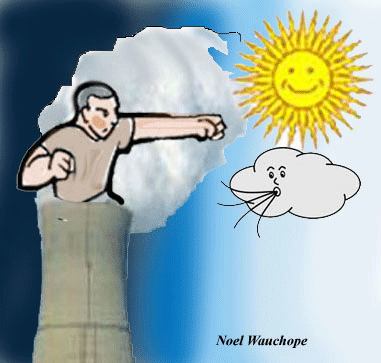 Big miners need to win hearts and minds in fight against environmental activism, Australian Financial Review, Jennifer Hewett, 3 June 15 The mining industry may have seen off the mining tax it despised but industry executives seem less certain about how to deal with a much more generic threat.
Environmental activism against the mining industry – particularly the coal and coal seam gas industries – is becoming more powerful, sophisticated and effective.
It ranges from protesters chaining themselves to gates or trees on mining sites to the divestment movement, which has seen groups ranging from the massive Norwegian sovereign wealth fund to Australian universities to French banks get out of fossil fuel investments or financing…….
the potential impact and risk of reputational damage from the level of environmental opposition is growing – making discussion about it a natural feature of the annual conference of the Minerals Council of Australia in Canberra on Wednesday.
LOSING THE PR BATTLE
A lot of frustrated companies belatedly realise they are losing the public relations battle and the support of large sections of the community, ………
Industry Minister Ian Macfarlane says it has become a “war of ideology” and the industry must not stop pushing back against this sort of attack.
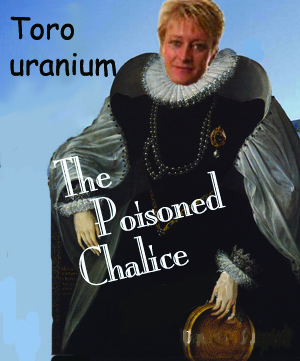 But how best to do so is not so clear to the industry players…. Vanessa Guthrie, chief executive of uranium company Toro Energy, said her 30 years in the nuclear industry had convinced her it was necessary to fight with the heart as well as the head…….
The ability to be more persuasive becomes even more important given the momentum of the global movement to combat climate change by limiting or even closing down the coal industry. That means the protesters’ targets have changed.
Although Guthrie is sure environmental activism will return to her industry, she said uranium was going through a “quiescent” period while coal and coal seam took the heat. For the first time, there were no protesters outside last year’s annual uranium conference……
Aboriginal leader Warren Mundine, who formerly worked with Forrest and now runs his own 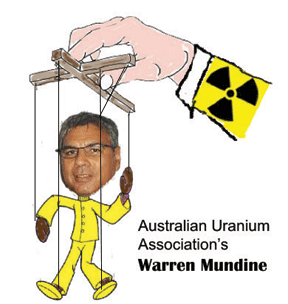
consultancy, said it was vital to engage with the community and use the right language as part of a “soft war”.
The companies are now slowly becoming more attuned to the need for this and using social media themselves. But so far there seems little enthusiasm for the sort of people-focused, soft big advertising campaign that helped put the industry’s case against the mining tax. …..
As a sign of the mood of the times, industry fund Auscoal Super, with more than $9 billion in assets and 76,000 mining industry members, says it’s changing its name to Mine Wealth+Wellbeing. Consider it the triumph of marketing over reality.http://www.afr.com/opinion/columnists/big-miners-need-to-win-hearts-and-minds-in-fight-against-environmental-activism-20150603-ghg1n5
2014 Clean Energy Australia Report released
 Clean Energy Australia Report 2014 Released http://www.energymatters.com.au/renewable-news/clean-energy-australia-em4854/ June 4, 2015 2014 was a difficult year for renewable energy in Australia with the grim reaper looming over the RET for much of it – but it wasn’t without its bright spots.
Clean Energy Australia Report 2014 states more than 230,000 households and businesses installed either solar power systems or solar hot water last year.
While this may be down on previous years; the average size of each system installed continued to increase (nudging 4.5kW on average), thanks to the plummeting cost of solar panels, other components and increased competition.
More businesses are switching on to solar savings and by the end of 2014, 15,000 commercial enterprises across Australia had installed solar panels; collectively saving more than $64 million on their power bills.
All up, 823.42 MW capacity of residential and commercial solar installs up to 100kW occurred during 2014.
Only two large-scale solar power stations were commissioned in 2014, totaling 23.5 MW. However, 5 new plants with a collective capacity of 258.275 MW were under construction at the end of last year.
The majority of the 16 wind farms under construction in 2014 were on hold by the end of the year due to policy uncertainty. Three wind farms with a combined capacity of 566.7 megawatts were completed in 2014; Snowtown II in South Australia, Gullen Range in New South Wales and Mount Mercer in Victoria. Five wind farms remained in progress early this year and five and are expected to be completed in 2015.
By the end of 2014, there were 71 wind farms Australia-wide, consisting of 1,866 wind turbines in total and with a collective output capacity of 3807MW.
Overall, 13.47 per cent of Australia’s electricity came from renewables last year, enough to power 4.5 million average homes . While dropping from 2013 (14.76 per cent), this was mainly due to reduced rainfall in hydro catchments.
There was a huge difference in renewables use between the states – around 95 per cent of the electricity consumed in Tasmania came from renewables last year (primarily hydro) and approximately 40 per cent of South Australia’s power (primarily wind power). The next best was Western Australia at 13 per cent.
While investment in new large-scale renewable energy fell 88 per cent in 2014 compared to the year before due to policy uncertainty, with bipartisan backed legislation now being considered by Parliament, the CEC says the outlook for the sector is looking more positive.
The Clean Energy Australia 2014 Report was produced with the support of the Australian Renewable Energy Agency and can be downloaded here (PDF).
SBS examines 23 years of native title in Australia – on Mabo Day
On June 3, 1992 the High Court of Australia overtuned the notion of Australia being ‘terra nullius’ (nobody’s land) before settlement. The Mabo decision, as it become known, followed a decade-long legal battle by Eddie Mabo and several others to have their land rights recognised.
Edward Koiki Mabo was born at Mer (Murray Island) where Meriam people are the traditional custodians of the land……..
A history of native title in Australia………http://www.sbs.com.au/news/article/2015/06/02/mabo-day-23-years-native-title-australia
1 This month

of the week – Australians for War Powers Reform (AWPR)
To see nuclear-related stories in greater depth and intensity
 Antinuclear