Victorian government moves to speed up wind farm projects
 Streamlined Victorian wind farm planning laws promise more regional renewable energy investment ABC News, 12 June 15, The Victorian Government says changes to wind farm planning laws will drive renewable energy investment in the state.
New changes mean the Planning Minister will assess wind farm applications and their infrastructure together.
Previously, developers had to submit multiple applications to local and state governments.
Planning Minister Richard Wynne said it made the application process easier for investors.
“What we are saying is that the doors are open, we are unambiguously in the space of wind farms, we are encouraging investment and the decisions that we reach today around the planning considerations give a streamlined outcome for anyone who wants to invest in wind farms in Victoria,” he said.
He said the move would create jobs in country Victoria.
“Investment in wind farms just makes tremendous sense in terms of employment outcomes for regional communities, it makes tremendous sense in terms of climate change and it’s a great win for regional economies right across regional Victoria,” he said.
Meanwhile, the Australian Wind Alliance said it has concerns for south-west Victoria’s renewables sector, in the wake of comments made by the Prime Minister……http://www.abc.net.au/news/2015-06-12/victorian-wind-farm-planning-laws-streamlined/6540634
Uranium glut, Ranger shutdown, leave Rio Tinto with $300M writedown
 Rio Tinto mulls $300M writedown as uranium mine expansion cancelled, Mining.com Cecilia Jamasmie | June 12, 2015 Mining giant Rio Tinto (LON, ASX:RIO) is contemplating to take a writedown of about $300 million after its subsidiary Energy Resources of Australia (ASX:ERA) decided to cancel plans to expand a uranium mine.
ERA, in which Rio has a 68.4% stake, said on Thursday that it would not proceed with the final feasibility study of its Ranger 3 Deeps uranium project in Australia’s Northern Territory, citing weak market conditions.
The decision underscores the ongoing strains in the nuclear industry following the Fukushima meltdown in 2011, which prompted Japan to mothball its 43 operable reactors, causing uranium prices to drop as a result of a worldwide supply glut……..http://www.mining.com/rio-tinto-mulls-300m-writedown-as-uranium-mine-expansion-cancelled/
South Australia’s great opportunity to transition from coal to 100% renewable energy
Bye bye baseload Our calculations show that SA does not need any baseload power stations, such as coal or nuclear. Indeed, the lack of operational flexibility of coal and nuclear makes them poor partners for high penetrations of variable renewable energy. The SA system has already operated reliably for long periods without its coal-fired stations, as last weekend’s incident demonstrated. Moving fully to renewable energy will deliver environmental, social and economic benefits. The transition would reduce SA’s greenhouse gas emissions, air pollution and associated respiratory diseases. It would cap electricity prices.
SA could create a wide range of new jobs in manufacturing, installation, grid connection, technical support and sales, which could help to compensate for the forthcoming job losses in its coal industry.
As for the nuclear question, the multinational financial analyst Lazard estimates the average costs of subsidized new nuclear energy in the United States in 2017 to be 12.4–13.2 US cents per kilowatt hour (kWh), compared with unsubsidized costs of 3.7–8.1 c/kWh for onshore wind, and 7.2–8.6 c/kWh for large-scale solar PV
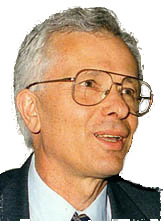 Coal closures give South Australia the chance to go 100% renewable https://theconversation.com/coal-closures-give-south-australia-the-chance-to-go-100-renewable-43182 June 12, 2015 Mark Diesendorf Associate Professor and Deputy Director, Institute of Environmental Studies, UNSW at UNSW Australia South Australia is facing the closure of its Northern and Playford B power stations and Leigh Creek coal mine, after Alinta Energy yesterday announced plans to shut them ahead of schedule. It will cost 438 jobs in the coal-mining and coal-fired electricity industries. But this threat to employment could be transformed into an opportunity for creating many new jobs in renewable energy.
The South Australian electricity system could be operated entirely on scaled-up, commercially available, renewable energy sources. This is the conclusion of my forthcoming report (to be published next week) to the Conservation Council of South Australia. Continue reading
Rapidly growing appeal of renewable energy, for institutional investors
 Institutional Investor Appetite For Renewable Energy, Forbes.com, Christopher P Skroupa, 12 June 15 “…..Richard Rankin: Most people do not know how substantial renewable energy is or that, in a global context, renewable energy is competitive with and can replace conventional energy entirely.
In the Great Plains and Southwest USA, several companies have signed contracts, known  as power purchase agreements, for solar and wind energy at prices lower than that of natural gas. Renewable energy can be a cheaper alternative to fossil fuels because of the ability to harness sources of energy that are prevalent to certain locations. It is a young industry with room for growth and improvement.
However, globally, it is already as big as the apparel and fashion industry worldwide and four times the size of the semi-conductor industry. Navigant Research, in their Advanced Energy Now 2015 Market report, observed that in the US, the market for advanced energy is bigger than the airline industry, equal to pharmaceuticals and four times the size of the semi-conductor industry.
With newly available forms of financing such as YieldCos which lower the cost of capital, and policies in place that would put the industry on par with traditional carbon energy producers, there appears to be no limit to renewable energy. Demand is strengthening for renewables at a faster pace than ever before and I cannot wait to see where it takes us.
Skroupa: What sector of renewable energy is the most promising?
Rankin: Electricity generation from solar looks to me to be one of the most promising segments. Continue reading
Dr Helen Caldicott on the need for Australians to understand the implications of Fukushima nuclear disaster

“The misinformation about this is endless. Radiation is an invisible killer — that’s the ace up the nuclear industry’s sleeve. You don’t get cancer immediately, it takes years … and it doesn’t bear a sign denoting where it came from.”
She adds:
“The latent period for leukemia is five to 10 years and solid cancers, 15 to 80 years.”
Thus, she says, it is premature and “misleading” to conclude that there are no radiation-related deaths from the Fukushima accident.
Educating Australians about Fukushima’s implications: Dr Helen Caldicott, Independent Australia Michelle Pini 13 June 2015, In April last year, Michelle Pini interviewed Dr Helen Caldicott on the Fukushima disaster. As IA was the first to report the nuclear melt down in Australia with some dozen updates as the full disaster unfolded, we think you’ll find this story highly relevant.
DR HELEN CALDICOTT is hard to ignore. Her breadth of knowledge and fervour for her subject seem limitless. She gesticulates often, her gaze is direct, and there is a practical sense of urgency in her voice.
An Australian physician and world-renowned anti-nuclear activist and educator, she makes time to be interviewed despite having just returned from a speaking tour of Japan and Denmark. Continue reading
Tony Abbott’s Australia: globally isolated, and left with “stranded” coal assets
This is remarkable. The former Liberal leader, economist John Hewson, who once employed Abbott as his press secretary, says that Abbott’s comments were “ignorant and irresponsible”.
Hewson these days works on so-called “stranded assets”, energy assets like coal mines that risk becoming uneconomic as the market and regulation moves against them.
Tony Abbott at odds with the world on renewable energy and climate change, SMH June 13, 2015 Peter Hartcher Sydney Morning Herald political and international editor The Prime Minister’s scathing comments on wind-farms and renewable energy put him out of step with the way the world is moving.
……….The Group of Seven biggest developed nations declared that the world needed to phase out fossil fuel emissions by the end of this century.
The leaders said their countries supported cutting greenhouse emissions from 2010 levels by 40 to 70 per cent by 2050, and then going further:
“Deep cuts in global greenhouse gas emissions are required with a decarbonisation of the global economy over the course of this century” announced the leaders of the US, Japan, Germany, Britain, France, Canada and Italy after their summit in a Bavarian mountain resort.
“They’re not mincing words any more,” says Frank Jotzo, a climate change economist at ANU. “You are seeing high-level political preconditions for stronger domestic policy change.”
In the same week, two things happened in Australia. The Abbott government’s Environment Minister Greg Hunt envisaged Australia joining the same historic transition: “I believe it’s not only possible but likely that Australia will achieve zero-emissions energy by the end of the century” he told me.
And the leader of the Abbott government struck precisely the opposite stance. He appeared to stand in direct opposition to the threshold event of our time. Continue reading
How wind and solar power provided South Australia’s electricity when coal power stopped
the chief qualities of the energy system of the future will not be baseload, but flexibility. This will likely be delivered by the quick-start gas generators that already exist in the system to back up fossil fuels, but also the grid and household-based storage that will be installed in coming years.
 How South Australia coped without any baseload power http://reneweconomy.com.au/2015/how-south-australia-coped-without-any-baseload-power-65138 By Giles Parkinson on 9 June 2015 South Australia’s electricity system was put the test over the long weekend when the state’s only baseload power contributor, the brown coal Northern power station near Augusta, suddenly tripped and stopped providing power.
The incident was caused by a fire that caused several injuries, including one serious injury to a worker still in hospital. This is not the first time that South Australia has been without baseload coal power, of course. Northern was mothballed for nearly a year because of the declining economics of the coal generator. The difference with this event is that it came unannounced.
While declines and increases in the output of wind and solar are quite predictable, sudden outages in baseload fossil fuels are not, which is why the energy system needs a large amount of redundancy to support large centralised generation.
So how did the South Australian energy market cope? Quite well, as it turns out. There was a lot of wind blowing at the time, so it was a while before the Torrens gas plant was needed. Most of the gas came from the Osborne plant.
There was so much wind – more than 1GW through most of the day – that electricity prices dived into negative territory on several occasions during the day, which means that the gas generators were not making any money.
Indeed, for most of the day South Australia had the cheapest wholesale electricity prices in the country. Continue reading
Mirarr Traditional Owners of the Ranger Uranium Mine area oppose any further uranium mining
 Gundjeihmi Aboriginal Corporation, 12 June 15 The Mirarr Traditional Owners of the Ranger Uranium Mine area and the site of the proposed Jabiluka uranium mine release this statement following yesterday’s announcements by Energy Resources of Australia and Rio Tinto that ERA will not at this time proceed with the final feasibility study of the proposed Ranger 3 Deeps underground mine.
The Mirarr and the GAC welcome the clarity that yesterday’s announcements provide in terms of the present viability of the Ranger Three Deeps project. We are also pleased that both companies now publicly recognise the importance of adequately financing the rehabilitation of the Ranger site.
First and foremost in our minds is ensuring the permanent protection of the natural and cultural values for which Kakadu is inscribed World Heritage. We need to see a concrete and comprehensive commitment and plan for the clean-up of Kakadu; that commitment and planning needs to start today.
Mirarr have maintained ongoing dialogue with ERA and governments throughout this process and notwithstanding today’s announcement will continue to talk through all relevant issues as necessary. However, as things stand today we will not support any extended term of mining at Ranger beyond 2021.
We take this position because of our experience of 30 years of environmental and cultural impacts at Ranger and because in our talks with Rio Tinto and the Australian government we have been given no guarantee that Ranger will be the last uranium mine in Kakadu. The Mirarr remain fundamentally opposed to Jabiluka’s development – that opposition is intergenerational. We are concerned about the lack of adequate planning for Jabiluka’s final rehabilitation and its incorporation into Kakadu National Park. ____________________________________________________________________________________ For further information contact 08 8979 2200 / 0427 008 765
Ranger 3 Deeps cancellation should spell end of an ERA for uranium mining in Kakadu
 Northern Territory and national environment groups have welcomed the announcement that a planned underground uranium mine in Kakadu – Energy Resources of Australia’s Ranger 3 Deeps project – has been cancelled.
“ERA’s move to abandon plans for an underground expansion at Ranger is an overdue acknowledgement that the underground mine plan lacked economic and environmental sense. It is also a significant step towards the end of uranium mining in Kakadu,” said Nuclear-Free campaigner Lauren Mellor.
Local and national environment groups have for long called for ERA and parent company Rio Tinto to commit to the rehabilitation of the Ranger site and have welcomed that ERA’s ASX announcement has now accepted it needs to secure adequate rehabilitation funding.
“We welcome the fact that ERA has sought an assurance from its parent company Rio Tinto that the required clean-up costs will come at the expense of the company and not the public,” said ACF spokesperson Dave Sweeney.
“ERA has lost around $1 billion on the under-performing Ranger project and has left its run too late in developing the Ranger 3 Deeps proposal – with the continuing low post-Fukushima commodity price the window for uranium mining at Ranger is closing and the operation has moved from dig up to clean up.”
The groups have called for all project applications and approvals to be withdrawn and for ERA to detail its closure and clean-up plan and costings.
*ERA ASX announcement available here: http://www.energyres.com.au/documents/Media_release_Ranger_3_Deeps_project_update.pdf
For further context and comment contact:
Lauren Mellor, Environment Centre NT on 0413 534 125
Dave Sweeney, Australian Conservation Foundation on 0408 317 812
Energy Resources of Australia(ERA) announces it is not proceeding with Ranger uranium min eexpansion
 Uranium miner Energy Resources Australia pulls plug on 3 Deeps expansion, ABC News 11 June 15 Uranium miner Energy Resources of Australia (ERA) will not proceed with its proposed 3 Deeps expansion project at the present time, the company has announced to the stock exchange.
In a statement, the company said the uranium market has not improved like ERA had previously expected and there is uncertainty as to what prices would do in the future.
The company also said the mine only had the authority to operate until 2021, and the economics of the project required certainty beyond that point. Those conditions meant ERA would not proceed to a final feasibility study at this time, the statement said. ERA will continue to “process stockpiles and meet obligations to its customers”, the statement said.
The 3 Deeps expansion would have seen the Ranger Uranium Mine commence underground operations for the first time. Its current operations are open-cut.
ERA said it had engaged its major shareholder, Rio Tinto, about funding to rehabilitate the mine site, which is completely ensconced by Kakadu National Park.
The company previously said rehabilitation was funded under its current business plan, but if the 3 Deeps expansion did not go ahead it would require another source of funding to pay for all of the rehabilitation works…… http://www.abc.net.au/news/2015-06-11/energy-resources-australia-pulls-plug-on-3-deeps-expansion/6540046
BHP CEO hypes up Olympic Dam uranium mine – but also hedges his bets with a plug for renewables
 BHP says Olympic Dam expansion is ‘game on’ THE AUSTRALIAN Scott Murdoch JUNE 12, 2015 BHP Billiton chief executive Andrew Mackenzie has declared the Olympic Dam expansion is “game on” but admits there are technical and manufacturing hurdles that must be worked out before final approval is given to the giant project…….
The upgraded production targets at Olympic Dam would make it the second-largest copper mine in the world after giving the uranium and gold output an equivalent copper value, and it would be the world’s largest producer of uranium……..
BHP exports uranium to China and Japan for power generation but it would not reveal the value or volume of its annual sales. The miner is expected to make a submission shortly to the Nuclear Fuel Cycle Royal Commission in South Australia on uranium mining……
[But I note that CEO Andrew Mackenzie hedges his bets a bit: -]
“A move to renewable energy (in China) is good for our copper business. Copper is a material that will do well in a world that puts a greater accent on renewable energy. The quicker you can get thermal energy into the form of electrical energy the better in terms of efficiency and the best relatively affordable conductor is copper,” Mr Mackenzie said. “Part of the strength of our portfolio is that we are reasonably flexible as to what path China and other nations choose towards decarbonising their energy…” http://www.theaustralian.com.au/business/mining-energy/bhp-says-olympic-dam-expansion-is-game-on/story-e6frg9df-1227393713719
Nuclear Royal Commission’s top expert source, AREVA, is in a heap of trouble
French nuclear watchdog urges quick resolution of Areva rescue plan, Reuters, PARIS | BY MICHEL ROSE AND BENJAMIN MALLET Areva’s (AREVA.PA) financial situation is worrying, the head of France’s ASN nuclear watchdog said on Thursday, urging the loss-making nuclear company and utility EDF (EDF.PA) to wrap up a rescue plan for Areva as soon as possible.
The French government last week approved EDF’s plan to take a majority stake in Areva’s nuclear reactor business and gave the two state-owned companies a month to do a deal.
“Areva’s current financial situation, it could get better, (it) can be considered as preoccupying in terms of safety,” ASN Director Pierre-Franck Chevet told Reuters in an interview.
“That’s why we have formally asked to hear them … to ask what kind of organisation they are putting in place to fulfils the commitments they have made in terms of safety for the incoming period,” he added, noting a meeting was scheduled by the end of June.
An EDF spokeswoman declined to comment, while an Areva spokeswoman pointed to comments made by Areva Chairman Philippe Varin on Wednesday, that safety remained an absolute priority.
ASN, an independent regulatory authority, last year imposed on Areva a requirement to recondition radioactive waste stored at its La Hague facility in northern France, which could cost several billion euros and which must be provisioned for, Chevet said.
However the watchdog has no power on the merger per se and its only remit is safety. It can shut down a nuclear plant if it sees a safety issue or fine companies for any transgressions……..http://uk.reuters.com/article/2015/06/11/uk-france-nuclear-asn-idUKKBN0OR2EU20150611
Australia’s Prime Minister Tony Abbott boasts of his plan to restrict renewable energy
Mr Abbott had exposed the government’s true intentions on the renewable energy target.
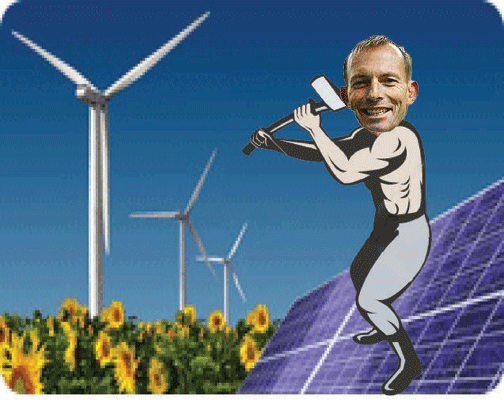 ‘Noisy compared to what?’: Tony Abbott’s claim wind farms awful and noisy dismissed, The Age June 11, 2015 Lisa Cox National political reporter Prime Minister Tony Abbott has described wind farms as “visually awful” and boasted slashing the Renewable Energy Target will restrict growth in the industry.
Mr Abbott also said the Howard government would never have introduced the clean energy policy if it had its time over again.
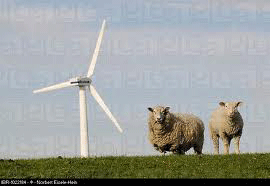 Victorian cattle farmer Hamish Officer lives a good deal closer to wind turbines than most people.”You don’t need to lift your voice to have a conversation under a wind turbine nearly as much as you would in a city street,” Mr Officer said.
“For someone like the Prime Minister to stand there and say they’re noisy – it’s a very blanket statement. Noisy compared to what?”
Dangerous game of nuclear chicken between USA and Russia
the US has a policy still to fight and win a nuclear war against Russia. And when they do that launch first and land 200 hydrogen bombs on each of your missile silos and kill your missiles. The fact that billions of people will die is called by the Pentagon ‘collateral damage’. I don’t know what the Russian military strategy is about this, but the whole thing is extremely dangerous and the news media is not talking about it on the whole
 US and Russia ‘playing nuclear chicken with each other’ Rt.com Dr Helen Caldicott is one of the most articulate and passionate advocates of citizen action to remedy the nuclear and environmental crises. June 11, 2015 Current US and Russian war games at a time of serious international tension are very dangerous and someone’s mistake or a computer error could push the world over the brink into a nuclear war, claimed Dr. Helen Caldicott to RT.
UK Foreign Secretary Philip Hammond claims the UK could deploy US nuclear missiles as a response to increased “levels of activity both by Russian forces and by Russian-controlled separatist forces” in Ukraine. Hammond added Russia needs to get “a clear signal” that “we will not allow them to transgress our red lines.” Nevertheless, the UK hosting US nuclear missiles still remains a distant prospect.
For more on this RT asked pediatrician Dr. Helen Caldicott, founding president of Physicians for Social Responsibility and president of the Helen Caldicott Foundation for a Nuclear Free Future. Continue reading
Western Australian Liberal Senator Chris Back rejects medical expertise on wind farms
A Sydney University review of 25 studies into the possible health effects of wind turbines found none had produced evidence they were detrimental to human health and in 2014 the Australian Medical Association issued a statement saying the available evidence did not support the idea that windfarm noise harmed human health
 Liberal senator wants windfarm inquiry to recognise ‘adverse health effects‘, Guardian, Lenore Taylor Political Editor, 12 June 15
Coalition figures want inquiry to acknowledge alleged health impacts and support more checks by the regulator A new federal inquiry could call for commonwealth oversight of windfarm regulations and demand recognition of the alleged health impacts of turbines on people living near them, according to Coalition senators.
The prime minister, Tony Abbott, dismayed the wind industry on Thursday when he told Sydney radio announcer Alan Jones that he wished the government had been able to reduce the number of new windfarms more than was possible in a recent renewable energy deal with Labor, and agreed windfarms had “potential health impacts”. Continue reading
1 This month
7 April – WEBINAR – Australia and the Doomsday Clock – Preventing nuclear war through NoFirstUse and other policies
Online | Tuesday April 7, 4:00-5:30pm, Australian Eastern Time / 8:00-9:30am Central Europe Time
– Access the registration link
15 April – Zoom –Nuclear Power is Not the Solution
Apr 15, 2026 01:00 AM in Canberra, Melbourne, Sydney

Join the International Physicians for the Prevention of Nuclear War (IPPNW) on Tuesday, April 14th for a timely webinar exploring the risks associated with nuclear power and challenging the myth that it offers a simple, safe, carbon-free solution to the climate crisis

21 April Webinar: No Nuclear Weapons in Australia
Start: 2026-04-21 18:00:00 UTC Canberra, Melbourne, Sydney (GMT+10:00)
End: 2026-04-21 19:30:00 UTC Canberra, Melbourne, Sydney (GMT+10:00)
Event Type: Virtual
A virtual link will be communicated before the event.
Host Contact Info: australia@icanw.org

of the week – Australians for War Powers Reform (AWPR)
To see nuclear-related stories in greater depth and intensity
 Antinuclear