Germany leads the way in nuclear phaseout and renewable energy growth
 ‘Green superpower’ Germany plots the way to a low-carbon world by closing Grafenrheinfeld nuclear power plant, SMH, June 20, 2015 Peter Hannam Environment Editor, The Sydney Morning Herald
Many countries face challenges in cutting greenhouse emissions but few set their bar as high as Germany. Germany will permanently close the Grafenrheinfeld nuclear power plant in the country’s south on Saturday, the latest in a phase-out that is scheduled to see the European powerhouse’s last nine fissile fuel plants closed by about 2022.
Leaving nuclear is not without its critics, especially among big utilities: Sweden’s Vattenfall is reportedly suing the German government for €4.7 billion ($6.9 billion) to compensate for its losses.
And yet, German policymakers seem determined to stick to an ambitious – and unilateral – goal of slashing greenhouse gas emissions by 40 per cent on 1990 levels, even if that means shutting near zero-carbon nuclear plants along the way. The cuts deepen to 55 per cent by 2030 and 80-95 per cent by 2050.
The country is also betting big that renewable energy mainly from wind, solar and hydro power will continue to surge beyond its current share of about 28 per cent of total supply…….
The dramatic plunge in renewable energy prices – with solar panels becoming about 20 per cent cheaper for every doubling of output – has undermined whatever business case existed for nuclear energy, Kraemer says.
“Solar is competitive with new coal and new nuclear [power plants], and even with old coal if you price the carbon emissions properly,” Kraemer says. [Andreas Kraemer, founder and director emeritus of the Ecologic Institute, a Berlin-based think tank.]
Germans freely admit that overly generous feed-in tariffs paid to those supplying renewable energy to the grid meant the country paid billions of euros too much to install solar panels on the roofs of some 3.5 million homes and small businesses in a country not known for its bounteous sunshine. Sunshine hours in Berlin, a relatively northern city, peak at an average of eight hours a day in May-July, but drop to just one hour by December, according to a local tourist guide.
The levy now costs users 6.17 euro cents (9¢) per kilowatt-hour, boosting residents’ costs for power to about 26 euro cents/KW-hour. [By contrast, this correspondent pays about 31¢ in Sydney for 100 per cent renewable power.]
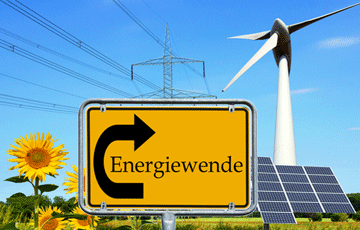
The subsidies underpin Germany’s Energiewende, or energy transition, a policy which is gaining international attention. The word is apparently the most commonly searched-for German word, eclipsing angst and blitzkrieg, according to one local supporter.
Renewable energy’s share of the country’s total electricity supply has almost quadrupled. Nuclear’s share has roughly halved over the same period from 27 per cent to about 14 per cent………http://www.smh.com.au/environment/climate-change/green-superpower-germany-plots-the-way-to-a-lowcarbon-world-by-closing-grafenrheinfeld-nuclear-power-plant-20150619-ghpbcf.html
1 Comment »
Leave a comment
1 This month
To see nuclear-related stories in greater depth and intensity
– go to https://nuclearinformation.wordpress.com/


 Antinuclear
Germany is making the Leaders of rest of the World (Japan, UK, USA, France, India, China, Russia and now AU look like “bought” promoters of Nuclear Energy because they continue to push the use of nuclear when Solar (of all flavors) is far less expensive and far less RISKY than Nuclear.
LikeLike