‘the time has gone for nuclear power’ – civil servants must speak out
The public has been ‘protected’ from the truth of Fukushima Many people are gravely disturbed by the prospect of new nuclear power. That is particularly so among Treasury civil servants. We are in an extraordinary situation, where there is still public support in spite of Fukushima.
One of the main reasons for that is that the British public were ‘protected’ by a skilled public relations operation from knowing the terrible cost of Fukushima – between $100 billion and $250 billion.

 Civil servants must speak out: ‘the time has gone for nuclear power’, Ecologist, Paul Flynn MP 18th June 2015 Despite the PR spin the truth about nuclear power is clear, says Paul Flynn. Current projects are plagued with technical failures, cost escalations and long delays – while renewables power ahead. As tin-eared ministers refuse to get the message, it’s time for civil servants to speak out direct to the public.
Nuclear power was promised as an energy source that would be too cheap to meter. It is now too expensive to generate.
If we were planning a nuclear policy from scratch, would we choose to do a deal with two French companies, one of which is bankrupt, while the other, Électricité de France, has a debt of €33 billion?
Would we also collaborate with a country with a dreadful human rights record – China, whose national investment department is coming into the arrangement – and with Saudi Arabia, with its atrocious record on human rights, where people are executed on the street?
ANZ leads big four bank exposure to fossil fuel industry
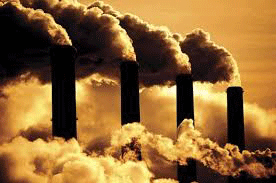 A new report finds that Australia’s big four banks have almost $37 billion in loan exposures to the fossil fuel sector.
http://www.abc.net.au/news/2015-06-18/anz-leads-big-four-bank-exposure-to-fossil-fuels/6556330
Victorian government concerned about Abbott’s anti wind energy position
Victoria baffled by Prime Minister’s comments on wind turbines http://www.abc.net.au/news/2015-06-16/wind-energy-turbine-investment-in-victoria/6550822 Vic Country Hour By James Jooste The Victorian Labor Government says it will be a “one stop shop” for investment in renewable energy by building more wind farms across the state.
But recent efforts by the State Government to underwrite Victoria’s energy production with renewables has been stifled by a reduction in the Renewable Energy Target (RET) to 33,000 gigawatt hours by 2020 and negative comments by the Prime Minister.
Victorian Minister for Planning Richard Wynne said recent remarks by Prime Minister Tony Abbott, where he called wind turbines “visually awful”, were sending mixed messages to industry.
“Well I think people we’ll be looking very curiously and saying, ‘Well where does the Federal Government stand in terms of renewable energy and climate change?'” he said.
The State Government wants to scrap section 7c of the Renewable Energy (Electricity) Act which prevents states fromreinstating independent targets for renewable energy.
Greenpeace warns of legal showdown over charitable tax status
Greenpeace has warned of a legal challenge to any moves to strip environmental groups of their charitable status. (subscribers only)
http://www.theaustralian.com.au/national-affairs/treasury/greenpeace-warns-of-legal-showdown-over-charitable-tax-status/story-fn59nsif-1227401137358
Federal Bill to change powers of Australia’s nuclear watchdog, ARPANSA
Nuclear watchdog’s powers strengthened AAP http://www.9news.com.au/national/2015/06/18/10/08/nuclear-watchdog-s-powers-strengthened The federal government is strengthening the powers of its nuclear safety watchdog.
A bill introduced by Health Minister Sussan Ley on Thursday updates the Australian Radiation Protection and Nuclear Safety Agency in line with international and local reviews.
The agency regulates Commonwealth bodies that use radiation.
These include CSIRO, the Australian Nuclear Science and Technology Organisation and Defence in operations ranging from baggage X-ray machines at airports to a research reactor at Lucas Heights.
Ms Ley said the changes would give the agency greater powers to monitor compliance and act in an emergency.
They would also give it a clear legal basis to oversee the safety of contaminated sites.
Long term effects of Fukushima radiation on Pacific salmon, tuna and other maritime species
 Study: Fukushima radiation will cause long-term harm to Pacific salmon population — Efforts needed to protect species from possible extinction — Radiation monitoring is critical to avoid human health problems — “US inland areas also at risk of exposure” http://enenews.com/study-fukushima-will-result-marked-lasting-decrease-population-pacific-salmon-efforts-needed-protect-species-possible-extinction-continued-monitoring-will-be-critical-avoidance-health-problems-h?utm_source=feedburner&utm_medium=email&utm_campaign=Feed%3A+ENENews+%28Energy+News%29
Journal of Applied Mathematics — Modelling the Effects of Radioactive Effluent on Thunnus orientalis and Oncorhynchus gorbuscha, New Jersey City Univ. (Chen, Ding, Laracuenti, Lipat(Columbia Univ., NASA Goddard Institute for Space Studies)), 2013 (emphasis added):
- The contamination of the Pacific Ocean by the radioactive pollutants released from the Fukushima Daiichi Nuclear Power Plant has raised legitimate concerns over the viability of marine wildlife. We… explore the extent of the effects of the radioactive effluent on two marine species: the Pacific Bluefin Tuna and the Pacific Pink Salmon…
- Because of the brevity of the period of time during which radioactive material was discharged… [it’s] assumed to be instantaneous [note the study was released beforeTEPCO admitted the flow of radioactive material into the Pacific never ended]…
- This pollution was spread through the entire Pacific Ocean…
- A numerical solution… will simulate the effects of the Fukushima Daiichi nuclear disaster…This simulation has far-reaching implications for decisions related to the location of nuclear power plants as well as to fishing policy…
- According to data released by Tepco, the initial concentrations of radioactivity following the release of 11,500 metric tonnes of contaminated water into the Pacific Ocean… are 310,000 Bq/L of iodine-131, 230,000 Bq/L of caesium-134, and 230,000 Bq/L of caesium-137 [which] produces the initial radioactivity of the iodine-131: 3.57 trillion Bq… caesium-134: 2.65 trillion Bq… caesium-137: 2.65 trillion Bq [note that estimates by gov’t scientists are 10,000+ times higher]…
- Analysis of the results shows that the Pacific Bluefin Tuna will experience a steeper population decline in the short term compared to its expected population decline… after which the population will return to the expected population.
- Pacific Pink Salmon, on the other hand, will simply decline at a faster pace than the expected population decline… radioactive effluent will result in a marked and lasting decrease in population [see Fig. 5, 6]…
- Before the conclusions are subjected to social analysis, the model’s limitations must be considered… the model does not reflect the migratory nature of both fish species. This does not, however, entirely negate the validity of the simulation: over a sufficiently long period of time, the short-term movement of the fish throughout the Pacific Ocean becomes negligible… The results of the model… opt to consider the fish species’ population on average…
- The very high rate of decline of the Pacific Pink Salmon indicates that live specimens may contain relatively high levels of radioactivity. Continued monitoring of the Pacific Pink Salmon, as well as all marine species, for radioactivity will be critical to the avoidance of health problems for humans. Because the species migrates throughout freshwater rivers and tributaries of British Columbia, Alaska, and the Pacific Northwest of the United States, inland areas are also at risk of exposure to, at the very least, low-level radioactivity. Moreover, the rapid rate of decline of the Pacific Pink Salmon, in conjunction with rapidly deteriorating conditions, seems to necessitate drastic action. Work beyond sustainability is needed to protect the species from possible extinction…
- Because of the deleterious effects on the marine environment… it seems reasonable to suggest that any new nuclear power plants be constructed sufficiently far from coastal waterways so as to mitigate the absorption of any radioactive contaminants into the biosphere. This, however, would pose a risk to the environment near the nuclear power plant without the capacity of an ocean to diffuse the radioactivity…
- The authors are thankful to [National Science Foundation award] NSF HRD-0902132 (LSAMP) for the support to do this research.
Pope Francis brings environmental justice to the fore, in lead-up to Paris Climate Talks
 Climate change is the anticipated focus of Francis’ long-awaited papal encyclical on ecology because it merges his vocal concern for the poor and marginalized with condemnation of environmental exploitation. The world’s poor, who contribute the least to climate change, are disproportionately impacted by worsening droughts, rising seas, mega storms and famine, and they are least able to evade its destructive reach…………
Hopes are high that the pope’s encyclical creates momentum and will for the enactment of a United Nations climate change accord in Paris this December
With encyclical, Pope Francis elevates environmental justice, The Conversation, Lisa Sideris, 16 June 15 When the former Cardinal Jorge Mario Bergoglio chose Francis as his papal name, he signaled to the world a dual commitment to sustainability and the global poor. His namesake, Saint Francis of Assisi, was a man of poverty and peace who loved nature and animals, and is said to have preached his sermons to birds. Continue reading
1 This month
15 April – Zoom –Nuclear Power is Not the Solution
Apr 15, 2026 01:00 AM in Canberra, Melbourne, Sydney

Join the International Physicians for the Prevention of Nuclear War (IPPNW) on Tuesday, April 14th for a timely webinar exploring the risks associated with nuclear power and challenging the myth that it offers a simple, safe, carbon-free solution to the climate crisis

21 April Webinar: No Nuclear Weapons in Australia
Start: 2026-04-21 18:00:00 UTC Canberra, Melbourne, Sydney (GMT+10:00)
End: 2026-04-21 19:30:00 UTC Canberra, Melbourne, Sydney (GMT+10:00)
Event Type: Virtual
A virtual link will be communicated before the event.
Host Contact Info: australia@icanw.org

of the week – Australians for War Powers Reform (AWPR)
To see nuclear-related stories in greater depth and intensity
 Antinuclear